Monday, November 06, 2006

Freestonia - pictures of life in a squat

Tony Sleep says:-
"In 1977, Freston Road, a squatted street in Notting Dale, West London, seceded from the United Kingdom, and appealed to the United Nations to send a peacekeeping force to prevent evictions by the Greater London Council. "

His 70 amazing pictures & documentary show life in Freestonia in the late 1970s - early 80s. Drugs, alcohol and dissolution were an ever-present dark side of Frestonian life.

Sunday, November 05, 2006

How to backup my data? - Part 1

My work and home data is in hundreds of different formats: Word documents, photos, outlook files etc. I backup 11.5GB of this type of data on my laptop. I have used an online backup service Connected DataProtector for the past eight years for all the important work and home data. All data at work is stored on one PC which uses this service. This is almost completely hassle free (set it up once and let it run automatically every night) & relatively cheap.

Recently i've upgraded, after much procrastination, from the 10GB limit (Gold $280 pa) to the 20GB limit (Gold+ $535 pa) service. But i dont want to upgrade to the 30GB limit (Platinum $800) which i consider to be too expensive.

But with 20GB backup limit I still cannot backup all 50GB+ of data. Less important ripped music (from my CDs) or movies (ripped from my DVDs) is not backed up. Connected DataProtector service would be too expensive to backup these multimedia files.

I will investigate other cheap and hassle free solutions to backup ALL my data. The criteria will be:-

  • The total cost of backing up 50GB+ work & home data should be <$500 pa
  • the backup should be as hassle free as the Connected DataProtector service.
  • have the ability to easily backup several PC at home and work

Thursday, November 02, 2006

Fingers crossed Superstitions are perfectly natural, and entirely understandable

The Times September 05, 2006

Avoided walking under any ladders lately? Tied a knot in a handkerchief? Of course you haven’t. Such beliefs are just pure superstition, touch wood.

According to Bruce Hood, Professor of Experimental Psychology at the University of Bristol, this kind of irrational behaviour is natural. Speaking at the British Association Festival of Science yesterday, he claimed that superstition is a product of evolution. Mankind is adapted to reason intuitively, to invent explanations for how the world works, which increases the odds of keeping safe. Superstitions also provide a welcome sense of control. We cross our fingers to trap the bad luck between them. We say “bless you” to stop the soul following the sneeze out of the body.

Modern members of Homo sapiens, texting on their BlackBerries while skirting round black cats, have also evolved to know that some beliefs are really just indulgent nonsense. So they cheat. See only one magpie? Look again. Horoscope bleak? Suddenly remember your birthday is close to the cusp. Is that hypocrisy, or a clever way to reconcile rationality with irrationality?

One thing is clear: the foundations of science were built on mankind’s ability to reason intuitively. Anyone who insisted on direct visible proof would have been unable, for example, to discover gravity. So we should perhaps think more kindly of human credulity. Paul Ince’s legendary insistence on being the last to leave the changing room and pull on his jersey probably had little bearing on the outcome of any particular England football games. But no doubt the habit made him feel better. So do not mock: after all the wind might change.

Evolution keeps us superstitious. Now that's lucky

The Times September 05, 2006

Professor Bruce Hood of the University of Bristol said humans have evolved into accepting superstitions such as witches (Channel 4) By Mark Henderson, Science Editor

HUMANS have evolved over tens of thousands of years to be susceptible to supernatural beliefs, a psychologist has claimed.

Religion and other forms of magical thinking continue to thrive — despite the lack of evidence and advance of science — because people are naturally biased to accept a role for the irrational, said Bruce Hood, Professor of Experimental Psychology at the University of Bristol.

This evolved credulity suggests that it would be impossible to root out belief in ideas such as creationism and paranormal phenomena, even though they have been countered by evidence and are held as a matter of faith alone.

People ultimately believe in these ideas for the same reasons that they attach sentimental value to inanimate objects such as wedding rings or Teddy bears, and recoil from artefacts linked to evil as if they are pervaded by a physical “essence”.

Even the most rational people behave in irrational ways and supernatural beliefs are part of the same continuum, Professor Hood told the British Association Festival of Science in Norwich yesterday.

To demonstrate his theory he asked members of the audience if they were prepared to put on an old-fashioned blue cardigan in return for a £10 reward. He had no shortage of volunteers. He then told the volunteers that the cardigan used to belong to Fred West, the mass murderer.

“Most hands went down,” he said.

“When people did wear it people moved away from them. It’s not actually West’s jumper. But it’s the belief that it’s West’s jumper that has the effect.

“It is as if evil, a moral stance defined by culture, has become physically manifest inside the clothing.”

Similar beliefs, which are held even among the most sceptical scientists, explain why few people would agree to swap their wedding rings for replicas. The difference between attaching significance to sentimental objects and believing in religion, magic or the paranormal is only one of degree, Professor Hood said.

These tendencies, he said, were almost certainly a product of evolution. The human mind is adapted to reason intuitively, so that it can generate theories about how the world works even when mechanisms cannot be seen or easily deduced.

While this is ultimately responsible for scientific thinking, as in the discovery of invisible forces such as gravity, it also leaves people prone to making irrational errors. “In most cases, intuitive theories capture everyday knowledge, such as the nature and properties of objects, what makes something alive, or the understanding that people’s minds motivate their actions,” Professor Hood said.

“But because intuitive theories are based on unobservable properties, such theories leave open the possibility of misconceptions. I believe these misconceptions of naive intuitive theories provide the basis of many later adult magical beliefs about the paranormal.”

This innate tendency means it is futile to expect that such beliefs will die out even as our scientific understanding of the world improves, he said. “The mind is adapted to reason intuitively about the properties of the world. Because we operate intuitively, it is probably pointless to get people to abandon belief systems.

“No amount of evidence is going to get people to take it on board and abandon these ideas.”

Credulous minds may have evolved for several reasons. It was once less dangerous to accept things that were not true than it was to reject real facts, such as the threat posed by a nearby predator. This may have predisposed humans to err on the side of belief. Superstition may also give people a sense of control that can reduce stress.

“I don’t think we’re going to evolve a rational mind because there are benefits to being irrational,” said Professor Hood. “Superstitious behaviour — the idea that certain rituals and practices protect you — is adaptive.

“If you remove the appearance that they are in control, both humans and animals become stressed. During the Gulf War, in 1991, in areas attacked by Scud missiles there was a rise in superstitious belief.

“I want to challenge recent claims by Richard Dawkins, among others, that supernaturalism is primarily attributable to religions spreading beliefs among the gullible minds of the young. Rather, religions may simply capitalise on a natural bias to assume the existence of supernatural forces.”

Tuesday, October 31, 2006

The animal roots of human morality


Dominic says Alex Coleman does not believe the god bits in the Bible - but he does believe in the morality. So are religious texts the root of all human morals? No!

In New Scientist (14 October 2006, pg 60) Frans de Waal argues that animals have an inbuilt sense of fair play and show compassion to others in their group.

Emotions nudge an organism towards rapid decisions based on millions of years of evolution, and provide a window on behavioural adaptation. This even holds for human morality.

If it is true that morality is reasoned from abstract principles, why do our judgements often come instantly? We often make snap moral judgements that seem to come from the "gut".

I don't claim that monkeys and apes are moral beings, but I do believe that human morality is on a continuum with animal sociality. Charles Darwin saw it this way. In The Descent of Man he wrote: "Any animal whatever, endowed with well-marked social instincts... would inevitably acquire a moral sense or conscience, as soon as its intellectual powers had become as well developed, or nearly as well developed, as in man."

It is not hard to recognise the two pillars of human morality in the behaviour of other animals. These pillars are elegantly summed up in the golden rule that transcends the world's cultures and religions: "Do unto others as you would have them do unto you." This unites empathy (attention to another's feelings) with reciprocity (if others follow the same rule, you too will be treated well). Human morality as we know it is unthinkable without empathy and reciprocity.

These tendencies are widespread in other primates, too. For example, it is not uncommon that, after one chimpanzee has attacked another, a bystander will go over to embrace the victim. We have documented hundreds of cases. The usual effect of such consolation is that the screaming, yelping and other signs of distress stop. In fact, the tendency to reassure others is so strong that Nadia Ladygina-Kohts, a Russian scientist who raised a juvenile chimp a century ago, said that if her charge escaped to the roof of her house, holding out food would not make him come down. The only way was to sit and sob as if she were in pain, whereupon the young ape would rush down to put an arm around her, a worried expression on his face. This attests to the power of the empathic tendency in our close relatives: it beats the desire for a banana.

“It is not uncommon after one chimp has attacked another for a bystander to embrace the victim”

Reciprocity can be seen in our own experiments on captive chimpanzees when we give an individual food to divide with others. Before doing so, we measure spontaneous grooming: who grooms whom for how long. Grooming is a pleasurable, relaxing activity, and being groomed is much appreciated. We found that if one chimpanzee had groomed another, this greatly improved his chances of getting a share of the food from the groomee. In other words, chimpanzees remember who has groomed them, and return the favour later. Like humans, they seem to keep track of incoming and outgoing services.

Humans enforce social norms that dictate how we treat others and promote communal interests, but at morality's core we find an ancient primate psychology. This is quite different from the idea that morality goes against human nature, a view I dub "veneer theory". Veneer theorists argue that our moral lives are a thin crust that barely covers our inborn nastiness and selfishness: the only reason we act morally is to avoid punishment and impress each other. For three decades, this curiously non-evolutionary explanation has been promoted by biologists and science writers alike. It is best captured in the quip by biologist Michael Ghiselin from the California Academy of Sciences: "Scratch an 'altruist', and watch a 'hypocrite' bleed."

One of the momentous developments of our time is the effort to wrest morality from Kantian philosophy and put it back in touch with evolution. This effort is not only supported by studies of cooperative behaviour among animals but also by modern neuroscience. Whereas veneer theory attributes moral problem-solving to the latest additions to our brain such as the prefrontal cortex, imaging human brains has shown that moral dilemmas activate a wide variety of areas, some of them present in all mammals and closely tied to the emotions. Recent research at McGill University in Montreal, Canada, shows that empathy may exist in mice - which only goes to show how old these tendencies may be.

There is also continuity between humans and animals when it comes to social rules. When Sarah Brosnan in the Yerkes National Primate Research Center in Atlanta, Georgia, divided rewards, she found that monkeys had a crude sense of fairness. One monkey will throw away a perfectly fine reward that she normally relishes if she sees her companion getting an even better one. By investigating the expectations primates hold about each other, we may find we are not alone in judging some social situations to be unacceptable.

To show that even social rule enforcement is not beyond non-human animals, let me recount a fascinating situation that I witnessed years ago at Arnhem Zoo in the Netherlands. One balmy evening, when the keeper called the large chimpanzee colony inside, two adolescent females refused to enter the building. The weather was superb, they had the whole island to themselves and were loving it. The zoo's rule was that none of the apes would get fed until they had all moved inside. The obstinate teenagers threw the rest of the group into a grumpy mood. When they finally came in, they were assigned a separate bedroom by the keeper to prevent reprisals.

This protected them only temporarily, though. The next morning, out on the island, the entire colony vented its frustration about the delayed meal by a mass pursuit ending in a beating for the culprits. That evening, the same two females were the first to come in.

More... Primates and Philosophers: How Morality Evolved by Frans De Waal

Thursday, October 19, 2006

The Complete Works of Charles Darwin Online


BBC News Science review

WELCOME to the largest collection of Darwin's writings ever assembled. For a basic, non-academic, entryway click here. For a complete list click contents.

This site currently contains more than 50,000 searchable text pages and 40,000 images of both publications and handwritten manuscripts. There is also the most comprehensive Darwin bibliography ever published and the largest manuscript catalogue ever assembled. More than 150 ancillary texts are also included, ranging from secondary reference works to contemporary reviews, obituaries, published descriptions of Darwin's Beagle specimens and important related works for understanding Darwin's context.

Wednesday, October 18, 2006

2 portions per week of oily fish provides Omega-3 Fatty Acids - Live 17% Longer!


Eating
1-2 servings per week oily fish reduces the risk of coronary death by 36% and total mortality by 17%. Intake of 250 mg/day of Omega-3 Fatty Acids (EPA & DHA) is sufficient for primary prevention of Coronary Heart Disease.


contains sufficient Omega-3 fatty acids if taken daily:  EPA 351mg, DHA 234mg
Cost: £18 for 60 capsules taken once a day.
http://www.boots.com/en/Boots-Pharmaceuticals-Omega-3-Fish-Oil-1300mg-30-Capsules-_1139898/

Oily fish (salmon, mackerel, sardines, trout, tuna, mussels, oysters, anchovy, herring, crab) is very good for your heart. Eating fish means you could live 17% longer!

The Harvard School of Public Health reviewed existing studies (15 page Review - Full Text pdf) that looked at the health effects of eating fish.
The benefits of eating a modest amount of fish per week - 2 portions —about 3 ounces (90g) of farmed salmon or 6 ounces (180g) of mackerel - reduce the risk of death from coronary heart disease (CHD) by 36%. 180g of mackerel is about half a pound and costs £3. The benefit was related to the level of intake of omega-3 fatty acids, and thus benefits are greater for oily fish (e.g. salmon, bluefish), which are higher in beneficial omega-3 fatty acids, than lean fish (haddock, cod).
Some types of shellfish contain more omega 3 than others. For example, crab and mussels are quite good sources of omega 3, but prawns contain hardly any. Oily fish are the best sources of omega 3 according to UK Food Standards Agency.
You can check which fish are oily and which aren't in the table below:


Oily / fatty fish White / non-oily fish
Salmon Trout Mackerel Herring Sardines Pilchards Kipper Eel Whitebait Tuna* (fresh only - not tinned) Anchovies Swordfish Bloater Cacha Carp Hilsa Jack fish Katla Orange roughy Pangas Sprats Cod Haddock Plaice Coley Whiting Lemon sole Skate Halibut Rock salmon/Dogfish Ayr Catfish Dover sole Flounder Flying fish Hake Hoki John Dory Kalabasu Ling Monkfish Parrot fish Pollack Pomfret Red and grey mullet Red fish Red snapper Rohu Sea bass Sea bream Shark Tilapia Turbot Tinned tuna Marlin

*Fresh tuna is an oily fish and is high in omega 3 fatty acids. But when it's canned, these fatty acids are reduced to levels similar to white fish so doesn't count as oily fish.

How much oily fish?

Most people should be eating more oily fish because omega 3 fatty acids are very good for our health. However, oily fish can contain low levels of pollutants that can build up in the body. For this reason there are recommendations for the maximum number of portions of oily fish we should be eating each week (a portion is about 140g):


mg EPA+DHA

per 100g fish
g fish per week for

1750mg EPA+DHA*
salmon (farmed) 2648 66
anchovy 2055 85
herring (atlantic) 2014 86
mackerel (atlantic) 1203 145
salmon (wild) 1043 167
sardines 982 178
trout 935 187
tuna (white, albacore) 862 203
mussels 782 223
oysters 688 254
halibut 465 376
crab 413 423
mackerel (king) 401 436
tuna (light, skipjack) 270 648
cod (atlantic) 158 1107

*: 250mg per day = 1750mg per week = recommended EPA+DHA


The Harvard review also demonstrated that intake of fish or fish oil reduces total mortality—deaths from any causes--by 17%.

More than two decades ago, pioneering studies showed that Greenland Eskimos, who consumed high amounts of omega-3 fatty acids from seafood, had very low rates of CHD death. Some studies have shown that PCBs and dioxins may be carcinogenic. The authors found that the benefits of eating fish far outweighed the potential cancer risks from these chemicals.
The benefits of eating one to two servings of fish a week greatly outweigh the risks among adults and, except for a few species of fish, women of child-bearing age. Seafood is likely the single most important food one can consume for good health said Mozaffarian.
The UK Food Standards Agency advise eating two servings of fish a week - one of these servings should be oily fish.

What levels of omega-3 fatty acids are in seafood?
In Wikipedia article - the 3 refers to the first carbon atom (red numbers) from the omega end of a polyunsaturated fatty acid that contains a double bond. Chemists (blue numbers) use reverse numbering from the carbonyl group.


Important omega-3 fatty acids in human nutrition are: α-linolenic acid (above) (18:3, ALA), eicosapentaenoic acid (20:5, EPA), and docosahexaenoic acid (22:6, DHA). These three polyunsaturates have either 3, 5 or 6 double bonds in a carbon chain of 18, 20 or 22 carbon atoms, respectively. All double bonds are in the cis-configuration, i.e. the two hydrogen atoms are on the same side of the double bond.
In Haliborange high DHA concentration Omega-3 fish oil (& Boots Smart Omega-3 Fish oil) each capsule contains 100mg DHA and 28mg EPA. Two capsules are recommended per day.
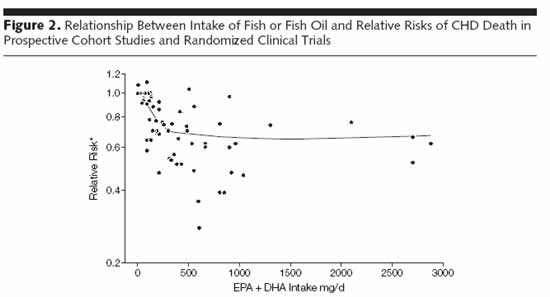
Mozaffarian say Intake of 250 mg/day of EPA and DHA appears sufficient for primary prevention (ie. 2 capsules of Haliborange or 10oz/week of canned tuna or equivalent) See Figure 2 & 6 top of page):-
Modest consumption of fish (eg, 1-2 servings/wk), especially
species higher in the n-3 fatty acids eicosapentaenoic acid (EPA) and docosahexaenoic acid (DHA), reduces risk of coronary death by 36% (95% confidence interval, 20%-50%; P .001) and total mortality by 17% (95% confidence interval, 0%-32%; P=.046) and may favorably affect other clinical outcomes. Intake of 250 mg/day of EPA and DHA appears sufficient for primary prevention.
What is the effect of Omega-3 fatty acids?
Omega-3 FA influence several cardiovascular risk factors and give altered membrane fluidity
and receptor responses following incorporation of (n-3 Poly Unsaturated Fatty Acids
n-3 PUFAs ) into cell membranes and direct binding of n-3 PUFAs to intracellular receptors regulating gene transcription. At typical dietary intakes, antiarrhythmic effects predominate, reducing risk of sudden death and CHD death within weeks by (1) modulation of myocardial sodium and calcium ion channels, reducing susceptibility to ischemia-induced arrhythmia and (2) reduced left ventricular workload and improved myocardial efficiency as a result of reduced heart rate, lower systemic vascular resistance, and improved diastolic filling.
n-3 PUFAs reduced total mortality by 17%. This can be compared to effects of statins on total mortality - a 15% reduction.
Avoidance of modest fish consumption due to confusion regarding risks and benefits could result in thousands of excess CHD deaths annually and suboptimal neurodevelopment in children.

Monday, October 16, 2006

National Secular Society

I visited the NSS website and extracted this info from it:-


About the National Secular Society

We want a society in which all are free to practise their faith, change it or not have one, according to their conscience. Our belief or lack of it should neither advantage or disadvantage. Religion should be a matter of private conscience, for the home and place of worship; it must not have privileged input into the political arena where history shows it to bring conflict and injustice.

The National Secular Society is the leading pressure group defending the rights of non-believers from the demands of religious power-seekers. We campaign on a wide range of issues, including religious influence in the government, the disestablishment of the Church of England, the removal of the Bench of Bishops from the House of Lords and for conversion of religious schools (paid for by the taxpayer) to community schools, open to all.

Additionally:

  1. We fight to protect free expression from attacks by religious groups, often keen to restrict comment about, and examination of, their activities.
  2. We want the blasphemy law to be abolished and artistic expression to be protected from religious censors.
  3. We lobby the BBC to reduce the amount religious propaganda paid for by license-payers, very few of whom are interested.
  4. We want to ensure that human rights always come before religious rights, and to fight the massive exemptions religious bodies are granted from discrimination laws that everyone else has to observe. The NSS was prominent in the campaign to frustrate religious bodies’ attempts to opt out of the Human Rights Act – we fought to limit exemptions in the employment discrimination legislation and other equality law.

Even now the government seems anxious to increase religious involvement in public life. Each increase disadvantages those who have no religion.

Only by secularising our institutions can we ensure that no religious ideology can dominate and discriminate against others.

More Information

The NSS was founded in 1866 by Charles Bradlaugh. A message from Claire Rayner.

The National Secular Society’s General Principles

  • Secularism affirms that this life is the only one of which we have any knowledge and human effort should be directed wholly towards its improvement.
  • Affirming that morality is social in origin and application, Secularism aims at promoting the happiness and well-being of mankind. Secularism demands the complete separation of Church and State and the abolition of all privileges granted to religious organisations.
  • Secularism affirms that progress is possible only on the basis of equal freedom of speech and publication; that the free criticism of institutions and ideas is essential to a civilised state.
  • It asserts that supernaturalism is based upon ignorance and assails it as the historic enemy of progress.
  • It seeks to spread education, to promote the fraternity of all peoples as a means of advancing universal peace to further common cultural interests and to develop the freedom and dignity of mankind.
  • To remove an impediment to these objectives, we demand the complete separation of Church and State and the abolition of all privileges granted to religious organisations.

Welcome

Those of us who value reason are becoming alarmed about the increasingly extreme religious influence in our government, our lawmakers, and our public institutions - especially in our education system. Many people, while standing up for freedom of religion, and freedom not to believe, feel that the proper place for religion is in the place of worship or home. They see the danger of religion becoming too politically ambitious.

The NSS is a rallying point for opposition to this religious resurgence. We must convince our politicians and public servants - as well as our friends, neighbours and colleagues - that our institutions and public life should be secular. A secular state should guarantee freedom of conscience, but eliminate religious privilege.

The only way to prevent the kind of religious power-seeking that leads to conflict is to make both religious discrimination and religious privilege constitutionally impossible.

We need a secular constitution that will:

  • End the privileged input of religious bodies to policy making and law-making
  • Keep all public services free from religious control so that that they remain equally available to all on the same terms
  • Abolish the established church and all its privileges (including 26 bishops in the House of Lords)
  • Put an end to the divisiveness of publicly funded religious schools by making them open to all without discrimination on grounds of religion, or lack of it, and bringing them under local authority controll
  • Abolish blasphemy and similar repressive laws, rather than extend them

Religious influence in Government has not been higher in living memory. The rise of fundamentalist religion of all shades has the potential to seriously erode hard-won freedoms.

Individually, we can only look on with mounting fear, but working together we can make a difference. Join the fight for a truly secular society and join the National Secular Society today.

Sunday, October 15, 2006

British Humanist Association

I visited the BHA website and extracted this stuff from it:-

The British Humanist Association

Atheist? Agnostic? Not religious?
Culturally Christian (you tick the box but don't believe)?

Then You're Probably a Humanist Already
Try Our Test &
Join the British Humanist Association Today!

The BHA is the largest organisation in the UK supporting and representing the non-religious and campaigning for a secular society.

The Test: Are you a Humanist?
I scored mostly Ds with a few Cs. I am a humanist!

Humanism

Humanism is the belief that we can live good lives without religious or superstitious beliefs. Humanists make sense of the world using reason, experience and shared human values. We seek to make the best of the one life we have by creating meaning and purpose for ourselves. We take responsibility for our actions and work with others for the common good.


What humanists believe

Humanism is an approach to life based on humanity and reason - humanists recognise that moral values are properly founded on human nature and experience alone. Our decisions are based on the available evidence and our assessment of the outcomes of our actions, not on any dogma or sacred text.

Humanism encompasses atheism and agnosticism ‑ but is an active and ethical philosophy far greater than these negative responses to religion.

Humanists believe in individual rights and freedoms ‑ but believe that individual responsibility, social cooperation and mutual respect are just as important.

Humanists believe that people can and will continue to find solutions to the world's
problems ‑ so that quality of life can be improved for everyone.

Humanists are positive ‑ gaining inspiration from our lives, art and culture, and a rich natural world.

Humanists believe that
we have only one life ‑ it is our responsibility to make it a good life, and to live it to the full.


Humanists - who are they?

At least 15.5% of the population is non-religious according to the 2001 census, making this the second largest "belief" group in the UK. Other surveys on religious belief in Britain have found 30 - 40% (and 65% of young people) declaring themselves atheists or agnostics. A Home Office survey (2004) found almost 22% of no faith, and that religion played little part in the lives of most of those calling themselves Christians. Many people, even if they do not call themselves humanists, live their lives by the principles outlined above, and many thousands use the services of the British Humanist Association every year; organised Humanism is the tip of a very large iceberg.

More statistics on religion and belief here .

BHA Vice-President Claire Rayner says: "I was a humanist without knowing it for many years before I found the Association - when I did, it was like finding a sort of home. Here were people with a range of views that matched my own, who shared my respect for life in all its forms, and who, above all, did not try to bully other people to follow their beliefs".

To find out more about the work of the BHA click here , and see also Why join?


Want to know more about Humanism?

Humanism, a brief introduction for students of all ages

Humanist Philosophers ' Group What is Humanism? (BHA, 2002, buy it here ) - a pamphlet from the Humanist Philosophers' Group makes the case for Humanism. Read an extract .

So you think you can live without God? - members of the Humanist Philosophers' Group answer some common questions and challenges.

Click here for a list of distinguished supporters of Humanism.

"Who needs God?" - an Independent on Sunday feature about Humanism and the BHA.

Non-religious beliefs - some definitions and distictions. What's the difference between an atheist, an agnostic and a humanist, for example?

What do humanists mean by "spirituality" ?

Humanists talking - individual humanists talk about their lives and beliefs.

Humanist "Thoughts for the Day " - short talks showing what humanists can do when asked for a "thought".

Barbara Smoker Humanism (BHA, buy it here ) - a useful and accessible introduction to humanist ideas and history.

Richard Norman On Humanism (Routledge, 2004) - an accessible and powerful defence of humanist ideas and ethics, written by a humanist philosopher. Buy it here .

Jim Herrick Humanism - an Introduction - Humanism for the general reader. Buy it here .

Hobson & Jenkins Modern Humanism - answers to some of the basic questions of life from a humanist perspective. Buy it here

A Short Course on Humanism (BHA, buy it here ), suitable for adults who think they may be humanists and groups that would like to study and discuss Humanism.

Are you a humanist? This quiz will help you decide!

Thinking About Death - read the introduction to the Humanist Philosophers' Group book of essays based on their 2002 conference, and buy the book by phoning 020 7079 3580.

Thinking about Ethics - an account of where humanists think moral values come from, and the implications.

Discussions of philosophical, ethical and social issues outline how humanists approach a range of issues and provide discussion questions and further reading for students of all ages. (Please note that these are not definitive statements about what all humanist think or BHA policy.)

Richard Robinson An Atheist's Values - long out of print, this excellent defence of humanist morality and critique of "Christian values" can be read at http://www.positiveatheism.org/hist/athval0.htm

Humanist ideas have a long history - read about it here . You can also read extracts from humanist writers past and present in A Humanist Anthology (edited by Jim Herrick and Margaret Knight, RPA, buy it here ), and E M Forster's What I believe (BHA, buy it here ).

Are your ideas on God, religion and morality philosophically consistent? Try Battlefield God and other philosophical games at The Philosophers' Magazine website .

The UK based Humanists website carries information about the humanist ethical tradition, news, answers to common questions, and jokes.

About the BHA

Our Vision
A world without religious privilege or discrimination, where people are free to live good lives on the basis of reason, experience and shared human values.

Our Mission
The British Humanist Association exists to promote Humanism and support and represent people who seek to live good lives without religious or superstitious beliefs.

The British Humanist Association (BHA)
represents the interests of the large and growing population of ethically concerned but non-religious people in the UK – helping to set the agenda for debate. Committed to human rights, democracy, equality and mutual respect, the BHA works for an open and inclusive society with freedom of belief and speech, and for an end to the privileged position of religion – and Christianity in particular – in law, education, broadcasting and wherever else it occurs.

The BHA is renowned for its humanist funerals, weddings, baby-namings and other non-religious ceremonies. These meet a very real need in the community, and the rapidly growing demand for high quality ceremonies keeps our network of trained and accredited officiants extremely busy. Find out more here.

We also help humanists and other non-religious people to gain confidence in their beliefs (see Humanism) and build a foundation from which to live their lives with integrity. The BHA supports networks for families, teachers and others to share ideas and experience and provide mutual support. Local humanist groups provide opportunities for humanists to meet like-minded people for lectures, discussions and social activities. We lobby for the inclusion of Humanism in the school curriculum so that all pupils have the opportunity to learn about it, and provide educational resources for schools and students of all ages. Our contribution to improvements in religious education is widely recognised.

BHA policies are based on humanist principles and informed by our members and supporters, who include eminent authorities in many fields. With the support of its Humanist Philosophers’’ Group, scientists and other experts, the BHA contributes to debate on a wide range of ethical issues from sex education to gene therapy, and acts as a unique watchdog and lobbying organisation. Click here to see some of our submissions and briefings on human rights, social and ethical issues.

With a mixture of: high profile campaigns; submissions to Government, e.g. in proposed legislation; evidence to official enquiries, e.g. on the ethics of genetic research; liaison with humanists in Parliament; briefing and lobbying, the BHA campaigns for:

· freedom of belief and respect for the non-religious, including recognition of humanist views on a wide range of issue;

· an end to discrimination on the grounds of religion or belief, whether in marriage law, the workplace, or the provision of public services;

· an end to religious privilege;

· inclusive schools where children with parents of all faiths and none learn to understand and respect each other, instead of being segregated in the growing number of faith and sectarian schools;

· impartial, fair and balanced education about religion and beliefs, with an emphasis on shared human values;

· school assemblies without religious worship.


For an "independent" view of the BHA and our activities, see "Who needs God? " - an Independent on Sunday article which includes interviews with our Executive Director, Hanne Stinson. ceremonies officiant Caroline Black, and philosop
her A C Grayling.

Saturday, October 14, 2006

My first meeting at Dorset Humanists

Sharon and I went to our first meeting of Dorset Humanists. The speaker was Stewart Lee, stand up comedian & lyricist of of Jerry Springer, The Opera - the DVD is available from HMV.

Fundamentalist Christians campaigned to prevent the Opera being shown at provincial theatres during 2006. They succeeded in preventing it being performed at a third of the theatres that had originally booked the show. Stewart said his severest tests were sharing debating platforms with Christian Voice (wiki) (who threatened the BBC with blasphemy) and other fundamentalist religious believers (both Christian and Muslim). The majority of the 60,000 protests (58,000 more than had been received before) to the BBC prior to the transmission of the Opera in January 2005 were from Texas - the server of Christian Voice.

A lot of discussion after the talk, led by Jane Bannister, about the use of swear words, freedom of speech and the Fundamentalist Religious.

We met my fathers great friends Hyme Lionel Blackman and his wife Rene who have been members of Dorset Humanists for 8 years. His business has tried to compete with Ebay. He still has his shop in Barrack Road, Bournemouth.

Tuesday, October 10, 2006

Social Networking - Google buys YouTube for £900m

The Social Networking phenomenum on the web continues.

YouTube allows anyone to post or watch videos on the net for free. Google is buying video-sharing website YouTube for $1.65bn (£883m). YouTube, launched in February 2005 has 100 million videos viewed every day and an estimated 20 million individual visitors each month.

"The YouTube team has built an exciting and powerful media platform that complements Google's mission to organize the world's information and make it universally accessible and useful," said Google chief executive Eric Schmidt.

"Our community has played a vital role in changing the way that people consume media, creating a new clip culture," said Mr Hurley (co founder of YouTube).

BBC Video - wacky videos and subversive content; follows NewsCorp buying www.myspace.com

About YouTube
Founded in February 2005, YouTube is a consumer media company for people to watch and share original videos worldwide through a Web experience.

Everyone can watch videos on YouTube—both on YouTube.com and across the Internet. People can see first-hand accounts of current events, find videos about their hobbies and interests, and discover the quirky and unusual. As more people capture special moments on video, YouTube is empowering them to become the broadcasters of tomorrow.

What is YouTube?
YouTube is a place for people to engage in new ways with video by sharing, commenting on, and viewing videos. YouTube originally started as a personal video sharing service, and has grown into an entertainment destination with people watching more than 70 million videos on the site daily.

With YouTube, people can:

  • Upload, tag and share videos worldwide
  • Browse millions of original videos uploaded by community members
  • Find, join and create video groups to connect with people who have similar interests
  • Make videos public or private—users can elect to broadcast their videos publicly or share them privately with friends and family upon upload

Monday, October 09, 2006

Taking Statins would reduce by 0.5% my chance of a heart attack or stroke in the next 10 years. Is it worth me taking this drug?

My Best Man, Harvey Clarke survived a triple by pass heart operation in 2005. Harvey told me on 14th October 2006 that, prior to the operation, he had an average Cholesterol level, low blood pressure and had not smoked for 20 years. But he has furred up arteries & Atrial Fibrulation. He now is treated with Warfarin. This reduces the risk, from 4% to 1%, of blood clots causing a stroke.

I booked a test at Boots in Ringwood on 9th October 2006. My result was 5.2 millimoles total cholesterol per litre of blood. I am a non smoker & 50 years young. My systolic blood pressure is 130mm Hg - the UK average is 135mm Hg. According to the European Society of Cardiology SCORE system (see table below) I have a 2% chance of a fatal cardiovascular event in the next ten years. If i had had a higher risk of 5% then the SCORE recommendation is to see a doctor who may well recommend statins - if you cannot reduce the risk below 5% by changes in lifestyle.

I dont have associated heart risk factors viz. neither my parents or brother or sisters have had a heart attack. I dont have diabetes (although my father at 70 has got diabates).

But I am overweight (BMI 28 kg /m2 at 13st 3lbs, height 5'7.5"). My BMI should be less than 25.

I do 30 mins exercise at least 3-4 times a week - thanks to Jazzie our Cocker Spaniel! This is the minimum recommended level of exercise.

The average total cholesterol in UK population is 6 millimoles / litre total cholersterol - the target is currently 5.2. This target is likely to be reduced in future years. But the lower the cholesterol level the better. You cannot get to zero because some cholesterol is needed by cell membranes. LDL Cholesterol (bad cholersterol) delivers cholesterol to the tissues. HDL Cholesterol (good cholesterol) has a beneficial effect. The ratio of Total Cholesterol to good cholesterol is important.

Statins lower cholesterol. Could i benefit by lowering cholesterol by 30% - eg 5.2 to 3.6? If you take Statins for 8 weeks I can reduce by Cholesterol levels by 20%. But I need to take Statins for life to maintain a reduction.

In my case with a 2% chance of a heart attack might reduce to a 1.6% chance (20% reduction) or 1.4% (30% reduction) if i took statins . Is a 0.4-0.6% reduction in the risk of a heart attack or stroke over the next 10 years worth taking? What are the side effects of taking statins?

For now, my conclusion is NOT to take statins. As a result of this decision I increase my chances of a heart attack or stroke by 0.5% in the next 10 years.

Wednesday, October 04, 2006

Social Networking


Read the 17th September New Scientist magazine article on Social Networking.

I am experimenting with some of the sites mentioned in this article:

http://christophergovanstreet.spaces.live.com/PersonalSpace.aspx?_c02_owner=1 - Windows Live Spaces (Microsoft)

http://www.myspace.com/christophergstreet - MySpace.com - the leading Social Networking site with 100 million members.
http://www.eons.com/ - designed specifically for folks 50 plus
http://en.facebox.com/ - blogs, music
http://www.friendster.com/ - mostly USA networking it seems
http://www.genesreunited.com/ - explore your relations - i've logged over 600 of my relations since February.
http://www.meetup.com/topics/ - arrange face to face local meetings with people interested in whatever topics interest you.
http://www.siphs.com/regsuccess.jsp - Life Sciences Community

Tuesday, September 26, 2006

The God Delusion by Richard Dawkins - Reviews & Discussion


The God Delusion book by Richard Dawkins - read the wikipedia article and discussion.

One of my favourite reviews is Joan Bakewells' Review in The Guardian - whilst Marilynne Robinson rebuts the book.

Monday, September 25, 2006

Mums' 70th Birthday Party 20th Sept 2006

At Wendys' on 17th September

Mums 70th party
Sep 24, 2006 - 15 Photos
Chris's Photos

Photobucket - Video and Image Hosting

Wendys Photos

Thursday, September 21, 2006

Use technology to transfer what I read to this blog

I've sold C-Pen for 8 years and I'm going to use C-Pen 20 to effortlessly transfer in context snippets of what I read to this blog.

The Online Social Networking Revolution

Great series of articles in 14th September New Scientist magazine explaining the rise and rise of Online Social Networking titled "Living Online". Discusses phenomenum of myspace.com, MSN Messenger etc.

Tuesday, September 19, 2006

The Brights


Mynga Futrell defined a bright to be "a person whose worldview is naturalistic—free of supernatural and mystical elements. A bright's ethics and actions are based on a naturalistic worldview."

So by this definition .... I am a Bright.

I first heard of this term from a Radio 4 talk with Daniel Dennett in 2006.

The brights movement was started by Paul Geisert and Mynga Futrell in 2003 to provide a positive-sounding umbrella term to describe various types of people who have a naturalistic worldview, without casting that worldview as a negative response to religion (as the terms "atheist", "infidel" or "non-believer" may be taken to do).

More information on The Brights:


Richard Dawkins wrote an article on Brights in Wired "Religion be damned" (edited)
"Like the word "Gay", bright is intended to come to the aid of another beleaguered community in the US: those who, in the most religiose country in the Western world, have no religion, who are variously labeled atheists, agnostics, freethinkers, philosophical naturalists, secularists, or humanists. I am a bright. You are (quite probably) a bright. Most of the people I know are brights. The majority of scientists are brights. Presumably there are lots of closet brights in Congress, but they dare not come out. Notice from these examples that the word is a noun, not an adjective. We brights are not claiming to be bright (meaning clever, intelligent), any more than gays claim to be gay (meaning joyful, carefree). Whether there is a statistical tendency for brights (noun) to be bright (adjective) is a matter for research. I would dearly like to see such research undertaken, and I know the result I am betting on, but it is no part of the definition of the noun. So, the bright meme is launched. Will it spread, like gay, and basically, and the backward baseball cap? Or will it nose-dive into the sand? I'm hoping it will take off. I'm even betting that it will, despite the hostility of those who misunderstand the humble noun as an arrogant adjective, and those who, notwithstanding the success of gay, resent all such coinings out of hand. But mostly, I am simply curious, as a disinterested scientist, to see what will happen."

Richard Dawkins in The Guardian

Language can help to shape the way we think about the world. Richard Dawkins welcomes an attempt to raise consciousness about atheism by co-opting a word with cheerful associations. Children are too young to know their religious opinions. Just as you can't vote until you are 18, you should be free to choose your own cosmology and ethics without society's impertinent presumption that you will automatically inherit your parents'. We'd be aghast to be told of a Leninist child or a neo-conservative child or a Hayekian monetarist child. So isn't it a kind of child abuse to speak of a Catholic child or a Protestant child? Especially in Northern Ireland and Glasgow where such labels, handed down over generations, have divided neighbourhoods for centuries and can even amount to a death warrant?

Catholic child? Flinch. Protestant child? Squirm. Muslim child? Shudder. Everybody's consciousness should be raised to this level. Occasionally a euphemism is needed, and I suggest "Child of Jewish (etc) parents". When you come down to it, that's all we are really talking about anyway. Just as the upside-down (northern hemisphere chauvinism again: flinch!) map from New Zealand raises consciousness about a geographical truth, children should hear themselves described not as "Christian children" but as "children of Christian parents". This in itself would raise their consciousness, empower them to make up their own minds and choose which religion, if any, they favour, rather than just assume that religion means "same beliefs as parents". I could well imagine that this linguistically coded freedom to choose might lead children to choose no religion at all.

Please go out and work at raising people's consciousness over the words they use to describe children. At a dinner party, say, if ever you hear a person speak of a school for Islamic children, or Catholic children (you can read such phrases daily in newspapers), pounce: "How dare you? You would never speak of a Tory child or a New Labour child, so how could you describe a child as Catholic (Islamic, Protestant etc)?" With luck, everybody at the dinner party, next time they hear one of those offensive phrases, will flinch, or at least notice and the meme will spread.

A triumph of consciousness-raising has been the homosexual hijacking of the word "gay". I used to mourn the loss of gay in (what I still think of as) its true sense. But on the bright side (wait for it) gay has inspired a new imitator, which is the climax of this article. Gay is succinct, uplifting, positive: an "up" word, where homosexual is a down word, and queer, faggot and pooftah are insults. Those of us who subscribe to no religion; those of us whose view of the universe is natural rather than supernatural; those of us who rejoice in the real and scorn the false comfort of the unreal, we need a word of our own, a word like "gay". You can say "I am an atheist" but at best it sounds stuffy (like "I am a homosexual") and at worst it inflames prejudice (like "I am a homosexual").

Paul Geisert and Mynga Futrell, of Sacramento, California, have set out to coin a new word, a new "gay". Like gay, it should be a noun hijacked from an adjective, with its original meaning changed but not too much. Like gay, it should be catchy: a potentially prolific meme. Like gay, it should be positive, warm, cheerful, bright.

Bright? Yes, bright. Bright is the word, the new noun. I am a bright. You are a bright. She is a bright. We are the brights. Isn't it about time you came out as a bright? Is he a bright? I can't imagine falling for a woman who was not a bright. The website http://www.celeb-atheists.com/ suggests numerous intellectuals and other famous people are brights. Brights constitute 60% of American scientists, and a stunning 93% of those scientists good enough to be elected to the elite National Academy of Sciences (equivalent to Fellows of the Royal Society) are brights. Look on the bright side: though at present they can't admit it and get elected, the US Congress must be full of closet brights. As with gays, the more brights come out, the easier it will be for yet more brights to do so. People reluctant to use the word atheist might be happy to come out as a bright.

Geisert and Futrell are very insistent that their word is a noun and must not be an adjective. "I am bright" sounds arrogant. "I am a bright" sounds too unfamiliar to be arrogant: it is puzzling, enigmatic, tantalising. It invites the question, "What on earth is a bright?" And then you're away: "A bright is a person whose world view is free of supernatural and mystical elements. The ethics and actions of a bright are based on a naturalistic world view."
"You mean a bright is an atheist?"
"Well, some brights are happy to call themselves atheists. Some brights call themselves agnostics. Some call themselves humanists, some free thinkers. But all brights have a world view that is free of supernaturalism and mysticism."
"Oh, I get it. It's a bit like 'gay'. So, what's the opposite of a bright? What would you call a religious person?"
"What would you suggest?"
Of course, even though we brights will scrupulously insist that our word is a noun, if it catches on it is likely to follow gay and eventually re-emerge as a new adjective. And when that happens, who knows, we may finally get a bright president.

The Brights website

The British Humanist Association and National Secular Society and The Brights are three societies promoting atheism in the UK. What are the differences?

The Brights

What is a bright?

  • A bright is a person who has a naturalistic worldview
  • A bright's worldview is free of supernatural and mystical elements
  • The ethics and actions of a bright are based on a naturalistic worldview

Reason and Purpose

Currently the naturalistic worldview is insufficiently expressed within most cultures, even politically/socially repressed. To be a Bright (someone who fits the definition and registers on this Web site) is to participate in a movement to address the situation.

There is a great diversity of persons who have a naturalistic worldview. Some are members of existing organizations that foster a supernatural-free perspective. Far more individuals are not associated with any formal group or label. Under the broad umbrella of the naturalistic worldview, the constituency of Brights can undertake social and civic actions designed to influence a society otherwise permeated with supernaturalism.

The movement's three major aims are:
  1. Promote the civic understanding and acknowledgment of the naturalistic worldview, which is free of supernatural and mystical elements.
  2. Gain public recognition that persons who hold such a worldview can bring principled actions to bear on matters of civic importance.
  3. Educate society toward accepting the full and equitable civic participation of all such individuals.

The Brights — An international Internet constituency of individuals

Are You a Bright?

Think about your own worldview to decide if it is indeed free of supernatural or mystical deities, forces, and entities. If you decide that you fit the definition, then you can simply say so and join with us in this extraordinary effort to change the thinking of society—the Brights Movement.

Can the Brights impact society's outlook regarding the naturalistic worldview and the people who hold it? That remains to be seen, but if you are intrigued by the possibilities, you are invited to explore this Web site, learn more about the Brights Movement, and register as a Bright.

The Vision

Persons who have a naturalistic worldview should not be culturally stifled or civically marginalized due to society’s extensive supernaturalism. Rather, they ought to be accepted as fellow citizens and full participants in the cultural and political landscape.

This egalitarian vision is not the reality today. Moving toward it requires that individuals who do hold a naturalistic worldview make manifest their existence within society. The idea of materializing as Brights at the Internet hub of The Brights’ Net is to acquire visibility, fortify one another in what is a worthwhile outlook on the world, and grow a constituency that can join forces broadly to work on broad aims of social and civic action. Those who register into this Internet constituency have worldviews free of the supernatural deities, forces, and entities in which so many others believe. They stand for “a level playing field” that provides the same foothold in society as citizens who believe in the supernatural. The time is here to garner visibility and work for full social acceptance and civic participation.

The Brights' Principles

The Brights’ Net has a set of guiding principles for association and action. While spreading the word about the constituency, the organization stands for these principles—as values, not dogma.

Word Talk

The generic noun form of bright is a tool to lay emphasis on the shared naturalistic worldview of a potentially large aggregate of persons. The term offers many individuals a means to step forward free of socially burdensome labels to speak more candidly and positively about their outlook.

Symbolism

Light!—clear and vivid! The imagery of brightness speaks to humanity’s impetus toward learning, audacity for open inquiry, and spirit of skepticism that once characterized an optimistic time on earth when science and reason seemed to offer the key to the future.

Essays on the Brights

The authors of these selections write as individuals and offer depictions of the Bright movement somewhat at variance. Nevertheless, the material offers useful background and exemplifies some of the controversy over the noun, bright.

Frequently Asked Questions (FAQs)

These concise questions and answers are a primer about the constituency of Brights, the Brights’ Network, and the overall Bright endeavor.

Backtalk!

The idea of the noun bright as an umbrella term covering individuals with a naturalistic worldview is controversial. Here are some comments from individuals, followed by a bit of counter-commentary on our part.

First Thoughts

My first thoughts about The Brights are that they are without much local presence in Dorset / UK. They have not narrowed their definition down to ethical principles. Largely Internet based they are without much local presence in Dorset / UK

Richard Dawkins - The Complete Works


Today I bought from Amazon.co.uk the "Extended Phenotype" and "The God Delusion" by Richard Dawkins. This completes my library of all of Richard Dawkins books - bar none!

I took this picture of Richard Dawkins in March 2005 at a British Association for the Advancement of Science lecture given by him in Reading. The professor organising the talk introduced me to Richard Dawkins whos was concerned that my pictures would interupt his concentration at a high point in the lecture - I assured Richard that the pictures they would be taken without flash - so he gave me his permission to take the photos.

Richard Dawkins and Lalla Ward (his wife the former Dr Who assistant actress) read extracts of his latest book The Ancestors Tale. During question time, I asked Richard Dawkins "At what stage did he reject the idea of God (recalling his TV interview with Jonathan Miller in his Rough History of Disbelief series) and was his rejection influenced by his knowledge of evolution." Richard Dawkins replied to me "it stuck me at 15 years that what he had been taught of religion just did not stack up - was not credible". I asked a supplimentary question, "Should research into the effectiveness of prayers be undertaken by the BA or others. Would not this research show that effectiveness of prayers had no statistically significant credibilty?" Richard Dawkins' reply to me was "Yes research could be conducted on this subject, but not by me - i dont have the time".


http://en.wikipedia.org/wiki/Richard_Dawkins.

My Library: http://www.librarything.com/catalog.php?view=cstreet

LibraryThing - I catalogue my books

Read the 17th September New Scientist magazine article on Social Networking which cited http://www.librarything.com. Today I started to catalogue all my books (and as a backup have photographed them in situ in my bookcases). First subject to be catalogued: Popular Science (Richard Dawkins, Daniel C Dennett et al).

My library here: http://www.librarything.com/catalog.php?view=cstreet

Update 16th October - have posted 240 books onto this site.