Showing posts with label heart. Show all posts

Monday, March 19, 2007

Warning over hidden salt in foods

pizza
Pizza may contain hidden salt
People are making progress on cutting their salt intake but too many still forget to check for hidden salt in foods, campaigners warn.

Three-quarters of the salt we eat is already lurking in the food we buy, says the Food Standards Agency.

Sandwiches, ready meals, pasta sauce, and pizza are some of the biggest sources of "hidden" salt, it says.

The agency's next round of TV ads, launched on Monday, shows consumers how to check food labels for salt content.

There is too much salt lurking in processed food. You can't always taste it
Betty McBride
British Heart Foundation

Salt levels can vary considerably from product to product and there is always a lower salt option, says the FSA.

In the UK, bread, breakfast cereals, biscuits, cakes and meat products such as bacon, sausages and ham are some of the main sources of salt in people's diet.

Yet only 40% of people check the label for salt content when buying food, according to a poll of nearly 2,000 British adults.

And just 14% of those asked correctly said that a pack of food with 1g of sodium contains more salt than one with 1g of salt.

More than half of the respondents (59%) mistakenly believed that both packs contain the same amount of salt.

Four in 10 claimed to be making a special effort to cut down on salt in their diet - an increase of 18% since the FSA's salt reduction campaign began in 2004.

HIDDEN SALT
Foods where some brands/recipes are high in salt
Baked beans
Breakfast cereals
Hot chocolate
Pizza
Ready meals
Soup
Source: FSA

However, 90% of these said that they were cutting down by not adding salt to their food - with only 15% saying they checked labels and 12% saying they were eating less processed food in order to reduce their intakes.

Latest data show daily salt consumption is going down - the average is now 9g, down from 9.5g in 2001.

But more work is needed to reach the ideal 6g target the government has set for 2010, says the FSA.

Check the label

FSA chair Dame Deirdre Hutton said: "To help achieve this, the FSA will continue its work in encouraging industry to offer consumers healthier choices and to encourage consumers to drive demand for those healthier choices."

Betty McBride of the British Heart Foundation said: "There is too much salt lurking in processed food. You can't always taste it, and sometimes it is in the most unlikely products.

HIGH OR LOW
HIGH -1.25g salt or more per 100g (0.5g sodium or more per 100g)
LOW - 0.25g salt or less per 100g (0.1g sodium or less per 100g)
If a figure is for sodium, multiply the amount eaten by 2.5 to find the amount of salt
Source: FSA

"It can cause high blood pressure and increase your risk of heart disease - so we've all got to become detectives on the trail of this hidden killer.

"By simply checking the labels and switching to a lower salt option, you'll be doing your heart a favour."

Public Health Minister Caroline Flint said: "Increasing consumer awareness is an integral part of driving the market towards lower salt options, and complements our partnership work with the food industry to deliver across the board salt reductions."

reposted from: bbc
my: highlights / emphasis / key points / comments

Thursday, January 04, 2007

individuals with a 1% risk of heart attack or stroke, 35 or older, could benefit from taking statins to lower cholesterol.

My risk of a heart attack or stroke is 1-2% according to my recent cholesterol and blood pressure tests. Should I take statins?

Widening the use of statins, beyond current guidelines to people at low risk of heart attack or stroke, could be beneficial reported three newspapers (10 November 2006). The papers gave an accurate summary of a cost-effectiveness study, though the model had limitations that should be considered when interpreting the findings.

  • Three newspapers (1-3) reported that individuals with a 1% risk of heart attack or stroke, who are as young as 35, could benefit from taking statins to lower cholesterol. Two reported that the cost of prescribing statins for people at lower risk than currently receive this medication was less than the cost of caring for patients who have a heart attack or stroke (2,3).

  • The newspaper articles are based on a cost-effectiveness model (4). The researchers extrapolated data from a randomised controlled trial of patients with heart disease or diabetes comparing the drug simvastatin to placebo for an average of five years. They used the data to develop a model assessing the lifetime cost effectiveness of taking statins and the cost effectiveness of using the drug with older and younger age groups and people at lower risk of disease than those included in the RCT. The authors concluded that treatment with statins is cost-effective in a wider population than is currently routinely treated based on current UK guidelines.

  • The newspaper articles were accurate in their report of the research. However, the research did not aim to investigate the benefits of taking statins in lower risk groups; it was specifically concerned with cost-effectiveness. It is not clear that all relevant costs were considered in the analysis. Further, the exclusion of adverse events, given the life time horizon of the analysis, is likely to impact on the results obtained. The results should be interpreted in the context of these limitations.

Systematic reviews

Information staff at CRD searched for systematic reviews relevant to this topic. Systematic reviews are valuable sources of evidence as they locate, appraise and synthesize all available evidence on a particular topic.

There was one related systematic review identified on the Cochrane Database of Systematic Reviews (CDSR) (5) and one review which is currently being undertaken and will be available in the future (6). Five related systematic reviews were identified on the Database of Abstracts of Reviews of Effects (DARE) (7-11).

References and resources

1. 'Widen use of cholesterol drug'. The Independent, 10 November 2006, p22.

2. Lifesaver that costs £4 a month. Daily Express, 10 November 2006, p25.

3. Put 6m patients on statins, say doctors. Daily Mail, 10 November 2006, p4.

4. Heart Protection Study Collaborative Group. Lifetime cost effectiveness of simvastatin in a range or risk groups and age groups derived from a randomised controlled trial of 20 536 people. BMJ Online First.

5. Manktelow B, Gillies C, Potter JF. Interventions in the management of serum lipids for preventing stroke recurrence. Cochrane Database of Systematic Reviews 2002, Issue 3. Art. No.: CD002091. DOI: 10.1002/14651858.CD002091

6. Moore THM, Bartlett C, Burke MA, Davey Smith G, Ebrahim SBJ. Statins for preventing cardiovascular disease. (Protocol) Cochrane Database of Systematic Reviews 2004, Issue 2. Art. No.: CD004816. DOI: 10.1002/14651858.CD004816.

7. Vrecer M, Turk S, Drinovec J, Mrhar A. Use of statins in primary and secondary prevention of coronary heart disease . and ischemic stroke: meta-analysis of randomized trials. International Journal of Clinical Pharmacology and Therapeutics, 2003;41(12):567-557. [DARE Abstract]

8. Law M R, Wald N J, Rudnicka A R. Quantifying effect of statins on low density lipoprotein cholesterol, ischaemic heart disease, and stroke: systematic review and meta-analysis. BMJ, 2003;326:1423-1427. [DARE Abstract]

9. Balk E M, Lau J, Goudas L C, Jordan H S, Kupelnick B, Kim L U, Karas R H. Effects of statins on nonlipid serum markers associated with cardiovascular disease. Annals of Internal Medicine, 2003;139(8):670-682. [DARE Abstract]

10. Cheung B M, Lauder I J, Lau C P, Kumana C R. Meta-analysis of large randomized controlled trials to evaluate the impact of statins on cardiovascular outcomes. British Journal of Clinical Pharmacology, 2004;57(5):640-651. [DARE Abstract]

11. Amarenco P, Labreuche J, Lavallee P, Touboul P J. Statins in stroke prevention and carotid atherosclerosis: systematic review and up-to-date meta-analysis. Stroke, 2004;35(12):2902-2909. [DARE Abstract]

Consumer information

British Heart Foundation

NHS Direct - cholesterol

Previous Hitting the Headlines summaries on this topic

'Statins cut heart risk for diabetics'. Hitting the Headlines archive, 8 June 2004.

Sunday, December 31, 2006

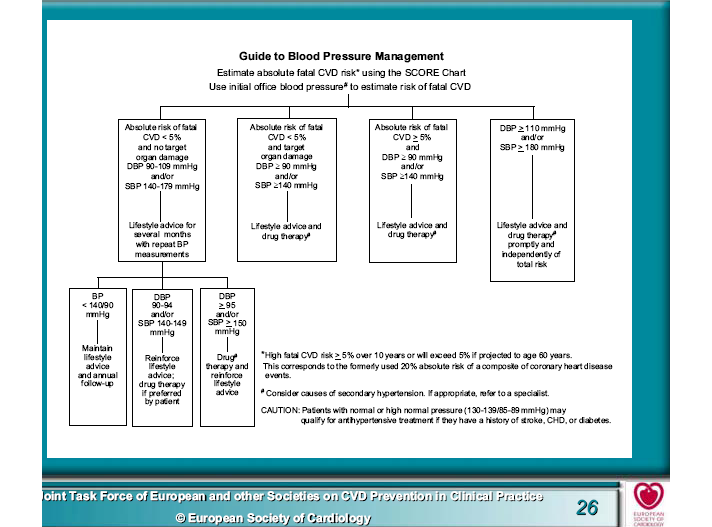
European Guidelines on CardioVascualar Disease


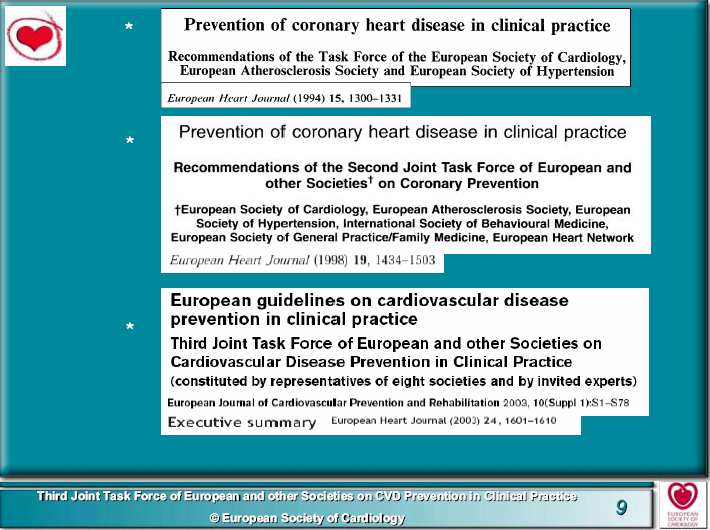
Exec summary - "European Guidelines on Cardiovascular disease (CVD) prevention in clinical practice" - download pdf (from our server) or here Download a series of excellent slides (updated Dec 2003).

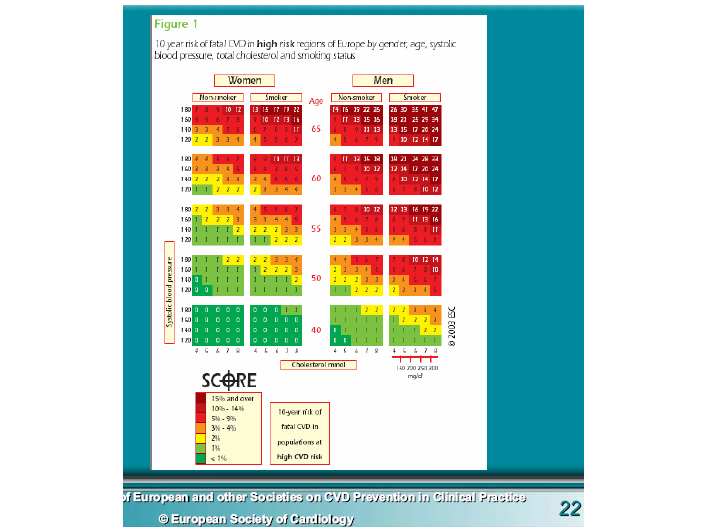
This new model for total risk estimation based on the SCORE (Systematic Coronary Risk Evaluation) system.

The SCORE risk assessment is derived from a large dataset of prospective European studies and predicts fatal atherosclerotic CVD events over a ten year period.

This risk estimation is based on the following risk factors: gender, age, smoking, systolic blood pressure and total cholesterol. The threshold for high risk based on fatal cardiovascular events is defined as "higher than 5%" , instead of the previous "higher than 20%" using a composite coronary endpoint.

Using HeartScore total CVD risk can also be projected to age 60 which may be of particular importance for guiding young adults, at the age of 20 or 30, at low absolute risk, but already with an unhealthy risk profile, which will put them at much higher risk when they grow older.

Relative risk can also be estimated from the pie charts. You can read more about the SCORE project in European Heart Journal, 2003, 24; 987-1003. source: European Society of Cardiology

Wednesday, December 13, 2006

Who are you calling fat?


Andy Wood, Billy Murrell, Brian Mansfield, Zac Gobi and Lee Embery
Four of these men are obese - but didn't know it, until we stepped in

By Denise Winterman
BBC News Magazine

Britain is the fattest country in Europe and part of the problem is people don't realise they are overweight, says the government. So what does obesity look like?

How hard can it really be? The rolls of surplus flesh, the tight waistband, not being able to see your own feet - you don't need to be a rocket scientist to work out you're carrying extra pounds.

But many people don't consider themselves overweight, according to fitness minister Caroline Flint, who says it's one reason why nearly a quarter of adults in the UK are obese.

OVERWEIGHT ACCORDING TO BMI
George Clooney, Brad Pitt and Matt Damon
George Clooney
Brad Pitt
Matt Damon

The government and doctors use the body mass index (BMI) to assess a person's condition; classing us as "underweight, ok, overweight, obese or clinically obese". The calculation is based on comparing a person's weight with their height and does not take into account sex or the proportion of body fat to muscle.

Some medical bodies, including the World Health Organization, say waist size is a more accurate measure, but the government has no plans to ditch the BMI.

"We are aware of criticism and that there has been talk of the hip-to-waist ratio, but BMI is the agreed system and we will continue to use it," says a Department of Health spokeswoman.

So what does obesity look like? The Magazine headed to Stratford, east London, to break the unhappy news to some unsuspecting men, who significantly outnumber women in the fight against fat.

ZAC GOBI - 6FT 4INS - 18 STONE - OFFICIALLY OBESE

"Obese! Not even just overweight. That is a bit of a shock. I think it's ridiculous, I'm 6ft 4ins so I'm never going to be as light as a feather. I think my weight is fine for my height.


"To get to the weight slap in the middle of what the index says is right for a man of my height I would have to lose around five stone. That's madness, I'd look ill and as if I had a massive head.

"I eat one big meal a day, it is a really big meal - maybe a whole chicken, rice and peas.

I think the amount I eat and my diet is good. There is a problem with weight in this country but the index is confusing. It doesn't take into account things like muscle."

BILLY MURRELL - 5FT 8INS - 14 STONE - OFFICIALLY OBESE

"No way. I don't agree with that - it's crazy. I know I'm carrying a few extra pounds and I am having a cheeseburger for breakfast, but obese? I'm just eating this to kill a bit of time before an appointment, I don't usually have a burger for breakfast.


"That classification isn't any good because it doesn't take into account my body frame, muscle or what sex I am, all of which make a difference.

"I'd have to lose around three stone for the government to think I'm the right weight, That's just stupid. I'd look ill and I probably would be ill.

"I know the government has to have a way to measure weight, but this is not it. They need to look at things again."

ANDY WOOD - 6FT 2INS - 16ST 11LBS - OFFICIALLY OBESE

"I know I'm carrying a little bit of extra weight but I'm not obese. I think I am a fair weight for my height and build.


"The BMI doesn't take into account things like muscle, which is important. It would class most rugby players and footballers as obese and look how fit they are.

"According to the index my healthy weight is around 12 to 13 stone, but I actually think that is underweight for my height.

"There is a problem with obesity in this country, people don't eat well or look after themselves. But using the BMI is not the right way of assessing the problem, it's not very helpful."

BRIAN MANSFIELD - 5FT 11INS - 17 STONE - OFFICIALLY OBESE

"I knew it would have me as obese. I know I am packing a few extra pounds, but I don't consider myself obese.


"I'm big boned but the index doesn't take that into account and it should. I do drive a cab, which means I'm sitting on my bum all day but I wouldn't say I was unhealthy.

"I have lost weight in recent months. I did it by eating healthily, my wife does all that stuff - salads and that. She looks after me very well.

"The BMI is not a helpful way of calculating who's overweight and not. The problem is if people don't trust it they're not going to trust what else the government says about being healthy."

LEE EMBERY - 6FT 2INS - 15 STONE - OFFICIALLY OVERWEIGHT

"I think that's a bit harsh. I know I could do with losing some weight, but only a few pounds.


"I'd have to lose about two stone to get to what the government thinks is the ideal weight for me. It's ridiculous, I would look ill, look like a skeleton. I would not look healthy.

"I know there are some things about my eating habits that I could change but on the whole I don't consider myself unhealthy.

"I'd like to see what some of those government ministers are classed as using this index. I would like to see how they react to being called fat."


I'm a male 5'8" and 12Stone. If I was built like George Cluney then the BMI wouldn't fit me but then I wouldn't have a double chin or love handles so I guess that I need to loose some weight. The problem is that because so many people are overweight being a bit chunky has become the norm and doesn't look out of place. However the fact of the matter is, if you are overweight then you increase your chances of dying before you should. So be fat or not but don't criticise the government for giving a simple guide to help you.
Paul, Glasgow

Current thinking is that a person's waist measurement is a more accurate way of seeing if they are obese. Many athletes, i.e. weight lifters, shot putters, etc. are very large but it is all muscle and would show as obese if bmi was used.
JILL BOND

I look at these pictures and see men that, mostly, look reasonably healthy. Maybe Britain's problem is not obesity but the BMI index. Its just another nanny state scare story.
Mike Ayres, Bodmin, UK

I challenge all members of parliament to have their weight checked against the BMI index and see how many of them come out overweight and obese.
maureen hodgson, telford shropshire UK

I'm sorry but I think many people in Britain are deluded about their weight. It is easy to disguise several stone of excess flesh by dressing carefully. However, the internal threat to our systems is there none the less. Stay fat if you like but be prepared to suffer the consequences of your denial!! Healthy eating is just a good habit we need to practise. Unhealthy eating is just a bad habit we need to give up. Not rocket science.
OmegaSarah, Huntingodn

These five men are in denial about their size. Of the four men you can see none of them look healthy, they are just hiding their bodies in lose fitting clothes. They all look overweight to me and could do with losing more than their suggested few pounds. Lee Embery sums up public perception of weight when he says "I'd have to lose two stone ... I would look ill, look like a skeleton". People don't see being overweight as looking ill they see being lean as ill. Even though the people with BMI index in the lower half of the ideal weight section have the least health problems.
Andrew Campbell, Southport, UK

Maybe the BMI takes it's baseline from the skeletal celebrities/models rather than real people? Not to take muscle into account is ridiculous as it weighs so much more than fat.
Sue, Cheshire

ig Boned? Given that your skeleton accounts for just 15% of your body weight it's clear that even if you had bones half as big again as the next person this isn't going to have much effect on your overall weight. Lay off the pies, and you'll end up with the correct BMI; people are just kidding themselves.
Ewan, Newcastle Upon Tyne

What a horrible world it would be if everyone conformed to this meaningless measure, and we all pottered about half starved, in our joyless feable frames. Thank god we still have the right to live our lives the way we want to, for now.
Steve Alcock, Colchester

According to the BMI Jonny Wilkinson is overweight and the likes of Lawrence Dallaglio are obese. Need I say more?
Steve Ferris, Gloucester

I have to say I agree with these blokes - they all look fine to me! I am in the ok weight-range on the chart, but then I am female so probably have less muscle than these guys, who all look ok to me. As they say, maybe a couple of them could do with losing a few pounds, but I certainly wouldn't class these people as obese...or even overweight in most cases! Very interesting - I thought BMI was a good way of measuring if someone was overweight or not, but now I'm not so convinced.
Rebecca, birmingham

Its crazy madness i tell you, none of those men look obese!! The chap who uses the example of rugby players is spot on, muscle weighs a lot more than fat. I went ona diet, exercised, changed shape and went down two dress sizes, but for the first few months i put weight on, as i was building muscle. I was told by a qualified fitness instructor NOT to weigh myself as it is misleading!! Utter rubbish this BMI scale, but unfortunatly it needs to be measured, just in a more realistic way.
Suz, Gloucestershire

I am a weight lifter and runner. I ran the Nike Run London 10km in 54 minutes and today I benched 120kg in the gym. At 6'1" and 105 kg I am obese according to the BMI.
Philip Duran, London

I'm 18 years old, and have lost 5and 1/2 stone in just over a year. My BMI states that I am right in the middle, if not towards the top end of the right weight for me (being 5ft 8 inches, weighing 1o stone 5 pounds) yet some people in my family have recommended that I need to put on 1/2 a stone to be at the right weight. I think that all the BMI can be used for is a vague benchmark for people, and is unreliable, and inaccurate.
Richard Durkin, Sheffield

Well, I'm 6'4" and approx 85kgs so with a BMI of about 22.5. Recently I weighed about 10kgs more than that, realised I was getting podgy and lost the weight. It's really not that hard, you've just got to stop deluding yourself that you're healthy. Theres a hude difference between International Rugby players and us common mortals.
Duncan, Cambridge

I'm 5'7", about 14st, broad-shouldered and stocky. The charts say I'm around 3.5st too heavy, and class me as obese. The charts lie. I had a medical a while ago (I weighed more then) that measured my actual body fat percentage. They calculated my ideal weight range to be only 1-2st less than my current. BMI is a fiction that succeeds only in setting unachievable targets, and making healthy people feel insecure in themselves.
Jon, Cambridge UK

Sunday, December 10, 2006

Scanner could reveal hidden fat

The scan can pinpoint the exact distribution of
A body scanner could help fitness fans work out exactly how much of their bodies are made up of fat.

Doctors could use the device - developed by UK scientists - to look for abnormal fat which may be putting their patients at risk.

Scientists at Lancaster University and the Institute of Food Research in Norwich used radiowaves to detect fat beneath the skin.

It is hoped that such machines could be commonplace in leisure centres one day.

The device works on the principle that the human body is a mixture of water and fat.

The amount of fat on a person can be calculated by working out their density using their exact volume and weight.

Other methods pass a tiny electrical current through the body - the level of resistance to the current can be used to estimate fat content.

However, none of these methods is particularly practical to be used in seriously-ill patients - or ordinary members of the public who need an easy way to find out the truth about their bodies.

Field method

The new method, revealed in New Scientist magazine, involves passing coils which create a radio-frequency electromagnetic field over the body.

The make-up of the object within the coil alters the phase of the field - and this can be measured and used to estimate the water content - and hence the fat content.

We should be able to put something like this in a leisure centre and members of the public could use it on a regular basis
Dr Henri Tapp, Institute of Food Research
When this information is coupled with an exact measurement of the body's volume collected by four lasers sweeping across it, the researchers can in theory create a rough picture of not only the amount of fat, but also its location on the body.

Dr Henri Tapp, from the Institute of Food Research, told BBC News Online: "The technique is called magnetic induction tomography - it has been around for a while, but it is the first time it has been used this way.

While traditional measures of obesity, such as body mass index, can help doctors predict the risk of diseases such as diabetes or heart disease, there is increasing evidence that the precise location of that fat - whether it evenly distributed or located around the waist - also has a bearing.

'Fat scan' shows up health risk


Image of MRI fat scan
Fat appears white on the MRI scan
A scan can spot which people harbour dangerous levels of fat around their vital internal organs, scientists say.

Hammersmith Hospital, in west London, is currently the only hospital in Europe using the MRI scan.

Its scientists say 40% of the population have "bad" fat around the heart, liver or pancreas, even though many appear thin. Only a litre of fat should surround these internal organs. People who are thin but do little exercise often exceed this amount.

They warn it is possible to be slim and yet still be at risk of conditions like diabetes because of "hidden" fat.

Evidence suggests the precise location of fat has more of a bearing on health than simply being overweight.

For example, people who have too much weight around their middle, often called an "apple" shape, have a greater risk of developing heart disease and type 2 diabetes than those who are pear shaped and carry the weight around the hips.

Image of Professor Bell
Fat is good in general, but when you have too much of it or fat in the wrong places it is bad
Researcher Professor Jimmy Bell

While doctors can check whether a person is a healthy weight for their height by calculating their body mass index or BMI (weight in kilograms divided by height in metres squared), they cannot see the dangerous hidden fat.

Lead researcher Professor Jimmy Bell, a Medical Research Council scientist, explained: "One of the problems with BMI is it gives you the wrong idea of how much fat you have.

"It's about where you have the fat.

"Fat is good in general, but when you have too much of it or fat in the wrong places it is bad.

"Someone can look really thin and have a normal BMI but have seven litres of fat inside them when they should ideally only have one litre."

Once doctors are aware someone has dangerous levels of hidden fat, they can work out the right combination of exercise and healthy eating needed to shift it, Professor Bell said.

He explained: "We are trying to understand what factors - genetic and environmental - make people put on fat internally and then determine what people need to do to get rid of this fat.

"When you diet you don't lose the right type of fat. If you exercise you lose more of the bad fat.

"If people are only going to do an hour of exercise a week, let's make sure that hour is spent doing the right exercise to shift the important internal fat."