Beyond Belief: Carolyn Porco On Science & Religion, Part 1 (video)
Beyond Belief: Carolyn Porco On Science & Religion, Part 2 (video)
Beyond Belief: Carolyn Porco On Science & Religion, Part 3 (video)
At the Beyond Belief seminar Carolyn Porco, an astronomer, presented her views on science v religion .. and some amazing photos of the universe.
Tuesday, January 02, 2007
Beyond Belief: Carolyn Porco On Science & Religion, Part 1
Posted by
crabsallover
at
Tuesday, January 02, 2007
0
comments
Labels: Beyond Belief, Carolyn Porco, science v religion
Richard Dawkins - Person of the Year 2006
William Crawley's Person of the Year 2006
- 31 Dec 06, 05:52 PM
- reposted from BBC, Northern Ireland
- Comments at RichardDawkins.net / BBC
- nominated from a short list which included: Richard Dawkins, Ian Paisley, Al Gore, Blogging, Tim Berners Lee, Gerry Adams, Robin Eames, Norman Kember, Anna Politkovskaya, Pope Benedict, Mahmoud Ahmadinejad, Atheism, Andy McIntosh, and George W Bush
This has been a big year for so many people across many fields, but in the field of religion, ethics and ideas, this is one man's year. Like him or loathe him, people are talking about him and his ideas. We recognise Richard Dawkins, the Charles Simonyi Professor of the Public Understanding of Science at Oxford University, as our Person of the Year 2006. This year also marks the 30th anniversary of the publication of his book The Selfish Gene. To some he's "Darwin's rottweiller" (echoing TH Huxley's nickname, "Darwin's bulldog"); to others he's "A Devil's Chaplain" (Darwin's phrase, now the title of one of Dawkins's books). You have voted overwhelmingly for Dawkins, and for many conflicting reasons:
For being everywhere this year, with the publication of his global bestseller, The God Delusion.
For proving that scientists can still change the way people think.
For writing a book (The God Delusion) which enabled Terry Eagleton to write the most negative review ever published.
For thinking clearly in a world that doesn't much value cear thinking anymore.
For saying what he thinks.
For defending the delusion that science and religious faith are incompatible.
For creating the Richard Dawkins Foundation for Reason & Science.
For writing the most overrated book of the year (in the judgment of Prospect magazine).
For making people talk about the dangers of religious fundamentalism.
For lobbying atheism and humanism into the headlines more than anyone else has done before.
For being the face of science on television across the western world.
For not having been given an honour by the Queen, while being a recipient of the Medal of the Presidency of the Italian Republic and many scientific and literary prizes.
For marrying the actress who played Romana in Doctor Who.
For raising questions that need to be answered by any intelligent religious believer wishing to develop a coherent worldview.
For being a scientific fundamentalist and the worst advert for atheism currently doing a book tour.
For raising a debate about the nature of "science" and how future generations of schoolchildren should be pretected from "pseudo-science".
For being rude and getting away with it.
For these, and many other reasons, Richard Dawkins is our Person of the Year 2006.

Should we teach religion to children in UK?
Divided by a common language: Richard Dawkins clarifies his position
by Nick Matzke, The Panda's Thumb
Reposted by Chris Street from: http://richarddawkins.net
Reposted from: http://www.pandasthumb.org
Those of you who have been watching the blogs over the last few days know that a kerfluffle has gone on about Richard Dawkins's position on religion and religious freedom. Basically, Dawkins signed this scary-sounding petition,
We the undersigned petition the Prime Minister to Make it illegal to indoctrinate or define children by religion before the age of 16.
More Details: In order to encourage free thinking, children should not be subjected to any regular religious teaching or be allowed to be defined as belonging to a particular religious group based on the views of their parents or guardians. At the age of 16, as with other laws, they would then be considered old enough and educated enough to form their own opinion and follow any particular religion (or none at all) through free thought.
Submitted by Jamie Wallis
it was linked from the Intelligent Design blog that likes to think the worst about Dawkins freaked out, Ed Brayton freaked out because the plain reading of the petition (to American ears; see below) seemed anti-civil liberties, then PZ Myers freaked out in reaction to Ed, etc., etc. PZ did helpfully get some clarification from Dawkins, who then retracted his signature of the petition, but the disavowal didn't cover the issues of whether or not the government should prevent parents from giving their children religious instruction, leading to yet more thinking of the worst on the ID blogs and yet more confusion in the comments on the blogs of PZ and Ed.
Well, I know that it is far more fun to spend endless threads bickering about what Richard Dawkins probably meant and whether or not it is good or evil, but as PZ noted, it really is better to email the guy. We can't blame Ed for not doing so, because the petition had a clear meaning on its face. But it seemed to me that the problem was that the petition meant very different things in British vs. American contexts. I sent my hypothesis to Dawkins and he has confirmed it; I comment a bit more at the bottom.
From: Richard Dawkins
Subject: Re: Clarification on religion petition?
Date: Sun, 31 Dec 2006 08:52:30 +0000
To: Nick Matzke matzkeATncseweb.org
On 31 Dec 2006, at 03:20, Nick Matzke wrote:
Dear Dr. Dawkins,
I have observed the kerfluffle surrounding the petition to the PM and your retraction of it on Ed Brayton's blog. I think part of what is going on is that Americans interpret the petition language
as a proposed universal statue [sci – "statute"] statute applying even to private communications in the home, parents taking children to church, etc. – whereas the petition, although poorly worded, was actually aimed at restricting the British government's promotion of religion in the government schools. The first would be a major violation of standard constitutional rights (in the U.S.) which makes people freak out; whereas the second is just a quite reasonable request to move the UK closer to the US position of strong church-state separation.
If you have half a second I would like to get your answer and post it on the Panda's Thumb blog (www.pandasthumb.org). It may seem silly, but this would avoid endless misrepresentation of your views on this point by creationists and others. So here goes:
1. Is my above understanding correct, i.e., that you read the petition in the second sense that I described?
Yes. In my all too cursory reading of the petition (if I had read the whole thing more carefully, I would have noticed the coercive phraseology and would not have signed it) I of course assumed that it referred to schools, not parents in the privacy of the home. I am sure that was also the intention of the petition organizer. The very idea of giving that control freak Tony Blair any more power over people than he already has appals me, and probably appals the author of the petition too. The problem in Britain is that Blair and his colleagues are hell bent on increasing the influence of religion in British schools. I want to reduce the power of religion in the schools. Blair wants to increase it. I now see that, since the petition lamentably failed to mention that it referred to schools, it can all too easily be read as an attempt to expand government power beyond the schools and into the home.
Incidentally, another reason why I would not have signed, if I had read the supporting statement as well as the petition itself, is that I am positively in favour of two aspects of religious education. I advocate teaching the Bible as literature. And I advocate teaching comparative religion as an important anthropological phenomenon. Schools should teach: 'Christians believe X, Muslims believe Y, Buddhists believe Z.' But a teacher should never say something like 'You are a Christian child and we Christians believe …'
2. Obviously you are opposed to theism and think it is harmful. But do you actually think it would be a good idea for a government to make it *illegal* for parents to teach their religion to their children? (e.g., taking them to church, sending them to Sunday school, giving them private religious instruction, etc.)
Of course I don't think it would be a good idea. I am horrified by the thought. My entire campaign against the labelling of children (what the petition called 'defining' children) by the religion of their parents has been a campaign of CONSCIOUSNESS-RAISING. I want to educate people so that they flinch when they hear a phrase like 'Catholic child' or 'Muslim child' – just as feminists have taught us to wince when we hear 'one man one vote'. But that is consciousness-raising, not legislation. No feminist that I would wish to know ever suggested a legal ban on masculine pronouns. And of course I don't want to make it illegal to use religious labels for children. I want to raise consciousness, so that the phrase 'Christian child' sounds like a fingernail scraping on a blackboard. But if I dislike the use of religious words to label children, I dislike even more the idea that governments should police the words that anybody uses about anything. I don't want a legal ban on the use of words like nigger and yid. I want people to feel ashamed of using them. Similarly, I want people to feel ashamed of using the phrase 'Christian child', but I don't want to make it illegal to use it.
Also please let me know if I may post your answer on the Panda's Thumb blog.
Yes, you may post this entire e-mail, and I hope you will include your own admirably clear introduction.
By the way, Ed Brayton himself made the same point very clearly during the exchanges on his blog:"If the petition was specific to what could and could not be taught in government-fun [presumably government-run] and financed schools, I would absolutely be in favor of it. But the text never mentions schools or government indoctrination, it says that the government would make it illegal to "indoctrinate" any child, which would include their parents advocating and teaching their own religion as well. That is my objection to it. If it only dealt with what schools could teach, I would be all for it."
Posted by: Ed Brayton | December 30, 2006 01:07 PM
Bloody hell! All that storm in a teacup for nothing! If only the petition had been worded properly in the first place … And if only I had read it more carefully … And if only Brayton had read it more charitably … No wonder lawyers and diplomats need special training. I'm out of my depth here.
Richard Dawkins
Thanks so much for your time,
Nick Matzke
----------------------------------
So, hopefully that answers all of the outstanding questions about Richard Dawkins's committment to religious freedom, and those who desire can get back to discussing his actual views on science and/or religion.
A final comment: It is commonly said that the U.S. and the U.K. are divided by a common language, and I think we have a strong case of that here, particularly with the legal/political context that can be put behind the very same words. To Americans, where there is no established church, and separation of church and state is rigorously maintained, any mention that indoctrinating or labeling children by their religion should be "illegal" seems like it must be advocating a massive intrusion of governmental power into the home. But in the UK, there is an established state church, religion is taught in the government schools, and, I gather, parents have to check boxes on tax forms and school forms to classify their children as Protestant, Catholic, Muslim, Hindu, etc., and tax revenue and religion courses are alotted on this basis. Protesting this elaborate system of official government classification of children to the British Prime Minister is quite reasonable, particularly for a guy like Dawkins.
I think some cultural background that contributed to this confusion is found in the fact that Americans tend to be extremely litigious and view any particular activity as either (a) illegal and absolutely forbidden or (b) an absolute civil right and therefore completely without restriction of any sort. This is so natural that Americans don't even realize that their way of thinking is peculiar unless they have spent a significant amount of time overseas.
Examples include:
* Private property: In the U.S., public land is public and private property is private and usually absolutely forbidden to the public. But in many other countries (like New Zealand and probably most of the British commonwealth) private land is often open to the public by default for hiking etc. It is quite clear that the British position is more rational and civilized, but for whatever reason Americans prefer to guard their private land with shotguns as if their lives depended on keeping everyone else off.
* Alcohol: In the U.S., alcohol is absolutely forbidden until the late age of 21, at which point you are suddenly given a license to get schnokered at will without restriction, which many people do. In many European countries, alcohol is served to teenagers in moderate amounts, and a culture of moderation limits binge drinking.
* Public/private schools: In the U.S., public schools are rigorously made to adhere to the Constitution and the state science standards, whereas private schools can usually teach whatever they want; other countries do things in very different ways.
* Finally, we have the religious establishment difference discussed above where the U.S. really is rather radical even compared with most other industrialized democracies (many of which have state churches and government-sponsored religious education).
For extra fun and confusion, in the U.K., the "private" "state" schools are run by the government and the "public" schools are privately funded. "Common language," indeed.
(* Note: see comments for clarification on the not-so-clear terminology in various parts of the UK)
***********
Comments (some deleted by Chris Street) @ 9.38am 2nd January 2007
2. Comment #15573 by Donald on January 1, 2007 at 11:39 am
I don't know what to make of this. I had thought Richard opposed religious indoctrination of children, and had described it as child abuse. If it is child abuse then petitioning for it to be made illegal makes sense (although unrealistic in the sweeping form of that petition). However, from the above, it seems it is only the labelling that Richard is campaigning against, not the indoctrination.
Perhaps we need more clarification on "indoctrination" as well. To me it means teaching dubious beliefs AS FACT when the recipient is either too young to judge for themselves, or has been placed in a vulnerable state of mind by psychological techniques.
3. Comment #15583 by Galactic Lord Xenu on January 1, 2007 at 12:32 pm
What concerns me is whether faith is "abusive" to children as it is irrational, and teaching children faith-based ideas is no different from having them grow up to believe the world is flat. Is it abuse to teach children in a cult that they must serve their charismatic cult leader or God will kill their family? Is it abusive to let children grow up and be subject only to Scientologist education?
Do parents and other authority, simply put, have the right to feed children what a rational mind would find to be patent nonsense?
If it is, does that mean religion should be included as abuse? It is probably not possible or desirable to make it illegal, but it's something to ponder.
8. Comment #15626 by Anat on January 1, 2007 at 5:15 pm
Galactic Lord Xenu posted: What concerns me is whether faith is "abusive" to children as it is irrational, and teaching children faith-based ideas is no different from having them grow up to believe the world is flat. Is it abuse to teach children in a cult that they must serve their charismatic cult leader or God will kill their family? Is it abusive to let children grow up and be subject only to Scientologist education?
------
There are many forms of childrearing that fail to prepare children for life in the greater society they may find themselves in adulthood. In Israel children of Haredi families hardly receive any education in basic secular areas such as mathematics, geography, science, foreign language, beyond the level of 4th-5th grade. Young adults who want to leave this environment have a huge problem with lack of job skills. OTOH for 2 or 3 generations children raised collectively on Israeli kibbutzim were ill-prepared for more typical family life. How do we balance people's freedom to explore different ways of life with the rights of children not to be forced out of mainstream society?
9. Comment #15629 by Jack Rawlinson on January 1, 2007 at 5:40 pm
Interesting. I need to revisit the wording of that petition. I signed it, because I didn't see anything controversial. Perhaps I was hasty. I certainly don't think we can - or should - make it illegal for parents to tell their kids lies. I saw it as a request to make it illegal to teach religious beliefs as fact in schools. I also saw it as an attack on so-called faith schools, and I support that. A school whose raison d'etre includes the promotion of religious belief and to inculcate its pupils with that belief should be banned. However, if Richard saw fit to withdraw his signature there's clearly a problem with the wording.
11. Comment #15653 by JohnC on January 1, 2007 at 10:04 pm
The entire affair throws into relief some interesting issues:
1. A number of us have from time to time commented on the fact that RD displays a certain political naivety, often shared by his most enthusiastic admirers. He now charmingly confirms this impression: "I'm out of my depth here." There is nothing wrong with this, and he is clearly comfortable with making his main contribution in the world of ideas rather than political strategies. Everyone should keep this in mind, not just with the education issue but also when reflecting on his views on, for instance, religious moderates.
2. On the other hand I would regard his comments about what he meant by "consciousness-raising" as particularly politically acute. The point is about changing the topography of what is socially acceptable. And it is not beyond the bounds of possibility that even religiously inclined parents can come to recognise the wisdom of a living pluralism in their child-rearing.
3. One person's indoctrination is another person's socialisation. In Australia (and elsewhere) the Catholic Church runs a large network of schools that since the 1960s here have received some government funding. Many parents send their children to these not for the religious component but because they believe such schools are better at inculcating values such as "respect for your elders", "concern for the poor". When I asked my 16yo's half-brother, who goes to such a school, whether he believed any of the religious doctrine to which he was regularly exposed, he looked at me as if I had just gone temporarily mad. "Of course not," he sneered with adolescent contempt.
4. Nonethess, such schools are obviously a major transmission belt for religious fantasy, and government funding would be simple illegal in the US. On the other hand, in Australia where private schools do receive funding there are very tight guidelines about the curriculum that is taught, and there is generally not a problem about the subversion of biology etc.
5. In all common law jurisdictions, the courts recognise that the key issue is to determine what is in the "best interests of the child". As a rule they accept wide parental discretion in determining those interests, but have no hesitation in overriding parents in cases where they see the child's interests compromised - physical and sexual abuse, proper care, medical treatment. Cases of religious sects are of particular interest, because I am not aware of any instances where filling a child's head with religious or other nonsense is in and of itself regarded as sufficient justification from intervention. The plaintiffs in such cases, usually social welfare agencies, invariably have to demonstrate actual abuse or neglect or incompetence before the courts will act. This is probably a good thing since, up until recent times here and perhaps in many other jurisdictions today, bringing up a child as an atheist would according to prevailing social norms be regarded as abuse if the test were extended to intellectual environment.
13. Comment #15669 by Veronique on January 1, 2007 at 11:41 pm
Galactic Lord Xenu - comment 15583
I never subjected my sons to any religious or poltical ideology throughout their young lives. They are now 42 and 35 respectively.
What I did do and that can't be avoided by any parent, was teach them language and communication skills. That language (that I use) with all its overtones and undertones, all its unconscious inflections and usage was transmitted directly to them. So, in some sense, one cannot help but indoctrinate one's children.
Both of them have excellent language skills and are very articulate. That's to their advantage.
Did I 'abuse' them by teaching my language with all its interpretive commutations? The answer is probably 'yes'.
Both my sons are atheists and both are married to marginal (however indocrinated) Catholics. My older son has the greater problem during this time of the year. My younger son is more sanguine.
It is all something to ponder.
Posted by
crabsallover
at
Tuesday, January 02, 2007
0
comments
Labels: Atheism, Richard Dawkins, Teaching religion to children
Monday, January 01, 2007
The Final Scientific Enlightenment - the completion of Darwin & Einsteins' theories
What are you optimistic about? Why?
by Edge.org
Reposted from:
http://edge.org/q2007/q07_index.html
The Edge Annual Question — 2007
WHAT ARE YOU OPTIMISTIC ABOUT? WHY?
As an activity, as a state of mind, science is fundamentally optimistic. Science figures out how things work and thus can make them work better. Much of the news is either good news or news that can be made good, thanks to ever deepening knowledge and ever more efficient and powerful tools and techniques. Science, on its frontiers, poses more and ever better questions, ever better put.
What are you optimistic about? Why? Surprise us!
RICHARD DAWKINS
Evolutionary Biologist, Charles Simonyi Professor For The Understanding Of Science, Oxford University; Author, The God Delusion
The Final Scientific Enlightenment
I am optimistic that the physicists of our species will complete Einstein's dream and discover the final theory of everything before superior creatures, evolved on another world, make contact and tell us the answer. I am optimistic that, although the theory of everything will bring fundamental physics to a convincing closure, the enterprise of physics itself will continue to flourish, just as biology went on growing after Darwin solved its deep problem. I am optimistic that the two theories together will furnish a totally satisfying naturalistic explanation for the existence of the universe and everything that's in it including ourselves. And I am optimistic that this final scientific enlightenment will deal an overdue deathblow to religion and other juvenile superstitions.
See more responses from other Edge.org contributors here:
http://edge.org/q2007/q07_index.html
Posted by
crabsallover
at
Monday, January 01, 2007
0
comments
Labels: Atheism, edge.org, Richard Dawkins, science v religion
Templeton Prize
Chris Street edits in bold.
The Templeton Prize (wikipedia) awarded annually is currently £795,000. A Nobel Prize awards ten million Swedish Kronor, £745,000. The monetary value of the prize is adjusted so that it exceeds that of the Nobel Prizes. The prize is, as of 2006, the largest single annual financial prize award given to an individual for intellectual merit.
The prize has been criticized by Richard Dawkins in The God Delusion, a British ethologist and atheist, who labeled it "a very large sum of money given (...) usually to a scientist who is prepared to say something nice about religion" (Dawkins 2006).
Hindus, Christians, Jews, Buddhists and Muslims have been on the panel of judges and have been recipients of the price. There have been no Atheist awardees.
A list of recent winners includes some notable scientists: Professor John D. Barrow (2006), Rev. Dr. John C. Polkinghorne (2002), Professor Freeman J. Dyson (2000), Professor Paul Davies (1995) and others: Aleksandr Solzhenitsyn (1983), Rev. Dr. Billy Graham (1982), Mother Teresa (1973).
The purpose of the Templeton Prize.
"If even one-tenth of world research were focused on spiritual realities, could benefits be even more vast than the benefits in the latest two centuries from research in food, travel, medicine or electronics, and cosmology?
- Research and innovation in food products just since 1800 caused over 100 fold more food production per American farmer.
- Research and innovation in travel methods since 1950, enabled over 100 fold increase in travel by Americans.
- Research and innovation in medicine just since 1900 caused over 100 fold increase in information about our bodies.
- Research and innovation in electronics just since 1900 caused over 1000 fold increase in information available to us.
- In 300 centuries, humans observed less than a million stars; but just in the last two centuries innovations in methods and research has revealed a cosmos of 100 billion times 100 billion stars."
— Sir John Templeton
How might humankind's spiritual information and advancement increase by more than a hundredfold? This is the challenge presented by the Templeton Prize. Just as knowledge in science, medicine, cosmology and other disciplines has grown exponentially during the past century, the Templeton Prize honors and encourages the many entrepreneurs trying various ways for discoveries and breakthroughs to expand human perceptions of divinity and to help in the acceleration of divine creativity.
Their various methods, particularly through scientific research, serve to supplement the wonderful ancient scriptures and traditions of all the world's religions. Many honors and titles and prizes have been given for many centuries and will be given in the future for good works, reconciliation, saintliness or for relief of poverty and sickness. But these very worthy endeavors are not the purpose of the Templeton Prize.
Instead, this award is intended to encourage the concept that resources and manpower are needed to accelerate progress in spiritual discoveries, which can help humans to learn more than a hundredfold more about divinity. We hope that by learning about the lives of the awardees, millions of people will be uplifted and inspired toward research and more discoveries about aspects of divinity. The Prize is intended to help people see the infinity of the Universal Spirit still creating the galaxies and all living things and the variety of ways in which the Creator is revealing himself to different people. We hope all religions may become more dynamic and inspirational.
The Templeton Prize is awarded annually to a living person. The Templeton Prize does not encourage syncretism but rather an understanding of the benefits of diversity. It seeks to focus attention on the wide variety of endeavors toward discoveries or spiritual realities research. It does not seek a unity of denominations nor a unity of world religions; but rather it seeks to encourage understanding of the benefits of diversity. There is no limitation of race, creed, sex, or geographical background.
Progress is needed in spiritual discovery as in all other dimensions of human experience and endeavor. Progress in religion needs to be accelerated as rapidly as progress in other disciplines. A wider universe demands deeper awareness of the aspects of the Creator and of spiritual resources available for humankind, of the infinity of God, and of the divine knowledge and understanding still to be claimed.
The Templeton Prize serves to stimulate this quest for deeper understanding and pioneering breakthroughs in religious concepts and knowledge by calling attention annually to achievements in this area. It is hoped that there will result from this enterprise expanded spiritual awareness on the part of humankind, a wider understanding of the purpose of life, heightened quality of devotion and love, and a greater emphasis on the kind of research and discovery that brings human perceptions more into concert with the divine will.
The judges consider a nominee's contribution to progress made either during the year prior to his selection or during his or her entire career. The qualities sought in awarding the Prize are: freshness, creativity, innovation and effectiveness. Such contributions may involve new concepts of divinity, new organizations, new and effective ways of communicating God's wisdom and infinite love, creation of new schools of thought, creation of new structures of understanding the relationship of the Creator to his ongoing creation of the universe, to the physical sciences, and the life sciences, and the human sciences, the releasing of new and vital impulses into old religious structures and forms.
The Prize, a sum in the amount of £795,000 sterling.
The Templeton Prize is awarded annually on the decision of a panel of judges from the major religions of the world today.
Nominations are sought from all people everywhere. Leaders of theological and religious institutions and those engaged in innovative and creative research are especially invited to submit nominations. Persons desiring to nominate should write to the Templeton Prize, Canyon Institute for Advanced Studies, 3300 W. Camelback Road, Phoenix, AZ 85017. To serve as guides for nominators, copies of nominations of earlier winners can be requested.
In some years nominations sent to judges may be limited to encourage a wide diversity of recipients from different races, sexes and religions. It is hoped that the recipients can serve as examples of the wide variety of possible ways to increase more than 100 fold the spiritual information, spiritual principles and concepts of divinity. Nominations are sought for potential recipients from all nations and religions of the world.
Posted by
crabsallover
at
Monday, January 01, 2007
0
comments
Labels: science v religion, Templeton Prize
Where Science and Ethics Meet

Chris Street edits in bold.
The Scientist as Rebel (New York Review Books Collection)
by Freeman Dyson
Where Science and Ethics Meet
A Review by Gregory M. Lamb
Throughout history scientists from Galileo to Andrei Sakharov have been persecuted for challenging the orthodoxy of their societies. But in The Scientist as Rebel, Freeman Dyson advocates rebellion of a broader kind.
Science, the theoretical physicist writes, should rebel "against poverty and ugliness and militarism and economic injustice." Benjamin Franklin is Dyson's ideal of the scientific rebel, one who embodied "thoughtful rebellion, driven by reason and calculation more than by passion and hatred." If science ever stops rebelling against authority, Dyson insists, it won't deserve to be pursued by our brightest children.
In this highly readable compilation of previously published essays and book reviews written over nearly four decades, Dyson also rebels against the idea that scientists should only concern themselves with the problems of the laboratory.
In one chapter he asks "can science be ethical?" In another he explores the uneasy relationship between science and religion ("Is God in the lab?"). He considers the qualities of mind expressed by the great scientists of the past in essays such as "In Praise of Amateurs" and "Seeing the Unseen."
What is science? Dyson quotes from biologist J.B.S. Haldane: "It is man's gradual conquest, first of space and time, then of matter as such, then of his own body and those of other living beings, and finally the subjugation of the dark and evil elements in his own soul."
Dyson, a professor emeritus at the Institute for Advanced Study at Princeton University, has made his own share of contributions to the advancement of scientific knowledge, in fields from nuclear physics to quantum electrodynamics. But here he also proves himself an adept essayist on ethical issues less obviously connected with science.
Dyson also stands opposed to the "reductionist" view of science, the concept that all knowledge, whether history, the arts, or ethics, "can be reduced to science." Dyson argues for a wider definition of knowledge that comes from a broader array of sources, including artistic values and religion, "parts of a human heritage that is older than science and perhaps more enduring."
Science and religion need not be seen as foes, argues Dyson, who finds the roots of modern science, with its demand for logical thinking and "scientific method," in a millennium of Christian theological disputes in Europe that had the effect of sharpening minds. The contentiousness sometimes felt between Christianity and modern science actually springs from their common roots, he says.
"Science is a particular bunch of tools that have been conspicuously successful for understanding and manipulating the material universe," Dyson concludes. "Religion is another bunch of tools, giving us hints of a mental or spiritual universe that transcends the material universe."
To those who see the world evolving toward a post-religious era, Dyson offers the words of his mother, whom he describes as "a skeptical Christian, like me." She used to tell him, "You can throw religion out of the door, but it will always come back through the window."
For Dyson, scientists are neither secular saints who have an answer for every human need nor irresponsible devils without regard for human values. Science, for example, doesn't have solutions to the great issues of war and peace. But scientists can be advocates for international understanding and cooperation by serving as models of those values themselves, he says.
Science needs both its revolutionaries and conservatives, Dyson explains -- those eager to abandon past views and those who defend them. It also needs both hedgehogs and foxes, scientists who dig deeply at a few fundamental problems (hedgehogs include Albert Einstein) and those who have wide interests and move quickly from problem to problem (foxes include Dyson's mentor, Richard Feynman).
The Scientist as Rebel does not include a single equation or technical diagram. When scientific concepts do arise, as in an essay on the wonders of string theory, they are described in clear layman's language. What really fills this book is wisdom -- wisdom that helps us understand how scientists think and work and how science, properly understood, can help us make better sense of our world.
Gregory M. Lamb is a Monitor staff writer.
Posted by
crabsallover
at
Monday, January 01, 2007
0
comments
Labels: Freeman Dyson, science v religion
About Edge.org
Edge Foundation, Inc., was established in 1988. Its informal membership includes of some of the most interesting minds in the world.
The mandate of Edge Foundation is to promote inquiry into and discussion of intellectual, philosophical, artistic, and literary issues, as well as to work for the intellectual and social achievement of society.
No religion and an end to war: how thinkers see the future

Chris Street edits in bold
Alok Jha, science correspondent
Monday January 1, 2007
The Guardian
The web magazine Edge (www.edge.org) asked more than 150 scientists and intellectuals: "What are you optimistic about?" Answers included hope for an extended human life span, a bright future for autistic children, and an end to violent conflicts around the world.
Philosopher Daniel Denett believes that within 25 years religion will command little of the awe it seems to instil today. The spread of information through the internet and mobile phones will "gently, irresistibly, undermine the mindsets requisite for religious fanaticism and intolerance".
Biologist Richard Dawkins said that physicists would give religion another problem: a theory of everything that would complete Albert Einstein's dream of unifying the fundamental laws of physics. "This final scientific enlightenment will deal an overdue death blow to religion and other juvenile superstitions."
Part of that final theory will be formulated by scientists working on the Large Hadron Collider, a particle accelerator at Cern in Geneva, which is to be switched on this year. It will smash protons together to help scientists understand what makes up the most fundamental bits of the universe.
Steven Pinker, a psychologist at Harvard University, highlighted the decline of violence: "Most people, sickened by the bloody history of the 20th century, find this claim incredible. Yet, as far as I know, every systematic attempt to document the prevalence of violence over centuries and millennia (and, for that matter, the past 50 years), particularly in the west, has shown the overall trend is downward."
John Horgan, of the Stevens Institute of Technology, New Jersey, was optimistic "that one day war - large-scale, organised group violence - will end once and for all".
This will also be the year that we get to grips with our genomes. George Church, a geneticist at Harvard Medical School, believes we will learn "so much more about ourselves and how we interact with our environment and fellow humans".
Simon Baron-Cohen, a psychologist at Cambridge University, focused on autistic children, saying their outlook had never been better. "There is a remarkably good fit between the autistic mind and the digital age," he said. "Many develop an intuitive understanding of computers, in the same way other children develop an intuitive understanding of people."
Leo Chalupa, a neurobiologist at the University of California, Davis, predicted that, by the middle of this century, it would not be uncommon for people to lead active lives well beyond the age of 100. He added: "We will be able to regenerate parts of the brain that have been worn out. So better start thinking what you'll be doing with all those extra years."
Posted by
crabsallover
at
Monday, January 01, 2007
0
comments
Labels: ageing, Autism, Daniel Dennett, Richard Dawkins, science v religion
Sunday, December 31, 2006
The God Delusion by Richard Dawkins - Review by Mary Midgley
Chris Street edits in bold.
Mary Midgley has been a long time critic (since 1978) of Richard Dawkins.
- 07 October 2006
- Mary Midgley
THIS book is one of many that celebrate an allegedly bitter war between Science and Religion, two epic figures representing rival forces between which we must choose.
Different people understand this "war" differently. In the US, the default attitude (that of normal people) is increasingly assumed to be Religion, because a scientific or Darwinian world view is still taken to mean social Darwinism, the brash, brutal doctrine of the survival of the fittest that Herbert Spencer taught so successfully in the US and which deeply influenced the Nazis. In recent times, the sociobiological rhetoric of "selfishness" and "ruthlessness" in natural selection has served to reinforce this impression of meaningless brutality, leaving religion as the only tolerable option.
In the Middle East, however, talk of a scientific or Darwinian attitude stands for something different but no less hateful. It means primarily western materialism: the brash, greedy, uncaring lifestyle of people whose rulers trampled over oriental cultures and who trample them with increasing vigour today. Traditional religion appears as the only alternative to this odious attitude.
Thus, once the scene is polarised, once the two vast abstractions are set up, their ideologies turn the debate into incurable conflict. In that spirit, the preface of this book cries out for the abolition of the enemy: "Imagine, with John Lennon, a world with no religion. Imagine no suicide bombers, no 9/11, no 7/7, no Crusades, no Gunpowder Plot..."
These examples are, of course, endless, and the thought that removing religion would end such large-scale atrocities accounts in large part for the rise of anti-religious movements. However, the regimes they gave birth to during the 20th century included the governments of Nazi Germany, Pol Pot's Cambodia and Stalin's Russia. It is still not clear how it was possible for these regimes to commit the three most monstrous crimes of the epoch, but what does emerge is that removing religion had not helped at all. The roots of great crimes plainly lie far deeper than the doctrines people use to justify them.
In any culture, rogues defend their actions by professing whatever standards their society respects. Until recently, of course, Christianity was the norm in the west, but Marxism and fascism proved just as effective. Science, too, it turns out, can easily be used this way, as both Germany's and South Africa's justification of racism demonstrates. Religion is not really relevant at all, unless we carefully define "religion" to link it necessarily with atrocities.
This, of course, is the tendency of Dawkins's book. Dawkins is no rogue though; indeed, he is sincere in regarding God and religion the enemies of rationality - and in arguing that they are linked to atrocity to such an extent that they must be resisted. So much so that he is forced to assert that faiths which do not use the concept of God, such as Buddhism, Confucianism and Taoism, are not really religions at all. He also works hard to exclude scientists, such as Einstein, who firmly and repeatedly used religious language to express what are plainly central elements in their thought, from the taint of religion.
Dawkins is irritated by the Einstein phenomenon, and complains of a "confused and confusing willingness to label as 'religion' the pantheistic reverence which many of us share with its most distinguished exponent, Albert Einstein". He insists that this reverence has "no connection with supernatural belief". Pantheism, however, is unmistakably a religious attitude. And when, like Einstein, you speak of an immanent god, a divinity pervading the world, and when, like Spinoza, you equate God and Nature, words such as "supernatural" do not mean much.
Einstein understood this well. His language is only surprising if you assume, as Dawkins seems to, that science is the only possible source of knowledge. Thus in quoting Martin Rees's remark that such questions as why anything exists lie "beyond science", he simply cannot see what this might mean.
Similarly, when he cites NOMA - "nonoverlapping magisteria", the acronym coined by Stephen Jay Gould to describe how, in his view, science and religion could not comment on each other's sphere - and Freeman Dyson's description of himself as "one of the multitude of Christians who do not care much for the doctrine of the Trinity or the historical truth of the gospels", Dawkins declares flatly that they cannot mean what they say. As scientists, they must be atheists.
It seems not to have struck Dawkins that academic science is only a small, specialised, dependent part of what anybody knows. Most human knowledge is tacit knowledge - habitual assumptions, constantly updated and checked by experience, but far too general and informal ever to be fully tested. We assume, for instance, that nature will go on being regular, that other people are conscious and that their testimony can generally be trusted. Without such assumptions neither science nor any other study could ever get off the ground, and nor could everyday life.
When we build on these foundations we necessarily use imaginative structures - powerful ideas which can be called myths, which are not lies, but graphic thought-patterns that shape and guide our thinking. This is not irrational: the process of using these structures is a necessary preparation for reasoning. Thus the selfish gene is a powerful idea, so are the Science-Religion war, Gaia, natural selection, progress, and the hidden hand of the market.
With the largest, most puzzling questions, we have no choice but to proceed in mythical language which cannot be explained in detail at all, but which serves (as Einstein's did) to indicate what sort of spiritual universe we perceive ourselves to be living in. This is the province of religion. Adding God is not, as Dawkins thinks, adding an illicit extra item to the cosmos, it is perceiving the whole thing differently.
For a long time, this kind of language was reasonably well understood. Since the mid-19th century, however, there has been a disastrous attempt to get rid of it, keeping only literal statements of fact. This is, of course, the root of religious Christian fundamentalism, which tries, absurdly, to treat the whole of that strange compilation, the Bible, as literal fact. Yet in so doing it is only responding to a less obvious fundamentalism on the scientistic side, which claims that our knowledge reduces to one fundamental form - the literal statements of science. Both extremes show a similarly crass refusal to admit the complexity of life.
Dawkins is, of course, quite right to express horror at Biblical fundamentalism, especially in the neocon form that centres on the book of Revelation. But it is not possible to attack this target properly while also conducting a wider, cluster-bomb onslaught on everything that can be called religion. Since this particular bad form of religion is spreading rapidly in the world, we urgently need to understand it: not just to denounce it but to grasp much better than we do now why people find it attractive. It is not enough to say, as Dawkins does, that they are being childish.
”We urgently need to understand fundamentalism
We also need to ask why they have found the other attitudes that are open to them inadequate. As I have suggested, this means becoming more aware of the inadequacies of our own way of life, which are obvious to them and which put them off the opinions that we profess. What we need, in fact, is a bit more self-knowledge.
Posted by
crabsallover
at
Sunday, December 31, 2006
0
comments
Labels: Atheism, Mary Midgley, Richard Dawkins, science v religion, The God Delusion
European Guidelines on CardioVascualar Disease


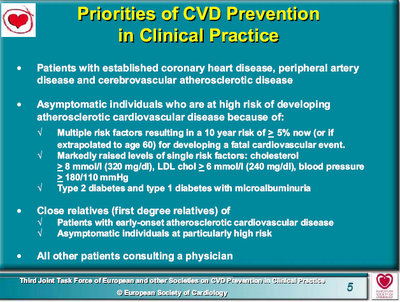
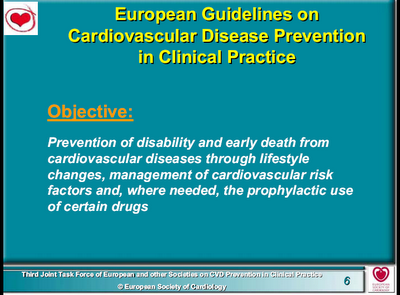
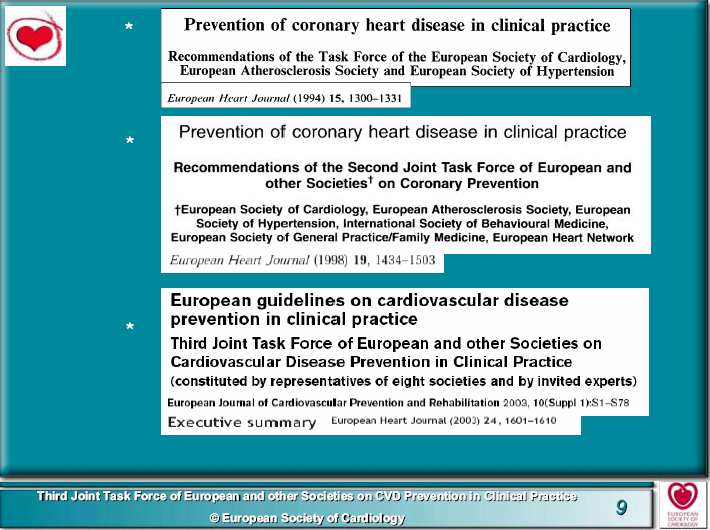
Exec summary - "European Guidelines on Cardiovascular disease (CVD) prevention in clinical practice" - download pdf (from our server) or here Download a series of excellent slides (updated Dec 2003).
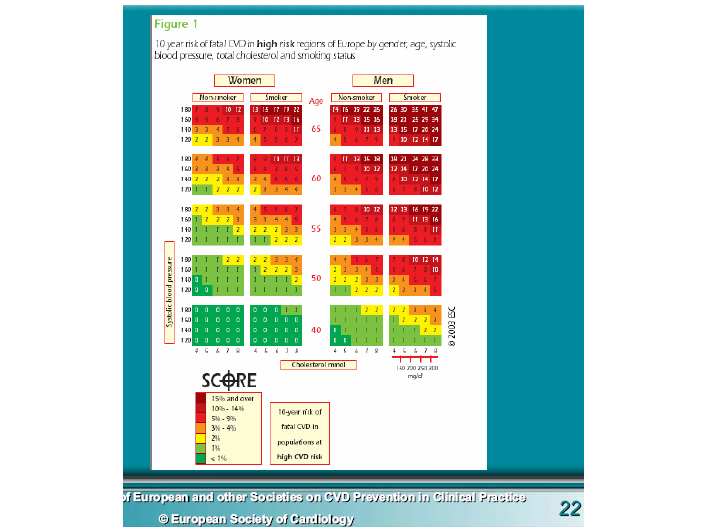
This new model for total risk estimation based on the SCORE (Systematic Coronary Risk Evaluation) system.
The SCORE risk assessment is derived from a large dataset of prospective European studies and predicts fatal atherosclerotic CVD events over a ten year period.
This risk estimation is based on the following risk factors: gender, age, smoking, systolic blood pressure and total cholesterol. The threshold for high risk based on fatal cardiovascular events is defined as "higher than 5%" , instead of the previous "higher than 20%" using a composite coronary endpoint.
Using HeartScore total CVD risk can also be projected to age 60 which may be of particular importance for guiding young adults, at the age of 20 or 30, at low absolute risk, but already with an unhealthy risk profile, which will put them at much higher risk when they grow older.
Relative risk can also be estimated from the pie charts. You can read more about the SCORE project in European Heart Journal, 2003, 24; 987-1003. source: European Society of Cardiology
Posted by
crabsallover
at
Sunday, December 31, 2006
0
comments
Labels: blood pressure, cardiovascular disease, cholesterol, diet, health, heart, statins
Statins to reduce heart attacks or strokes
Chris Street edits in bold.
New Scientist magazine (7th October 2006) reports on the use of Statins to reduce heart attacks or strokes.
"So you think you're healthy? You are in your 40s, feel right as rain, normal blood pressure, normal cholesterol, pretty good diet, occasional exercise. How would you react if your doctor suggested you take a powerful drug every day for the rest of your life? The drug, known as a statin, will lower your cholesterol even further and reduce your risk of a heart attack or stroke.
According to one recent estimate, most men and many women over 40 could benefit from the drugs.
If you are worried about side effects, your doctor will reassure you that a meta-analysis that pooled data from 14 trials involving more than 90,000 people shows the treatment is very safe.
The same study suggests that even if your cholesterol level is normal, taking a statin can still reduce your cardiovascular risk. And the greater your risk - if you smoke, suffer from high blood pressure or diabetes, or have a family history of heart disease, for example - the greater the potential benefits."
New Scientist says "Lowering cholesterol is beneficial in pretty much everyone who has been studied," says Colin Baigent, who coordinated the meta-analysis by the Clinical Trial Service Unit (CTSU) at the University of Oxford. "It doesn't really matter what the cholesterol level is. It could be average or even low, but if you reduce it even further in a person who is at high risk you get benefits." Statins also have anti-inflammatory properties, and have shown promising results when used to treat diseases like rheumatoid arthritis, multiple sclerosis and Alzheimer's. Some research even suggests they can help tackle viral infections such as hepatitis C and HIV.
Can any drug really be that good? As enthusiastic doctors put ever more people on statins, sceptics are warning that we don't know enough about the possible adverse effects of taking them over a lifetime.
Others claim that statins' potency against heart disease has little to do with lowering cholesterol and instead results from their anti-inflammatory properties, leading some to dismiss them as "expensive aspirin". So could the rush to put millions more people on statins be a costly mistake?"
"The association between cholesterol, its transport in the bloodstream by a protein called low-density lipoprotein and heart disease is fairly well established. Cholesterol in the form of LDL, so-called "bad cholesterol", can infiltrate the walls of coronary arteries, contributing to the formation of a fibrous plug of immune cells called a plaque. If this ruptures it can trigger the formation of a blood clot that blocks the artery and starves the heart of oxygen - a heart attack, in other words. Equally disastrously, the clot can break free and block arteries in the brain, triggering a stroke."
"Some doctors, however, are alarmed by the trend towards dishing out statins to millions more people and giving higher dosages to lower cholesterol even further. They say the benefits for those who do not already have heart disease are small, while the potential risks are largely unknown. "What price should you pay for a modest effect?" Sutter asks. "The price shouldn't be very high because the effect is weak at best." A 20 per cent reduction in cardiovascular risk may sound impressive, but it doesn't look quite as good when you realise what it means for each individual: if your risk of having a heart attack over the next five years is 5 per cent, say, then taking statins will reduce it only to 4 per cent."
"Sutter and others say that statin researchers have failed to report adverse effects in enough detail to allow doctors and patients to weigh the potential costs against the benefits. "There's no good reporting of adverse effects at high doses and very modest reporting even at moderate doses," Sutter says. "If you are prescribed a statin, the doctor expects you to take it for the rest of your life," says Uffe Ravnskov, an independent researcher and former hospital doctor based in Lund, Sweden, who runs The International Network of Cholesterol Skeptics. He claims almost half of patients have adverse effects."
"Alleged side effects include memory loss, extreme irritability, aggression, suicidal impulses and impotence. Evidence for these remains sketchy, however, coming from small trials and case studies. Statins do cause liver damage in around 1 per cent of patients, but this should be picked up by routine liver function tests and can be reversed by coming off the drugs. It is also clear that statins can damage muscles. As many as a fifth of people taking the drugs in trials say they experience some muscle weakness or pain, and exercise seems to make things worse. These symptoms are commonplace anyway in middle-aged and elderly people, however, and a similar number of patients taking a placebo also report them. So it is difficult to determine the exact extent of the problem. "
"In very rare cases statins cause rhabdomyolysis, a severe form of muscle damage in which the breakdown products cause kidney failure. The rate was especially high with cerivastatin (Baycol), which caused 50 deaths and was withdrawn in 2001. "
"Confusingly, some small studies have hinted that statins increase the risk of cancer while others suggest they may guard against it. The CTSU meta-analysis found no association between cancer and statins, and a similarly large study from the US, which looked at 26 trials involving 87,000 patients, also found no link."
"Most trials, though, have lasted only five years or less. For some this leaves lingering doubts. "You don't get lung cancer after smoking for 10 years; it takes much longer to show up," Ravnskov points out. "Heavy smokers get lung cancer in their 50s and 60s and they have smoked for decades before that." Nevertheless, White, who led the US study, is confident that even after five years some signs of increased cancer risk would show up in trials. "Within the period we were looking at you should at least have started to see some trends," he says. "
"The crucial issue now facing policy-makers is how and where to draw the line that defines who should be offered statins. In the US and Canada, prescribing guidelines focus on lowering cholesterol below certain thresholds, depending on the individual's overall risk of a heart attack or stroke. The lowering of the US target levels in 2004, which is leading to millions more people being put on statins, sparked controversy when it was revealed that eight out of the nine experts involved had ties to statin manufacturers. "
"In Australia, New Zealand and the UK, the emphasis is on treating those with the highest overall risk rather than on cholesterol targets. This year, a Canadian study that modelled the effects of applying the various guidelines concluded that the high-risk approach is more effective in terms of number of lives saved per number treated (BMJ, vol 329, p 529). It found, for instance, that applying the US guidelines would result in twice as many people taking statins as the New Zealand guidelines without preventing any more deaths. "
"Yet even the more conservative guidelines will lead to millions more people taking statins for the rest of their lives, often starting younger or being given higher doses. You could be one of them. If the advocates of statins are right, this policy will come to be seen as a triumph for preventative medicine, saving tens of thousands of lives. If the critics are right, for those with a low risk of heart disease statins could do more harm than good. Which will you bet your life on when your doctor mentions the s-word? "
Biomarkers that can predict a long life
Chris Street edits in bold.
My Action: Test for CRP, IL-6, fibrinogen, EPI and NE etc
What biochemicals can predict how long I will live?
Full Review:
"Combinations of biomarkers predictive of laterlife mortality" in PNAS September 19th 2006 vol. 103 no. 38, Gruenewald et al. Download the full article pdf (save $10) - Recommended.
13 biomarkers, reflecting activity in several biological systems predict death or ill health in older adults.
Neuroendocrine stress hormones
Nerve cells (Neuroendocrine glands) produce four hormones that are released under conditions of stress.
- Adrenaline
- aka epinephrine (EPI)
- plays a role under conditions of stress and anger
- Noraadrenaline
- aka norepinephrine (NE)
- is released by a stressful event.
- cortisol
- is involved in response to stress; increases blood pressure, blood sugar levels, and suppresses the immune system.
- dehydroepiandrosterone (DHEA)
- a natural steroid hormone produced from cholesterol. DHEA is the precursor of androstenedione, testosterone and estrogen. It is the most abundant hormone in the human body.
Immune activity
- C-reactive protein (CRP)
- a marker of inflammation. High levels indicate risk of developing fatty deposits on inner walls of arteries which can lead to heart attacks.
- Fibrinogen
- Fibrin made from fibrinogen is a protein involved in clotting of blood
- Interleukin 6 (IL-6)
- is a cytokine secreted by T cells and macrophages to stimulate immune response to trauma, especially burns or other tissue damage leading to inflammation.
- Albumin
- most abundant protein in human blood plasma. High levels is a sign of severe dehydration. Low levels can be caused by malnutrition, malabsorption, liver disease, etc.
Cardiovascular functioning
- Systolic (SBP) and Diastolic blood pressure (DBP)
- The systolic pressure is the peak pressure in the arteries during the cardiac cycle
- the diastolic pressure is the lowest pressure (at the resting phase of the cardiac cycle).
Metabolic activity
- High-density lipoprotein (HDL) cholesterol
HDL can remove cholesterol from atheroma within arteries, and transport it back to the liver for excretion or re-utilization.
HDL-bound cholesterol is called "good cholesterol" - protects against cardiovascular diseases.
Low HDL cholesterol levels [less than 40 mg/dL] increase the risk for heart disease.
- total cholesterol to HDL cholesterol ratio
- Glycosylated hemoglobin (HbA1c)
- a form of hemoglobin used primarily to identify the plasma glucose concentration
- formed by hemoglobin's normal exposure to high plasma levels of glucose
- found in retinopathy in diabetes mellitus.
Aims:-
- (i) identify combinations of biomarkers and their zones of values associated with high levels of mortality risk in older men and women
- (ii) examine whether biomarkers differ between men and women
- (iii) introduce prediction rules that are based on conjunctions of biomarker conditions.
Throughout, the focus is on identifying subclinical levels of biomarkers that characterize high-risk (HR) conditions, because such knowledge has the potential to contribute to preventive interventions that might prolong life beyond what is expected on the basis of current clinical risk criteria.
Biomarkers were selected for use in analyses if the biomarker was:-
- a primary mediator of a biological regulatory system responsive to internal or external challenges (e.g., sympathetic nervous system hormones and inflammatory cytokines, such as IL-6)
- the biomarker was known to exhibit change in response to interaction with a primary mediator (e.g., CRP production in response to IL-6).
- The remaining measures were selected to represent secondary outcomes of these mediating processes.

For example, a combination of high levels of NE, CRP, and EPI led to a subgroup of 30 male participants (terminal node 12 in Fig. 1) with a mortality rate of 93.3% within the group. A second group of male participants (terminal node 9) with a high mortality rate (83.3%) is characterized by a combination of biomarkers that includes NE levels in a moderate range, high levels of IL-6, and low levels of HDL cholesterol.
Results
Each biomarker for male and female participants are presented in Table 1.

Recursive Partitioning Forests and Mortality Prediction.


Discussion
In men, markers of the endocrine and immune systems were commonly represented in HR mortality pathways, with a lesser role for indicators of the cardiovascular and metabolic systems. Fewer HR pathways were identified in women, but a range of biomarkers was present, including blood pressure, inflammatory markers, DHEA, and HbA1c.
With a focus on prevention, it may be useful to include assays on biomarkers such as CRP, IL-6, fibrinogen, EPI, and NE as part of a standard physical examination.
A prediction rule for mortality, using a single tree, was specified as follows: predict dead within 12 years of baseline if the individual has biomarker conditions as specified by a pathway into a terminal node with mortality rate 70% (males) or 60% (females).
Posted by
crabsallover
at
Sunday, December 31, 2006
0
comments
Labels: blood pressure, cholesterol, health, recursive partitioning
Water on Mars?
Credit: MGS, MSSS, JPL, NASA
Explanation: The past year was extraordinary for the discovery of extraterrestrial fountains and flows -- some offering new potential in the search for liquid water and the origin of life beyond planet Earth.. Increased evidence was uncovered that fountains spurt not only from Saturn's moon Enceladus, but from the dunes of Mars as well. Lakes were found on Saturn's moon Titan, and the residual of a flowing liquid was discovered on the walls of Martian craters. The diverse Solar System fluidity may involve forms of slushy water-ice, methane, or sublimating carbon dioxide. Pictured above, the light-colored path below the image center is hypothesized to have been created sometime in just the past few years by liquid water flowing across the surface of Mars.
Xmas weight gain
Posted by
crabsallover
at
Sunday, December 31, 2006
0
comments
Labels: Chris Street, google 15, overweight
Saturday, December 30, 2006
Will Inflation be confirmed by discovering cosmological gravitational waves?
Steven Weinberg forecasts the future
- 18 November 2006
The most important development in physics that I can imagine in the next 50 years would be the discovery of a final theory that dictates all properties of particles and fields. That may be too much to hope for. A major step in this direction would be the discovery of particles like gauginos or squarks that are required by supersymmetry. Alas, we don't know what the masses of these particles would be, and they may be beyond the reach of any particle accelerator.
On the other hand, we can confidently predict breakthroughs in cosmology. We will know whether the density of dark energy varies with time at a rate comparable to the cosmic expansion rate, or is essentially constant - a crucial clue to the nature of dark energy. We will either have confirmed the general idea of inflation by discovering signs of cosmological gravitational waves (which I expect), or we will have ruled out inflation by showing that these gravitational waves are weaker than predicted. We may be using laser interferometers in space to detect cosmological gravitational waves that bear clues about the behaviour of the matter of the universe at energies higher than we can reach in accelerators. But the origin of the universe will remain obscure until we make more progress toward a final theory.
Posted by
crabsallover
at
Saturday, December 30, 2006
0
comments
Labels: big bang, gravitational waves
Nothing truly revolutionary is ever predicted because that is what makes it revolutionary.
John D. Barrow forecasts the future
- 18 November 2006
Cosmologists have much to look forward to: the direct detection of dark matter and gravitational waves, the extraction of more secrets of the early universe, the discovery of the cosmic neutrino background, possibly an exploding black hole, understanding dark energy, decisive evidence for or against the existence of other dimensions of space, new forces of nature and the possibility of time travel; perhaps even nano-sized space probes. I could go on.
All this is exciting, but take a moment to think back 50 years and look forwards. None of the greatest discoveries in the astronomical sciences were foreseen. The transformation in the practice of science brought about by the web is barely 30 years old. No one predicted it. Pulsars, quasars, gamma-ray bursts, the standard model of particle physics, the isotropy of the microwave background, strings and dark energy were equally unexpected. None of these was predicted 50 years ago.
Perhaps scientists are as blinkered as the politicians and economists who failed to foresee the fall of the Iron Curtain and the climatic implications of industrialisation. Yet this myopia may not be a fault. Perhaps it is a touchstone. If you can foresee what is going to happen in your field over the next 50 years then maybe it is mined out, or lacking what it takes to attract the brightest minds. Nothing truly revolutionary is ever predicted because that is what makes it revolutionary.


1. Comment #15572 by Pilot22A on January 1, 2007 at 11:29 am
This petition that Dawkins signed simply shows that he is subject to all the human foibles as the rest of us.
That said, the message is the same. Religion taught to freshly minted brains (i.e., children) is a form of child abuse. Dawkins has that right.
Also, a person as closely scrutinized as Dawkins is will surely err and the opposition will pounce on him as was done.