Monday, November 13, 2006

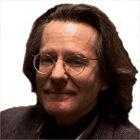
Religions don't deserve special treatment - AC Grayling


Unedited

It is time to reverse the prevailing notion that religious commitment is intrinsically deserving of respect. by Prof. AC Grayling

It is time to reverse the prevailing notion that religious commitment is intrinsically deserving of respect, and that it should be handled with kid gloves and protected by custom and in some cases law against criticism and ridicule.

It is time to refuse to tip-toe around people who claim respect, consideration, special treatment, or any other kind of immunity, on the grounds that they have a religious faith, as if having faith were a privilege-endowing virtue, as if it were noble to believe in unsupported claims and ancient superstitions. It is neither. Faith is a commitment to belief contrary to evidence and reason, as between them Kierkegaard and the tale of Doubting Thomas are at pains to show; their example should lay to rest the endeavours of some (from the Pope to the Southern Baptists) who try to argue that faith is other than at least non-rational, given that for Kierkegaard its virtue precisely lies in its irrationality.

On the contrary: to believe something in the face of evidence and against reason - to believe something by faith - is ignoble, irresponsible and ignorant, and merits the opposite of respect. It is time to say so.

It is time to demand of believers that they take their personal choices and preferences in these non-rational and too often dangerous matters into the private sphere, like their sexual proclivities. Everyone is free to believe what they want, providing they do not bother (or coerce, or kill) others; but no-one is entitled to claim privileges merely on the grounds that they are votaries of one or another of the world's many religions.

And as this last point implies, it is time to demand and apply a right for the rest of us to non-interference by religious persons and organisations - a right to be free of proselytisation and the efforts of self-selected minority groups to impose their own choice of morality and practice on those who do not share their outlook.

Doubtless the votaries of religion will claim that they have the moral (the immoral) choices of the general population thrust upon them in the form of suggestive advertising, bad language and explicit sex on television, and the like; they need to be reminded that their television sets have an off button. There are a number of religious TV channels available, one more emetic than the next, which I do not object to on the grounds of their existence; I just don't watch them.

These remarks will of course inflame people of religious faith, who take themselves to have an unquestionable right to respect for the faith they adhere to, and a right to advance, if not indeed impose (because they claim to know the truth, remember) their views on others. In the light of history and the present, matters should perhaps be to the contrary; but stating that religious commitment is not by itself a reason for respect is not to claim that it is a reason for disrespect either. Rather, as it is somewhere written, "by their fruits ye shall know them"; it is this that far too often provides grounds for disrespect of religion and its votaries.

The point to make in opposition to the predictable response of religious believers is that human individuals merit respect first and foremost as human individuals. Shared humanity is the ultimate basis of all person-to-person and group-to-group relationships, and views which premise differences between human beings as the basis of moral consideration, most especially those that involve claims to possession by one group of greater truth, holiness, or the like, start in absolutely the wrong place.

We might enhance the respect others accord us if we are kind, considerate, peace-loving, courageous, truthful, loyal to friends, affectionate to our families, aspirants to knowledge, lovers of art and nature, seekers after the good of humankind, and the like; or we might forfeit that respect by being unkind, ungenerous, greedy, selfish, wilfully stupid or ignorant, small-minded, narrowly moralistic, superstitious, violent, and the like. Neither set of characteristics has any essential connection with the presence or absence of specific belief systems, given that there are nice and nasty Christians, nice and nasty Muslims, nice and nasty atheists.

That is why the respect one should have for one's fellow humans has to be founded on their humanity, irrespective of the things they have no choice over - ethnicity, age, sexuality, natural gifts, presence or absence of disability - and conditionally (ie. not for intrinsic reasons) upon the things they choose - political affiliation, belief system, lifestyle - according to the case that can be made for the choice and the defence that can be offered of the actions that follow from it.

It is because age, ethnicity and disability are not matters of choice that people should be protected from discrimination premised upon them. By contrast, nothing that people choose in the way of politics, lifestyle or religion should be immune from criticism and (when, as so often it does, it merits it) ridicule.

Those who claim to be "hurt" or "offended" by the criticisms or ridicule of people who do not share their views, yet who seek to silence others by law or by threats of violence, are trebly in the wrong: they undermine the central and fundamental value of free speech, without which no other civil liberties are possible; they claim, on no justifiable ground, a right to special status and special treatment on the sole ground that they have chosen to believe a set of propositions; and they demand that people who do not accept their beliefs and practices should treat these latter in ways that implicitly accept their holder's evaluation of them.

A special case of the respect agenda run by religious believers concerns the public advertisement of their faith membership. When people enter the public domain wearing or sporting immediately obvious visual statements of their religious affiliation, one at least of their reasons for doing so is to be accorded the overriding identity of a votary of that religion, with the associated implied demand that they are therefore to be given some form of special treatment including respect.

But why should they be given automatic respect for that reason? That asserting a religious identity as one's primary front to the world is divisive at least and provocative at worst is fast becoming the view of many, although eccentricities of dress and belief were once of little account in our society, when personal religious commitment was more reserved to the private sphere - where it properly belongs - than its politicisation of late has made it. From this thought large morals can be drawn for our present discontents.

But one part of a solution to those discontents must surely be to tell those who clamour for a greater slice of public indulgence, public money and public respect, that their personal religious beliefs and practices matter little to the rest of us, though sometimes they are a cause of disdain or amusement; and that the rest of us are as entitled not to be annoyed by them as their holders are entitled to hold them. But no organised religion, as an institution, has a greater claim to the attention of others in society than does a trade union, political party, voluntary organisation, or any other special interest group - for "special interest groups" are exactly what churches and organised religious bodies are.

No one could dream of demanding that political parties be respected merely because they are political parties, or of protecting them from the pens of cartoonists; nor that their members should be. On the contrary. And so it should be for all interest groups and their members, without exception.

Comments by Guardian readers

Here are a few of the hundreds of comments:

Comment No. 261336 October 19 16:11

At last, atheists awake from their slumber. Dawkin's has really stuck a chord with his new book (I see Anthony has read it). Let's hope we finally assert ourselves and challenge religious dogma where we see it.


GBR

Hurrah! I was having this very discussion the other day. Why do beliefs that are based on science come second to any beliefs that by definition have no scientific backing? It seems you can question anybody's beliefs, unless they believe in some kind of supernatural entity and a moral code laid down a couple of thousand years ago, at which point they (the beliefs) must automatically be respected and shown deference...


GBR

'...Faith is a commitment to belief contrary to evidence and reason...'
No, better to say faith is commitment to an opinion held piously. It's the piety bit that usually gets in the way of reason. It makes people think they can manage without reason, and that they are somehow virtuous for calling their belief or opinion 'faith'. It's this self-righteousness that leads to all the silly clothes, incense, belief in their own humility, acceptance of a jolly important Creator and so on.


You took your time this has been bubbling under for weeks, thank you oh so much. Let battle royale commence.

Religion is hard-wired into our brains, making it difficult for people to think outside of that paradigm. Religion is brainwashing, as with all ideologies a certain way of thinking is expected.

Religous scripts have been doctored time and again to fit contemporaneous society.

How many versions of the bible are there?

These people deserve protection from this ludicrous and ultimately destructive mental malaise of faith.

Look at those with the niqab, those with cross, those with the skullcap, they ahve a right to exist but please understand you have been brainwashed. You have a culture that I will defend with my life, but your superstitions, the earth 6000 years old, get off that cloud cuckoo.

Weak minds, unsure people accrete around poles of certainty, and religion masquerades as fact.

If it were not for religion though, the mental hospitals would be fuller. So there is a trade off.


Thank you again, though you took your bloody time.


GBR

If people want to dress up in funny clothes and speak in strange made-up languages the only sensible response is to laugh at them. There is no reason why we should find Trekkies speaking in 'Klingon' and less ridiculous than evangelists babbling in 'tongues'.

Why should fictional characters like 'Jesus' or 'Mohammed' to be treated any differently from King Arthur or Captain Kirk?


GBR

Spot on, wonderful comment piece. Religion should be a matter of private, and individual, conscience, and should not be imposed on those of us who are able to live quite happy and moral lives without it.


IRL

Belief in God should not confer any more moral authority on a population than belief in the fairies at the bottom of the garden (thanks Dawkins). The media could help - why when there is a "moral" debate do the media look to religious figures for comment. Why are they especially qualified? What about going to the sociologists instead? Let's put some faith in science and the well-educated. Those are the peers we should look to for good debate every time.

There is a middle ground to be won over; the strong atheists and agnostics just have to stand up and be counted. Well done AC Grayling.


Excellent piece.

I think some people here fail to distinguish between respecting people's right to practise their religion and respecting their religious beliefs. Two different things. Of course if you want to believe that God came to earth 2000 years ago to save all who believed in him, then please do so, but don't expect to be able to ban tv programmes that offend you, have automatic representation in the House of Lords, or receive state funding for your schools. Or, indeed, receive universal murmurs of admiration for your piety.


GBR

About time that someone said this.

As a rationalist scientific athiest I find the idea that people who believe something because God says so foolish.

I find the phrase "faith school" an oxymoron. Either you learn or you are indoctorated, you can't do both.

I do not think that belief should be irradicated, but should be taught in the same way that we learnt about Classical Greece or Roman times. You need to know ABOUT them, but not believe them.

I personally NEVER use the phase "I belive" as a matter of priciple. When I find I am about to say it, I don't use it as a shorthand for "I think that the arguments suggest.." because people of faith think that their foolish subjigation to a book is on the same par as centurys of reasoned thought and argument.


The Sickness of Secularism

Seems that the voice of secularism / humanism / atheism is being heard loud and clear by the religious. My comments in Red

The threat to tolerance and coexistence no longer comes from religion.

by Soumaya Ghannoushi

"We are witnessing the rise of an arrogant secularist rhetoric founded on belief in the supremacy of reason and absolute faith in science and progress.

These high priests of rationality, who in Britain include in their ranks such names as Richard Dawkins and Anthony Grayling have erected a world of dichotomies, borders and fences: secular v religious, rationality v superstition, progress v backwardness, public v private

... today's self- proclaimed guardians of enlightenment and rationality are offshoots of the intellectual poverty of eighteenth century positivism and scienticism, who disfigure philosophy and thought, history and reality.

Why are there views disfiguring? read above as: I don't agree with what they say.

They are the victims of what may be referred to as a sick secularist consciousness.

Are the religious victims of a sick religious consciousness?

Just as they simplify the breathtakingly complex phenomenon that is the human being,

Dawkins and Grayling dont do this.

these missionaries of secularism impoverish the social order, filling it with sacred boundaries between the private and the public, and strictly laying down what may and may not be practiced in each.

why should i or my children be exposed to religious superstitions? Why should religion have so many privelages in todays society?

You may indulge in your religious "superstitions" behind the thick closed doors of your home, church, temple, or mosque. But the moment you step outside into the light of the secular sphere, you must discard your cross, turban, or headscarf. Communication, they insist, is only possible within uniformity. Such was the argument used in France to ban the Islamic headscarf in schools and government offices last year, and which is gaining currency in Britain today.

Secularist dogmatism is no less dangerous than its religious sibling.

for dogmatism read fundamentalism.

Secularism itself can be, and indeed has been in many historical instances, highly destructive. We should remember that Europe's modern history is scarred with the brutality of secular totalitarianism. Neither the Jacobins, fascists, Nazis or Stalinists were priests or theologians. They were fanatical secularists who worshipped in reason's grand temple and sacrificed hundreds of thousands for the god of progress, fervently vowing to create a new man and a new world on the ruins of the old.

the religious are deluded.

With the retreat of Christianity and shrinking of the ecclesiastical institution in Western Europe, the threat to tolerance and coexistence no longer comes from religion. What we should be dreading today is the tyranny of an arrogant secularism

religion can be tyrannical

which hides its exclusionist and intolerant face behind the sublime mask of reason, enlightenment and progress. "

so what is wrong with reason and the scientific method? Are not reason & science the best ways to understand the world? Should the delusion of "Faith" and "Belief in God" be replaced by "Reason" and "Science" today?

Now read the
article by Anthony Grayling

Debunking Christianity

Debunking Christianity says "This Blog has been created for the express purpose of debunking Evangelical Christianity. We are all ex-Christians. Most of us are ex-ministers, and even ex-apologists for the Christian faith. We are now freethinkers, skeptics, agnostics, and atheists. With the diversity of our combined strengths, we seek to debunk Christianity."

For example read the extremely well written and powerful blog by Teresa: "I was a pastor’s wife. I lived a Christian life. I did the Christian things. I believed the Christian doctrine. I did it all. I believed it all. Now I am not a pastor’s wife. I do not lead a Christian life. I do not believe the Christian doctrine. This is my journey...."

Sunday, November 12, 2006

The FreeThinker - The voice of atheism since 1881

I was introduced to the The FreeThinker magazine by NSS President Dennis Cobell yesterday at the Dorset Humanists meeting.

Thanks Dennis.

Humanist Cards


Saturday, November 11, 2006

Dennis Cobell Meeting at Dorset Humanists & The National Secular Society


At the Dorset Humanists meeting in Bournemouth on 11th November Dennis Cobell gave a talk on the National Secular Society (NSS). He is the 10th President of NSS and described himself as a Secular Humanist. He is a member of both BHA (British Humanist Association) and NSS.

The weekly NSS Newsline is edited by Terry Sanderson (who should soon be the 11th President) and includes a database of articles in magazines & newspapers.


The NSS helped to defeat the Incitement to Religious Hatred bill. I note that NSS has a similar outlook as Comedian and actor Rowan Atkinson who branded as "draconian" plans to make incitement to religious hatred illegal. "In a democracy there is no right not to be offended" Shami Chakrabarti.


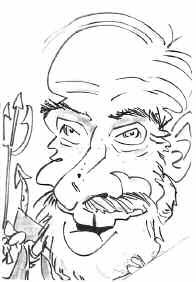
The Prophet is not the only one to
be caricatured – when the
President recently spoke this is
how one listener saw him… with
a devil’s trident! (source: NSS Annual Report 2006)

The NSS is opposed to Faith Schools. School entry criteria based on religion must be reduced and eventually eliminated. 16 year olds students now (as parents already have) have the right to opt of out Religious Education lessons.

Nicolas Walter (editor, New Humanist) has defined Secularism as "this life is all we know. Their is no evidence for any other world. One world is quite enough to deal with any one time, in any case". (this quote needs verifying)

When BNP Leader Nick Griffin told a crowd Islam was a "wicked, vicious faith", he had no idea his speech was being secretly captured on camera by the BBC. Nick Griffen has been acquitted of race hate offenses. I note that he has maintained his words were intended not to stir up racial hatred but to motivate already like-minded people to get involved in the party. Judge Norman Jones QC said a democratic society gave its citizens the right to free speech. He said: "That does not mean it is limited to speaking only the acceptable, popular or politically correct things."

The NSS advocates that ALL weddings be Civil weddings but that in addition a separate ceremony could include religious or humanist content.

The NSS publishes The Bulletin three times a year.

The "non belief in the supernatural" is an issue that a minority of NSS members want to exclude from the NSS "constitution". This was not discussed further at this meeting but is clearly a crucial issue for NSS.

It is unlikely that NSS & BHA will merge. This proposal has been rejected by both organisations in the past.

Securalist of the Year
Professor Steve Jones, the scientist & geneticist, has recently been giving a lecture around the country entitled “Why evolution is right and creationism is wrong.” He was awarded the "Secularist of the Year" prize in October 2006 by NSS. I note that Jones has offended some Christians with his allegations that Creationism is "anti-science". This brings him into direct opposition with proponents of Creationism like Ken Ham (who Jones publicly criticised) who argue that evolution is hypothesis, not science. Jones suggested in a BBC Radio Ulster interview on 19 March 2006 that Creationists should be disallowed from being medical doctors because "all of its (Creationism's) claims fly in the face of the whole of science", and disputes the claim that anyone who believes in Biblical Creation can be a serious biologist.

Cobell mentioned that Dorset Humanists could consider affiliating to the NSS just as they were affiliated to British Humanists. I note that South Hampshire Humanists affiliate to both groups.

Questions from the Floor
Chris Street asked Cobell "Was not the ongoing Evolution v Creationism Scientifhc debate important and what was the NSS view of Science in relation to Religion? Chris stated that he believed that Science (in the words of Lewis Wolpert) is the Best Way of Understanding the World.

?? Asked: What were the differances between NSS and BHA. Cobell said the NSS focuses on challenging religious privaleges and promoting the separation of Church & State whilst BHA focuses on officiation at Humanist Ceremonies (Namings, Weddings and Deaths). The NSS has 2500 members and BHA 5000 members. Membership of both groups has grown significantly recently.

From the
National Secular Society website

(this section needs editing)

We want a society in which all are free to practise their faith, change it or not have one, according to their conscience. Our belief or lack of it should neither advantage or disadvantage. Religion should be a matter of private conscience, for the home and place of worship; it must not have privileged input into the political arena where history shows it to bring conflict and injustice.

The National Secular Society is the leading pressure group defending the rights of non-believers from the demands of religious power-seekers. We campaign on a wide range of issues, including religious influence in the government, the disestablishment of the Church of England, the removal of the Bench of Bishops from the House of Lords and for conversion of religious schools (paid for by the taxpayer) to community schools, open to all.

Additionally:

  1. We fight to protect free expression from attacks by religious groups, often keen to restrict comment about, and examination of, their activities.
  2. We want the blasphemy law to be abolished and artistic expression to be protected from religious censors.
  3. We lobby the BBC to reduce the amount religious propaganda paid for by license-payers, very few of whom are interested.
  4. We want to ensure that human rights always come before religious rights, and to fight the massive exemptions religious bodies are granted from discrimination laws that everyone else has to observe. The NSS was prominent in the campaign to frustrate religious bodies’ attempts to opt out of the Human Rights Act – we fought to limit exemptions in the employment discrimination legislation and other equality law.

Even now the government seems anxious to increase religious involvement in public life. Each increase disadvantages those who have no religion.

Only by secularising our institutions can we ensure that no religious ideology can dominate and discriminate against others.

The NSS was founded in 1866 by Charles Bradlaugh. A message from Claire Rayner.

General Principles
  • Secularism affirms that this life is the only one of which we have any knowledge and human effort should be directed wholly towards its improvement.
  • Affirming that morality is social in origin and application, Secularism aims at promoting the happiness and well-being of mankind. Secularism demands the complete separation of Church and State and the abolition of all privileges granted to religious organisations.
  • Secularism affirms that progress is possible only on the basis of equal freedom of speech and publication; that the free criticism of institutions and ideas is essential to a civilised state.
  • It asserts that supernaturalism is based upon ignorance and assails it as the historic enemy of progress.
  • It seeks to spread education, to promote the fraternity of all peoples as a means of advancing universal peace to further common cultural interests and to develop the freedom and dignity of mankind.
  • To remove an impediment to these objectives, we demand the complete separation of Church and State and the abolition of all privileges granted to religious organisations.

Those of us who value reason are becoming alarmed about the increasingly extreme religious influence in our government, our lawmakers, and our public institutions - especially in our education system. Many people, while standing up for freedom of religion, and freedom not to believe, feel that the proper place for religion is in the place of worship or home. They see the danger of religion becoming too politically ambitious.

The NSS is a rallying point for opposition to this religious resurgence. We must convince our politicians and public servants - as well as our friends, neighbours and colleagues - that our institutions and public life should be secular. A secular state should guarantee freedom of conscience, but eliminate religious privilege.

The only way to prevent the kind of religious power-seeking that leads to conflict is to make both religious discrimination and religious privilege constitutionally impossible.

We need a secular constitution that will:

  • End the privileged input of religious bodies to policy making and law-making
  • Keep all public services free from religious control so that that they remain equally available to all on the same terms
  • Abolish the established church and all its privileges (including 26 bishops in the House of Lords)
  • Put an end to the divisiveness of publicly funded religious schools by making them open to all without discrimination on grounds of religion, or lack of it, and bringing them under local authority controll
  • Abolish blasphemy and similar repressive laws, rather than extend them

Religious influence in Government has not been higher in living memory. The rise of fundamentalist religion of all shades has the potential to seriously erode hard-won freedoms.

Heart disease is biggest killer

Heart disease still kills more people in England and Wales than any other condition, official figures show.

Office for National Statistics data showed one in five men and around one in six women died from heart disease, including heart attacks, in 2005. Heart Disease & Stokes - The Facts.

Diagnostic Tests for Heart Disease. Tests to establish whether people are at risk of, or have suffered, heart disease or stroke can involve chemicals being injected into the body - invasive - or readings taken externally only - non-invasive.

TOP 10 CAUSES OF DEATH IN MEN - 2005
Heart disease - 20.2%
Cerebrovascular diseases* - 7.9%
Lung cancer - 6.9%
Chronic lower respiratory disease - 5.6%
Flu/pneumonia - 5%
Prostate cancer - 3.7%
Colon cancer - 3.1%
Lymph cancers - 2.3%
Alzheimer's disease/dementia - 2.1%
Aortic aneurysm - 2%

TOP 10 CAUSES OF DEATH IN WOMEN - 2005
Heart disease - 16%
Cerebrovascular disease* - 12.9%
Flu/pneumonia - 7.9%
Alzheimer's disease/dementia - 5.2%
Chronic lower respiratory disease - 5.2%
Lung cancer - 4.9%
Breast cancer - 4.5%
Heart failure - 3%
Colon cancer - 2.7%
Urinary diseases - 2.5%


*: mainly strokes

Friday, November 10, 2006

Faith's last gasp


This article is reproduced without edits.

Despite superficial appearances of a resurgence in religious belief, we are actually witnessing the death throes of faith by AC Grayling in Prospect Magazine

On the basis of apparently incontrovertible evidence, commentators of various persuasions, among them Eric Kaufmann in Prospect, John Gray, writing recently in the New Statesman, and Damon Linker, author of The Theocons: Secular America Under Siege (Doubleday) are convinced that we are witnessing an upsurge in religious observance and influence.

Kaufmann relies on the weak argument that demographic trends will turn Europe into a predominantly religious place, John Gray seems to hope that this will be so, and Damon Linker is convinced that a “theocon” conspiracy has so successfully captured Washington that the US has become a de facto theocracy—the home of faith-based politics, faith-based science (creationism), faith-based medicine ("pro-life"), faith-based foreign policy (conducting jihad for American/Baptist values) and faith-based attacks on civil liberties. Add this to the all too obvious fact of political Islam—Islamism—and the case seems made.

But I see the same evidence as yielding the opposite conclusion. What we are witnessing is not the resurgence of religion, but its death throes. Two considerations support this claim. One is that there are close and instructive historical precedents for what is happening now. The second comes from an analysis of the nature of contemporary religious politics.

If a given interest group turns up the volume, it is usually reacting to provocation. We view the Victorian era as a sanctimonious period of improving movements such as self-help, temperance and university missions to city slums. But prudishness and do-goodery existed precisely because their contraries—poverty, drunkenness, godlessness and indecency—were endemic: some streets of Victorian London swarmed with child prostitutes, and were too dangerous to walk at night. In the same way, today’s “religious upsurge” is a reaction to the prevalence of its opposite. In fact, it is a reaction to defeat, in a war that it cannot win even if it succeeds in a few battles on the way down.

Here is what is happening. Over the last half-century, sections of the Muslim world have become increasingly affronted by the globalisation of western and especially American culture and values, which appears arrogantly to disdain their traditions. Yet latterly, some of these same sections of Islam have been emboldened by the victory of warriors of the faith over a superpower (Afghanistan’s mujahedin over Soviet Russia); the combination encourages them to assert their opposition to the engulfing encroachment of western modernity, even by taking up arms.

When a climate of heightened tension such as this prompts activists in one religious group to become more assertive, to push their way forward in the public domain to demand more attention, more respect, more public funds (faith-based schools are one example), other religious groups, not wishing to be left behind, follow suit. In Britain, Muslim activism has been quickly mimicked by others—by Sikhs demonstrating about a play, Christian evangelicals demonstrating about an opera, and all of them leaping on the funding bandwagon for faith and interfaith initiatives. To placate them, politicians lend an ear; the media report it; immediately these minorities of interest have an amplifier for their presence. The effect is that suddenly it seems as if there are religious devotees everywhere, and the spurious magnification of their importance further promotes their confidence. As a result they make some gains, as the faith schools example shows.

Yet the fact is that only 10 per cent of the British population attend church, mosque, synagogue or temple every week, and this figure is declining in all but immigrant communities. This is hardly the stuff of religious resurgence. Yes, over half the population claim vaguely to believe in Something, which includes feng shui and crystals, and they may be “C of E” in the sense of “Christmas and Easter,” but they are functionally secularist and would be horrified if asked to live according to the letter of (say) Christian morality: giving all one’s possessions to the poor, taking no thought for the morrow and so impracticably forth. Not even Christian clerics follow these injunctions. This picture is repeated everywhere in the west except the US, and there too the religious base is eroding.

The historical precedent of the counter-Reformation is instructive. For over a century after Luther nailed his theses to Wittenberg’s church door, Europe was engulfed in ferocious religious strife, because the church was losing its hitherto hegemonic grip and had no intention of doing so without a fight. Millions died, and Catholicism won some battles even as it lost the war. We are witnessing a repeat today, this time with Islamism resisting the encroachment of a way of life that threatens it, and as other religious groups join them in a (strictly temporary, given the exclusivity of faith) alliance for the cause of religion in general.

As before, the grinding of historical tectonic plates will be painful and protracted. But the outcome is not in doubt. As private observance, religion will of course survive among minorities; as a factor in public and international affairs it is having what might be its last—characteristically bloody—fling.

Thursday, November 09, 2006

Lewis Wolpert - Six Impossible Things Before Breakfast - The Evolutionary Origins of Belief - Part 1 - Introduction


Professor Lewis Wolpert FRS
Lewis Wolpert is a Rationalist who appeals to reason as a source of knowledge or justification & in which the criterion of truth is not sensory but intellectual and deductive. He is a Materialist and Vice President of the British Humanist Association . He describes himself as a Reductionist Materialist Atheist or an Atheist Reductionst Materialist (the difference escapes me). He is not religious and knows of no good evidence for God. Nor has he any beliefs in the spiritual world or paranormal happenings. A commited scientist he views science as the best way of understanding the world.

Synopsis
Why do 70 per cent of Americans believe in angels, and thousands more that they have been abducted by aliens? Why does every society around the world have a religious tradition of some sort? What makes people believe in things when all the evidence points to the contrary? Why do 13 per cent of British scientists touch wood? In "Through the Looking Glass", the White Queen tells Alice that to believe in a wildly improbable fact she simply needs to 'draw a long breath and shut your eyes'. Alice finds this advice ridiculous. But don't almost all of us, at some time or another, engage in magical thinking? Professor Lewis Wolpert investigates the nature of belief and its causes. He looks at belief's psychological basis and its possible evolutionary origins in physical cause and effect. How did toolmaking drive human evolution? Is it the lack of an explanation about fundamental questions which is truly intolerable? Are we born with an evolutionary propensity to believe in things that make us feel better? Wolpert explores the different types of belief - including that of animals, of children, of the religious, and of those suffering from psychiatric disorders. And he asks whether it is possible to live without belief at all, or whether it is a necessary component of a functioning society.

Introduction
Why is their a general absense of belief in the scientific method - verging on an anti-science movement? Surely science and the necessity for evidence is the best way to understand how the world works. By corollory why is the belief in the unbelievable so prevalent - from religion, aliens, telepathy and angels? How can people believe in something without a shred of reliable evidence? His aim is to understand what people believe about causal events (an example would be good here).

What distinguishes our thinking and beliefs from other animals and how has this been a part of evolution. How has our brain structure evolved? Our genes determine how our brains will work whilst culture, learning and nurture are of secondary importance. Evolutionary adaptiveness of the mind produces our behaviours, thoughts and beliefs helping humans to survive better.

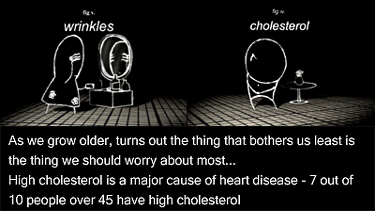
British Heart Foundation - 7 out of 10 over 45 have high cholesterol


My cholesterol level is 5.2 mmoles /Litre (Boots test) or 5.1 (GP Nurse test). British Heart Foundation say it should be <5.0>

How is cholesterol measured?

Measuring cholesterol levels involves a simple blood test. This can be done either through a full blood test or a pinprick test. It is measured in millimols per litre of blood. These tests should always be carried out by a GP or trained health professional rather than using a self test kit.

What is the ideal cholesterol level?

The BHF advises that people should have a total cholesterol level of under 5 mmol/1 and a LDL level under 3 mmol/1.

The average blood cholesterol level of people living in England is 5.5mmol/1. This is high compared to other countries. For example, in China the average is 4.5mmol/1.

Who is at risk?

Those most at risk are those people who have a high intake of saturated fat in their diets. However, you can lower your cholesterol level by reducing your saturated fat intake, increasing the amount of physical activity you do and increasing your intake of fresh fruit and vegetables.

BHF launched a campaign to highlight cholesterol - and get people to think more seriously about the health of their heart.

Today, nearly half of all deaths from coronary heart disease in Britain are due to raised cholesterol.

People should take positive steps to look after their hearts by cutting down saturated fats, increasing the amount of physical activity they take and eating more fresh fruit and vegetables.

You may have seen our adverts on TV, which show a series of animated characters worrying about the outward signs of ageing - such as getting wrinkles and loss of hair. But all of the characters show scant regard for their health - and especially their hearts. Watch the ad here.

And today ex Malaysian Prime Minister has heart attack.

Monday, November 06, 2006

Freestonia - pictures of life in a squat

Tony Sleep says:-
"In 1977, Freston Road, a squatted street in Notting Dale, West London, seceded from the United Kingdom, and appealed to the United Nations to send a peacekeeping force to prevent evictions by the Greater London Council. "

His 70 amazing pictures & documentary show life in Freestonia in the late 1970s - early 80s. Drugs, alcohol and dissolution were an ever-present dark side of Frestonian life.

Sunday, November 05, 2006

How to backup my data? - Part 1

My work and home data is in hundreds of different formats: Word documents, photos, outlook files etc. I backup 11.5GB of this type of data on my laptop. I have used an online backup service Connected DataProtector for the past eight years for all the important work and home data. All data at work is stored on one PC which uses this service. This is almost completely hassle free (set it up once and let it run automatically every night) & relatively cheap.

Recently i've upgraded, after much procrastination, from the 10GB limit (Gold $280 pa) to the 20GB limit (Gold+ $535 pa) service. But i dont want to upgrade to the 30GB limit (Platinum $800) which i consider to be too expensive.

But with 20GB backup limit I still cannot backup all 50GB+ of data. Less important ripped music (from my CDs) or movies (ripped from my DVDs) is not backed up. Connected DataProtector service would be too expensive to backup these multimedia files.

I will investigate other cheap and hassle free solutions to backup ALL my data. The criteria will be:-

  • The total cost of backing up 50GB+ work & home data should be <$500 pa
  • the backup should be as hassle free as the Connected DataProtector service.
  • have the ability to easily backup several PC at home and work

Thursday, November 02, 2006

Fingers crossed Superstitions are perfectly natural, and entirely understandable

The Times September 05, 2006

Avoided walking under any ladders lately? Tied a knot in a handkerchief? Of course you haven’t. Such beliefs are just pure superstition, touch wood.

According to Bruce Hood, Professor of Experimental Psychology at the University of Bristol, this kind of irrational behaviour is natural. Speaking at the British Association Festival of Science yesterday, he claimed that superstition is a product of evolution. Mankind is adapted to reason intuitively, to invent explanations for how the world works, which increases the odds of keeping safe. Superstitions also provide a welcome sense of control. We cross our fingers to trap the bad luck between them. We say “bless you” to stop the soul following the sneeze out of the body.

Modern members of Homo sapiens, texting on their BlackBerries while skirting round black cats, have also evolved to know that some beliefs are really just indulgent nonsense. So they cheat. See only one magpie? Look again. Horoscope bleak? Suddenly remember your birthday is close to the cusp. Is that hypocrisy, or a clever way to reconcile rationality with irrationality?

One thing is clear: the foundations of science were built on mankind’s ability to reason intuitively. Anyone who insisted on direct visible proof would have been unable, for example, to discover gravity. So we should perhaps think more kindly of human credulity. Paul Ince’s legendary insistence on being the last to leave the changing room and pull on his jersey probably had little bearing on the outcome of any particular England football games. But no doubt the habit made him feel better. So do not mock: after all the wind might change.

Evolution keeps us superstitious. Now that's lucky

The Times September 05, 2006

Professor Bruce Hood of the University of Bristol said humans have evolved into accepting superstitions such as witches (Channel 4) By Mark Henderson, Science Editor

HUMANS have evolved over tens of thousands of years to be susceptible to supernatural beliefs, a psychologist has claimed.

Religion and other forms of magical thinking continue to thrive — despite the lack of evidence and advance of science — because people are naturally biased to accept a role for the irrational, said Bruce Hood, Professor of Experimental Psychology at the University of Bristol.

This evolved credulity suggests that it would be impossible to root out belief in ideas such as creationism and paranormal phenomena, even though they have been countered by evidence and are held as a matter of faith alone.

People ultimately believe in these ideas for the same reasons that they attach sentimental value to inanimate objects such as wedding rings or Teddy bears, and recoil from artefacts linked to evil as if they are pervaded by a physical “essence”.

Even the most rational people behave in irrational ways and supernatural beliefs are part of the same continuum, Professor Hood told the British Association Festival of Science in Norwich yesterday.

To demonstrate his theory he asked members of the audience if they were prepared to put on an old-fashioned blue cardigan in return for a £10 reward. He had no shortage of volunteers. He then told the volunteers that the cardigan used to belong to Fred West, the mass murderer.

“Most hands went down,” he said.

“When people did wear it people moved away from them. It’s not actually West’s jumper. But it’s the belief that it’s West’s jumper that has the effect.

“It is as if evil, a moral stance defined by culture, has become physically manifest inside the clothing.”

Similar beliefs, which are held even among the most sceptical scientists, explain why few people would agree to swap their wedding rings for replicas. The difference between attaching significance to sentimental objects and believing in religion, magic or the paranormal is only one of degree, Professor Hood said.

These tendencies, he said, were almost certainly a product of evolution. The human mind is adapted to reason intuitively, so that it can generate theories about how the world works even when mechanisms cannot be seen or easily deduced.

While this is ultimately responsible for scientific thinking, as in the discovery of invisible forces such as gravity, it also leaves people prone to making irrational errors. “In most cases, intuitive theories capture everyday knowledge, such as the nature and properties of objects, what makes something alive, or the understanding that people’s minds motivate their actions,” Professor Hood said.

“But because intuitive theories are based on unobservable properties, such theories leave open the possibility of misconceptions. I believe these misconceptions of naive intuitive theories provide the basis of many later adult magical beliefs about the paranormal.”

This innate tendency means it is futile to expect that such beliefs will die out even as our scientific understanding of the world improves, he said. “The mind is adapted to reason intuitively about the properties of the world. Because we operate intuitively, it is probably pointless to get people to abandon belief systems.

“No amount of evidence is going to get people to take it on board and abandon these ideas.”

Credulous minds may have evolved for several reasons. It was once less dangerous to accept things that were not true than it was to reject real facts, such as the threat posed by a nearby predator. This may have predisposed humans to err on the side of belief. Superstition may also give people a sense of control that can reduce stress.

“I don’t think we’re going to evolve a rational mind because there are benefits to being irrational,” said Professor Hood. “Superstitious behaviour — the idea that certain rituals and practices protect you — is adaptive.

“If you remove the appearance that they are in control, both humans and animals become stressed. During the Gulf War, in 1991, in areas attacked by Scud missiles there was a rise in superstitious belief.

“I want to challenge recent claims by Richard Dawkins, among others, that supernaturalism is primarily attributable to religions spreading beliefs among the gullible minds of the young. Rather, religions may simply capitalise on a natural bias to assume the existence of supernatural forces.”

Tuesday, October 31, 2006

The animal roots of human morality


Dominic says Alex Coleman does not believe the god bits in the Bible - but he does believe in the morality. So are religious texts the root of all human morals? No!

In New Scientist (14 October 2006, pg 60) Frans de Waal argues that animals have an inbuilt sense of fair play and show compassion to others in their group.

Emotions nudge an organism towards rapid decisions based on millions of years of evolution, and provide a window on behavioural adaptation. This even holds for human morality.

If it is true that morality is reasoned from abstract principles, why do our judgements often come instantly? We often make snap moral judgements that seem to come from the "gut".

I don't claim that monkeys and apes are moral beings, but I do believe that human morality is on a continuum with animal sociality. Charles Darwin saw it this way. In The Descent of Man he wrote: "Any animal whatever, endowed with well-marked social instincts... would inevitably acquire a moral sense or conscience, as soon as its intellectual powers had become as well developed, or nearly as well developed, as in man."

It is not hard to recognise the two pillars of human morality in the behaviour of other animals. These pillars are elegantly summed up in the golden rule that transcends the world's cultures and religions: "Do unto others as you would have them do unto you." This unites empathy (attention to another's feelings) with reciprocity (if others follow the same rule, you too will be treated well). Human morality as we know it is unthinkable without empathy and reciprocity.

These tendencies are widespread in other primates, too. For example, it is not uncommon that, after one chimpanzee has attacked another, a bystander will go over to embrace the victim. We have documented hundreds of cases. The usual effect of such consolation is that the screaming, yelping and other signs of distress stop. In fact, the tendency to reassure others is so strong that Nadia Ladygina-Kohts, a Russian scientist who raised a juvenile chimp a century ago, said that if her charge escaped to the roof of her house, holding out food would not make him come down. The only way was to sit and sob as if she were in pain, whereupon the young ape would rush down to put an arm around her, a worried expression on his face. This attests to the power of the empathic tendency in our close relatives: it beats the desire for a banana.

“It is not uncommon after one chimp has attacked another for a bystander to embrace the victim”

Reciprocity can be seen in our own experiments on captive chimpanzees when we give an individual food to divide with others. Before doing so, we measure spontaneous grooming: who grooms whom for how long. Grooming is a pleasurable, relaxing activity, and being groomed is much appreciated. We found that if one chimpanzee had groomed another, this greatly improved his chances of getting a share of the food from the groomee. In other words, chimpanzees remember who has groomed them, and return the favour later. Like humans, they seem to keep track of incoming and outgoing services.

Humans enforce social norms that dictate how we treat others and promote communal interests, but at morality's core we find an ancient primate psychology. This is quite different from the idea that morality goes against human nature, a view I dub "veneer theory". Veneer theorists argue that our moral lives are a thin crust that barely covers our inborn nastiness and selfishness: the only reason we act morally is to avoid punishment and impress each other. For three decades, this curiously non-evolutionary explanation has been promoted by biologists and science writers alike. It is best captured in the quip by biologist Michael Ghiselin from the California Academy of Sciences: "Scratch an 'altruist', and watch a 'hypocrite' bleed."

One of the momentous developments of our time is the effort to wrest morality from Kantian philosophy and put it back in touch with evolution. This effort is not only supported by studies of cooperative behaviour among animals but also by modern neuroscience. Whereas veneer theory attributes moral problem-solving to the latest additions to our brain such as the prefrontal cortex, imaging human brains has shown that moral dilemmas activate a wide variety of areas, some of them present in all mammals and closely tied to the emotions. Recent research at McGill University in Montreal, Canada, shows that empathy may exist in mice - which only goes to show how old these tendencies may be.

There is also continuity between humans and animals when it comes to social rules. When Sarah Brosnan in the Yerkes National Primate Research Center in Atlanta, Georgia, divided rewards, she found that monkeys had a crude sense of fairness. One monkey will throw away a perfectly fine reward that she normally relishes if she sees her companion getting an even better one. By investigating the expectations primates hold about each other, we may find we are not alone in judging some social situations to be unacceptable.

To show that even social rule enforcement is not beyond non-human animals, let me recount a fascinating situation that I witnessed years ago at Arnhem Zoo in the Netherlands. One balmy evening, when the keeper called the large chimpanzee colony inside, two adolescent females refused to enter the building. The weather was superb, they had the whole island to themselves and were loving it. The zoo's rule was that none of the apes would get fed until they had all moved inside. The obstinate teenagers threw the rest of the group into a grumpy mood. When they finally came in, they were assigned a separate bedroom by the keeper to prevent reprisals.

This protected them only temporarily, though. The next morning, out on the island, the entire colony vented its frustration about the delayed meal by a mass pursuit ending in a beating for the culprits. That evening, the same two females were the first to come in.

More... Primates and Philosophers: How Morality Evolved by Frans De Waal

Thursday, October 19, 2006

The Complete Works of Charles Darwin Online


BBC News Science review

WELCOME to the largest collection of Darwin's writings ever assembled. For a basic, non-academic, entryway click here. For a complete list click contents.

This site currently contains more than 50,000 searchable text pages and 40,000 images of both publications and handwritten manuscripts. There is also the most comprehensive Darwin bibliography ever published and the largest manuscript catalogue ever assembled. More than 150 ancillary texts are also included, ranging from secondary reference works to contemporary reviews, obituaries, published descriptions of Darwin's Beagle specimens and important related works for understanding Darwin's context.

Wednesday, October 18, 2006

2 portions per week of oily fish provides Omega-3 Fatty Acids - Live 17% Longer!


Eating
1-2 servings per week oily fish reduces the risk of coronary death by 36% and total mortality by 17%. Intake of 250 mg/day of Omega-3 Fatty Acids (EPA & DHA) is sufficient for primary prevention of Coronary Heart Disease.


contains sufficient Omega-3 fatty acids if taken daily:  EPA 351mg, DHA 234mg
Cost: £18 for 60 capsules taken once a day.
http://www.boots.com/en/Boots-Pharmaceuticals-Omega-3-Fish-Oil-1300mg-30-Capsules-_1139898/

Oily fish (salmon, mackerel, sardines, trout, tuna, mussels, oysters, anchovy, herring, crab) is very good for your heart. Eating fish means you could live 17% longer!

The Harvard School of Public Health reviewed existing studies (15 page Review - Full Text pdf) that looked at the health effects of eating fish.
The benefits of eating a modest amount of fish per week - 2 portions —about 3 ounces (90g) of farmed salmon or 6 ounces (180g) of mackerel - reduce the risk of death from coronary heart disease (CHD) by 36%. 180g of mackerel is about half a pound and costs £3. The benefit was related to the level of intake of omega-3 fatty acids, and thus benefits are greater for oily fish (e.g. salmon, bluefish), which are higher in beneficial omega-3 fatty acids, than lean fish (haddock, cod).
Some types of shellfish contain more omega 3 than others. For example, crab and mussels are quite good sources of omega 3, but prawns contain hardly any. Oily fish are the best sources of omega 3 according to UK Food Standards Agency.
You can check which fish are oily and which aren't in the table below:


Oily / fatty fish White / non-oily fish
Salmon Trout Mackerel Herring Sardines Pilchards Kipper Eel Whitebait Tuna* (fresh only - not tinned) Anchovies Swordfish Bloater Cacha Carp Hilsa Jack fish Katla Orange roughy Pangas Sprats Cod Haddock Plaice Coley Whiting Lemon sole Skate Halibut Rock salmon/Dogfish Ayr Catfish Dover sole Flounder Flying fish Hake Hoki John Dory Kalabasu Ling Monkfish Parrot fish Pollack Pomfret Red and grey mullet Red fish Red snapper Rohu Sea bass Sea bream Shark Tilapia Turbot Tinned tuna Marlin

*Fresh tuna is an oily fish and is high in omega 3 fatty acids. But when it's canned, these fatty acids are reduced to levels similar to white fish so doesn't count as oily fish.

How much oily fish?

Most people should be eating more oily fish because omega 3 fatty acids are very good for our health. However, oily fish can contain low levels of pollutants that can build up in the body. For this reason there are recommendations for the maximum number of portions of oily fish we should be eating each week (a portion is about 140g):


mg EPA+DHA

per 100g fish
g fish per week for

1750mg EPA+DHA*
salmon (farmed) 2648 66
anchovy 2055 85
herring (atlantic) 2014 86
mackerel (atlantic) 1203 145
salmon (wild) 1043 167
sardines 982 178
trout 935 187
tuna (white, albacore) 862 203
mussels 782 223
oysters 688 254
halibut 465 376
crab 413 423
mackerel (king) 401 436
tuna (light, skipjack) 270 648
cod (atlantic) 158 1107

*: 250mg per day = 1750mg per week = recommended EPA+DHA


The Harvard review also demonstrated that intake of fish or fish oil reduces total mortality—deaths from any causes--by 17%.

More than two decades ago, pioneering studies showed that Greenland Eskimos, who consumed high amounts of omega-3 fatty acids from seafood, had very low rates of CHD death. Some studies have shown that PCBs and dioxins may be carcinogenic. The authors found that the benefits of eating fish far outweighed the potential cancer risks from these chemicals.
The benefits of eating one to two servings of fish a week greatly outweigh the risks among adults and, except for a few species of fish, women of child-bearing age. Seafood is likely the single most important food one can consume for good health said Mozaffarian.
The UK Food Standards Agency advise eating two servings of fish a week - one of these servings should be oily fish.

What levels of omega-3 fatty acids are in seafood?
In Wikipedia article - the 3 refers to the first carbon atom (red numbers) from the omega end of a polyunsaturated fatty acid that contains a double bond. Chemists (blue numbers) use reverse numbering from the carbonyl group.


Important omega-3 fatty acids in human nutrition are: α-linolenic acid (above) (18:3, ALA), eicosapentaenoic acid (20:5, EPA), and docosahexaenoic acid (22:6, DHA). These three polyunsaturates have either 3, 5 or 6 double bonds in a carbon chain of 18, 20 or 22 carbon atoms, respectively. All double bonds are in the cis-configuration, i.e. the two hydrogen atoms are on the same side of the double bond.
In Haliborange high DHA concentration Omega-3 fish oil (& Boots Smart Omega-3 Fish oil) each capsule contains 100mg DHA and 28mg EPA. Two capsules are recommended per day.
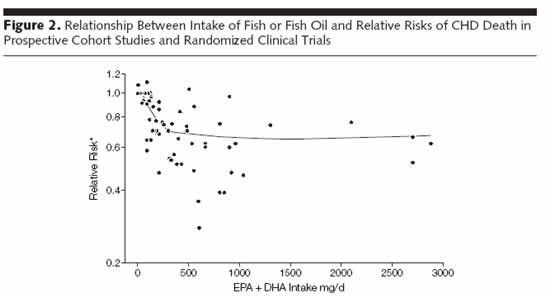
Mozaffarian say Intake of 250 mg/day of EPA and DHA appears sufficient for primary prevention (ie. 2 capsules of Haliborange or 10oz/week of canned tuna or equivalent) See Figure 2 & 6 top of page):-
Modest consumption of fish (eg, 1-2 servings/wk), especially
species higher in the n-3 fatty acids eicosapentaenoic acid (EPA) and docosahexaenoic acid (DHA), reduces risk of coronary death by 36% (95% confidence interval, 20%-50%; P .001) and total mortality by 17% (95% confidence interval, 0%-32%; P=.046) and may favorably affect other clinical outcomes. Intake of 250 mg/day of EPA and DHA appears sufficient for primary prevention.
What is the effect of Omega-3 fatty acids?
Omega-3 FA influence several cardiovascular risk factors and give altered membrane fluidity
and receptor responses following incorporation of (n-3 Poly Unsaturated Fatty Acids
n-3 PUFAs ) into cell membranes and direct binding of n-3 PUFAs to intracellular receptors regulating gene transcription. At typical dietary intakes, antiarrhythmic effects predominate, reducing risk of sudden death and CHD death within weeks by (1) modulation of myocardial sodium and calcium ion channels, reducing susceptibility to ischemia-induced arrhythmia and (2) reduced left ventricular workload and improved myocardial efficiency as a result of reduced heart rate, lower systemic vascular resistance, and improved diastolic filling.
n-3 PUFAs reduced total mortality by 17%. This can be compared to effects of statins on total mortality - a 15% reduction.
Avoidance of modest fish consumption due to confusion regarding risks and benefits could result in thousands of excess CHD deaths annually and suboptimal neurodevelopment in children.

Monday, October 16, 2006

National Secular Society

I visited the NSS website and extracted this info from it:-


About the National Secular Society

We want a society in which all are free to practise their faith, change it or not have one, according to their conscience. Our belief or lack of it should neither advantage or disadvantage. Religion should be a matter of private conscience, for the home and place of worship; it must not have privileged input into the political arena where history shows it to bring conflict and injustice.

The National Secular Society is the leading pressure group defending the rights of non-believers from the demands of religious power-seekers. We campaign on a wide range of issues, including religious influence in the government, the disestablishment of the Church of England, the removal of the Bench of Bishops from the House of Lords and for conversion of religious schools (paid for by the taxpayer) to community schools, open to all.

Additionally:

  1. We fight to protect free expression from attacks by religious groups, often keen to restrict comment about, and examination of, their activities.
  2. We want the blasphemy law to be abolished and artistic expression to be protected from religious censors.
  3. We lobby the BBC to reduce the amount religious propaganda paid for by license-payers, very few of whom are interested.
  4. We want to ensure that human rights always come before religious rights, and to fight the massive exemptions religious bodies are granted from discrimination laws that everyone else has to observe. The NSS was prominent in the campaign to frustrate religious bodies’ attempts to opt out of the Human Rights Act – we fought to limit exemptions in the employment discrimination legislation and other equality law.

Even now the government seems anxious to increase religious involvement in public life. Each increase disadvantages those who have no religion.

Only by secularising our institutions can we ensure that no religious ideology can dominate and discriminate against others.

More Information

The NSS was founded in 1866 by Charles Bradlaugh. A message from Claire Rayner.

The National Secular Society’s General Principles

  • Secularism affirms that this life is the only one of which we have any knowledge and human effort should be directed wholly towards its improvement.
  • Affirming that morality is social in origin and application, Secularism aims at promoting the happiness and well-being of mankind. Secularism demands the complete separation of Church and State and the abolition of all privileges granted to religious organisations.
  • Secularism affirms that progress is possible only on the basis of equal freedom of speech and publication; that the free criticism of institutions and ideas is essential to a civilised state.
  • It asserts that supernaturalism is based upon ignorance and assails it as the historic enemy of progress.
  • It seeks to spread education, to promote the fraternity of all peoples as a means of advancing universal peace to further common cultural interests and to develop the freedom and dignity of mankind.
  • To remove an impediment to these objectives, we demand the complete separation of Church and State and the abolition of all privileges granted to religious organisations.

Welcome

Those of us who value reason are becoming alarmed about the increasingly extreme religious influence in our government, our lawmakers, and our public institutions - especially in our education system. Many people, while standing up for freedom of religion, and freedom not to believe, feel that the proper place for religion is in the place of worship or home. They see the danger of religion becoming too politically ambitious.

The NSS is a rallying point for opposition to this religious resurgence. We must convince our politicians and public servants - as well as our friends, neighbours and colleagues - that our institutions and public life should be secular. A secular state should guarantee freedom of conscience, but eliminate religious privilege.

The only way to prevent the kind of religious power-seeking that leads to conflict is to make both religious discrimination and religious privilege constitutionally impossible.

We need a secular constitution that will:

  • End the privileged input of religious bodies to policy making and law-making
  • Keep all public services free from religious control so that that they remain equally available to all on the same terms
  • Abolish the established church and all its privileges (including 26 bishops in the House of Lords)
  • Put an end to the divisiveness of publicly funded religious schools by making them open to all without discrimination on grounds of religion, or lack of it, and bringing them under local authority controll
  • Abolish blasphemy and similar repressive laws, rather than extend them

Religious influence in Government has not been higher in living memory. The rise of fundamentalist religion of all shades has the potential to seriously erode hard-won freedoms.

Individually, we can only look on with mounting fear, but working together we can make a difference. Join the fight for a truly secular society and join the National Secular Society today.

Sunday, October 15, 2006

British Humanist Association

I visited the BHA website and extracted this stuff from it:-

The British Humanist Association

Atheist? Agnostic? Not religious?
Culturally Christian (you tick the box but don't believe)?

Then You're Probably a Humanist Already
Try Our Test &
Join the British Humanist Association Today!

The BHA is the largest organisation in the UK supporting and representing the non-religious and campaigning for a secular society.

The Test: Are you a Humanist?
I scored mostly Ds with a few Cs. I am a humanist!

Humanism

Humanism is the belief that we can live good lives without religious or superstitious beliefs. Humanists make sense of the world using reason, experience and shared human values. We seek to make the best of the one life we have by creating meaning and purpose for ourselves. We take responsibility for our actions and work with others for the common good.


What humanists believe

Humanism is an approach to life based on humanity and reason - humanists recognise that moral values are properly founded on human nature and experience alone. Our decisions are based on the available evidence and our assessment of the outcomes of our actions, not on any dogma or sacred text.

Humanism encompasses atheism and agnosticism ‑ but is an active and ethical philosophy far greater than these negative responses to religion.

Humanists believe in individual rights and freedoms ‑ but believe that individual responsibility, social cooperation and mutual respect are just as important.

Humanists believe that people can and will continue to find solutions to the world's
problems ‑ so that quality of life can be improved for everyone.

Humanists are positive ‑ gaining inspiration from our lives, art and culture, and a rich natural world.

Humanists believe that
we have only one life ‑ it is our responsibility to make it a good life, and to live it to the full.


Humanists - who are they?

At least 15.5% of the population is non-religious according to the 2001 census, making this the second largest "belief" group in the UK. Other surveys on religious belief in Britain have found 30 - 40% (and 65% of young people) declaring themselves atheists or agnostics. A Home Office survey (2004) found almost 22% of no faith, and that religion played little part in the lives of most of those calling themselves Christians. Many people, even if they do not call themselves humanists, live their lives by the principles outlined above, and many thousands use the services of the British Humanist Association every year; organised Humanism is the tip of a very large iceberg.

More statistics on religion and belief here .

BHA Vice-President Claire Rayner says: "I was a humanist without knowing it for many years before I found the Association - when I did, it was like finding a sort of home. Here were people with a range of views that matched my own, who shared my respect for life in all its forms, and who, above all, did not try to bully other people to follow their beliefs".

To find out more about the work of the BHA click here , and see also Why join?


Want to know more about Humanism?

Humanism, a brief introduction for students of all ages

Humanist Philosophers ' Group What is Humanism? (BHA, 2002, buy it here ) - a pamphlet from the Humanist Philosophers' Group makes the case for Humanism. Read an extract .

So you think you can live without God? - members of the Humanist Philosophers' Group answer some common questions and challenges.

Click here for a list of distinguished supporters of Humanism.

"Who needs God?" - an Independent on Sunday feature about Humanism and the BHA.

Non-religious beliefs - some definitions and distictions. What's the difference between an atheist, an agnostic and a humanist, for example?

What do humanists mean by "spirituality" ?

Humanists talking - individual humanists talk about their lives and beliefs.

Humanist "Thoughts for the Day " - short talks showing what humanists can do when asked for a "thought".

Barbara Smoker Humanism (BHA, buy it here ) - a useful and accessible introduction to humanist ideas and history.

Richard Norman On Humanism (Routledge, 2004) - an accessible and powerful defence of humanist ideas and ethics, written by a humanist philosopher. Buy it here .

Jim Herrick Humanism - an Introduction - Humanism for the general reader. Buy it here .

Hobson & Jenkins Modern Humanism - answers to some of the basic questions of life from a humanist perspective. Buy it here

A Short Course on Humanism (BHA, buy it here ), suitable for adults who think they may be humanists and groups that would like to study and discuss Humanism.

Are you a humanist? This quiz will help you decide!

Thinking About Death - read the introduction to the Humanist Philosophers' Group book of essays based on their 2002 conference, and buy the book by phoning 020 7079 3580.

Thinking about Ethics - an account of where humanists think moral values come from, and the implications.

Discussions of philosophical, ethical and social issues outline how humanists approach a range of issues and provide discussion questions and further reading for students of all ages. (Please note that these are not definitive statements about what all humanist think or BHA policy.)

Richard Robinson An Atheist's Values - long out of print, this excellent defence of humanist morality and critique of "Christian values" can be read at http://www.positiveatheism.org/hist/athval0.htm

Humanist ideas have a long history - read about it here . You can also read extracts from humanist writers past and present in A Humanist Anthology (edited by Jim Herrick and Margaret Knight, RPA, buy it here ), and E M Forster's What I believe (BHA, buy it here ).

Are your ideas on God, religion and morality philosophically consistent? Try Battlefield God and other philosophical games at The Philosophers' Magazine website .

The UK based Humanists website carries information about the humanist ethical tradition, news, answers to common questions, and jokes.

About the BHA

Our Vision
A world without religious privilege or discrimination, where people are free to live good lives on the basis of reason, experience and shared human values.

Our Mission
The British Humanist Association exists to promote Humanism and support and represent people who seek to live good lives without religious or superstitious beliefs.

The British Humanist Association (BHA)
represents the interests of the large and growing population of ethically concerned but non-religious people in the UK – helping to set the agenda for debate. Committed to human rights, democracy, equality and mutual respect, the BHA works for an open and inclusive society with freedom of belief and speech, and for an end to the privileged position of religion – and Christianity in particular – in law, education, broadcasting and wherever else it occurs.

The BHA is renowned for its humanist funerals, weddings, baby-namings and other non-religious ceremonies. These meet a very real need in the community, and the rapidly growing demand for high quality ceremonies keeps our network of trained and accredited officiants extremely busy. Find out more here.

We also help humanists and other non-religious people to gain confidence in their beliefs (see Humanism) and build a foundation from which to live their lives with integrity. The BHA supports networks for families, teachers and others to share ideas and experience and provide mutual support. Local humanist groups provide opportunities for humanists to meet like-minded people for lectures, discussions and social activities. We lobby for the inclusion of Humanism in the school curriculum so that all pupils have the opportunity to learn about it, and provide educational resources for schools and students of all ages. Our contribution to improvements in religious education is widely recognised.

BHA policies are based on humanist principles and informed by our members and supporters, who include eminent authorities in many fields. With the support of its Humanist Philosophers’’ Group, scientists and other experts, the BHA contributes to debate on a wide range of ethical issues from sex education to gene therapy, and acts as a unique watchdog and lobbying organisation. Click here to see some of our submissions and briefings on human rights, social and ethical issues.

With a mixture of: high profile campaigns; submissions to Government, e.g. in proposed legislation; evidence to official enquiries, e.g. on the ethics of genetic research; liaison with humanists in Parliament; briefing and lobbying, the BHA campaigns for:

· freedom of belief and respect for the non-religious, including recognition of humanist views on a wide range of issue;

· an end to discrimination on the grounds of religion or belief, whether in marriage law, the workplace, or the provision of public services;

· an end to religious privilege;

· inclusive schools where children with parents of all faiths and none learn to understand and respect each other, instead of being segregated in the growing number of faith and sectarian schools;

· impartial, fair and balanced education about religion and beliefs, with an emphasis on shared human values;

· school assemblies without religious worship.


For an "independent" view of the BHA and our activities, see "Who needs God? " - an Independent on Sunday article which includes interviews with our Executive Director, Hanne Stinson. ceremonies officiant Caroline Black, and philosop
her A C Grayling.