Thursday, March 08, 2007

Sam Harris Forum

Sam Harris Forum Topics include:-

reposted from: AAC
my: highlights / emphasis / key points / comments

Atheist Action Central - further reading list

Suggested Reading - Further Information

Atheist Action Central say "If you have not read any of these books I would read them in the following order for the following reasons"...

reposted from: AAC

Do I really want do a research Masters or PhD?

Another discovery channel

  • 17 February 2007
  • Matthew Killeya

HERE'S one thing we learned this month: no two scientists have the same experience during their master's or PhD. New Scientist has talked to a wide range of prominent researchers about their postgraduate years, and discovered a great deal about their personal journeys to the top flight of science (see "What I've learned...").

However, these conversations also provided a reminder that there are feelings, encounters and moments that the majority of postgrad students will almost definitely share. Some things are specific to a PhD, others are just as common during a master's or other course after your degree. So from the moment you decide to commit to further study through to life afterwards, here's what to expect as a postgrad.

The first discovery is a deep-rooted passion for your subject

You may have kept it hidden from your friends so far, for fear of losing a hard-earned "slacker" reputation. You may even have struggled to come to terms with it yourself. But the main thing any undergraduate realises when they decide to commit to a PhD or master's is just how much they love their discipline.

Discovering this is good news, of course: a consuming interest in your subject is probably the most important ingredient for success, says Mike Owen, head of the Biopharmaceuticals Centre of Excellence for Drug Discovery at GlaxoSmithKline in Stevenage. "You will only negotiate the inevitable low points by complete commitment to your research project."

However, just like the difference between falling in love and tying the knot, a passion for your subject does not necessarily come at the same time as knowing you want to commit to years more of study.

Do not worry if you are not completely confident that you are making the right decision - sometimes that doesn't come until later. For instance, Martin Rees, president of the Royal Society, says he was not sure of his choice until a year into his PhD (see "What I've learned...").

Success as an undergraduate does not guarantee success later

Clearly, anyone considering staying on at university and pursuing an academic career should have shown achievement as an undergraduate and demonstrated potential, but don't assume you need to have been the top of your class nor be expecting a first. Nor will you necessarily need to have been capable across every area - witness space scientist Colin Pillinger's description of his chemistry experiments (see "What I've learned...").

Conversely, success as an undergraduate does not necessarily transfer to the next level, especially to a PhD. Moving from the confines of undergrad exercises with known solutions to the potentially unbounded problems you will explore in a doctorate requires motivation, curiosity, creativity, imagination and stubbornness. If your undergraduate course has an option to do a project or dissertation module, grasp the opportunity with both hands. This is your best chance to get a feel for postgrad life.

This kind of experience can often prove a revelation. "Science was something I had fallen into," says Nancy Rothwell, vice-president of research at the University of Manchester. "But my final-year project suddenly made science seem like the most exciting thing imaginable, so a PhD was then obvious. I haven't changed that view since."

Lecturers can help enormously

Many students who go on to do a master's or PhD do so thanks to a gatekeeper - a lecturer or professor who recognises their potential and helps set them on their journey. If there is somebody in your department encouraging you, then take it as definite sign that you might be well suited.

Do not be shy of looking beyond your department for advice. If you are enjoying a fascinating part of your subject that is beyond the scope of your lectures, why not take physicist David Deutsch's advice (page 60) and get in touch with the relevant researcher at another university?

Further down the line, choose your supervisor carefully: that relationship is the keystone of postgrad study - particularly in PhDs. Ask yourself if you would want a hands-on supervisor who you see most days, or whether you would prefer one who communicates monthly via Post-it notes in your pigeon-hole? Try to visit a department before applying, and ask students what it's like working for the various professors.

A year's worth of fretting before comprehending what your supervisor is talking about is not uncommon. In the same way that road directions are often sketchier from people who know the route, your supervisor's familiarity with their own field can mean they take your understanding of it for granted.

"It was a massive shock, being thrown into the deep end of research," says Marcus Du Sautoy, professor of mathematics at the University of Oxford. "I remember being completely flummoxed by the onslaught of foreign words in the academic papers my supervisor gave me to read. But I began to learn a new style of reading, which pulled out the big story of the paper without trying to understand all the details."

I remember being completely flummoxed by the onslaught of foreign words

Listen carefully, note everything down and think about it in your own time. Sometimes a comment from your supervisor that confused you can come into its own months later. Your peers will be able to help you settle in, and will soon prove their worth by offering an alternative perspective on your work - something which makes all the difference when you get stuck.

It is important to be ambitious but also realistic. "Many students expect to be doing fundamental research from day one, and in most cases this is unrealistic," says Wendy Hall, professor of computer science at the University of Southampton. "You have a lot to learn and will spend considerable time reading about what others are doing."

Funding yourself has got a bit easier

PhD students can now expect significantly more help with finances compared to a decade ago. This year, PhD students will receive a stipend of £12,300. Funding can be trickier if you do a master's, but teaching, marking, demonstrating and exam invigilation all now offer potential extra sources of money.

Not everything goes to plan

It is easy to reach the second year of a research-based postgraduate placement and feel you have not achieved much. In a PhD, this is when you start to make your research your own. Starting to apply your knowledge to proper, independent research can be a shock. By its nature, it leads you down blind alleys, and your supervisor can only help so much.

Expect to have setbacks and failures. Everybody struggles - if all your experiments worked first time, then your supervisor would more than likely become suspicious.

Some things will be out of your control and you will need to make the best of it. It could be that your supervisor goes on sabbatical for a chunk of your PhD - something which happened to Rothwell. "At the time I thought it was a real disadvantage, but it made me stand on my own two feet," she recalls.

Interruptions can be positive

Time away from your desk can provide the inspiration that makes the difference between a breakthrough and banging your head against the wall. Teaching and other departmental responsibilities mean that you do something positive every week, even when your research does not go to plan. Not only is communicating ideas an important skill to have, teaching refreshes your broader understanding of your subject.

Your results are no good unless others believe them

You will reach a stage where you understand the intricate details of what you are doing more than your supervisor does. He or she will still be there to give you general guidance but, more importantly, to check your results. You need to be as sure as possible that these are correct. This is one of the single most important lessons to learn as a postgraduate, and this kind of rigour will also be central to your integrity as a scientist, which makes it highly valued in the job market.

Public speaking is not so bad

Somewhere along the way, you will probably attend academic conferences. This is a chance to meet some of the top people in the field and get some fresh perspectives on your work.

Seeing what others are working on can be invaluable for triggering thoughts about your own research. Hearing about the hurdles other research students have faced can also be quite reassuring.

If you do not like talking in public, then this is the time to sort it out. Speaking about something you are passionate about can do wonders for the nerves. Writing a talk forces you to think about the structure and main messages of your thesis, which of course will help you write and present the thing later on.

"You can do the most amazing experiments or make the most astounding observations, but if you fail to communicate them, you might as well never have done the work," says Mike Benton, professor of palaeontology at the University of Bristol.

In a PhD, one of the final hurdles is an oral defence of your thesis - or viva - to two experts in the field. It may be a two to three-hour grilling but, on the bright side, it is also a rare opportunity to talk non-stop about your research to people who will actually listen.

You pick up other useful life skills too

Time in academia beyond your degree will expand your abilities in ways few other things can. "Getting that final degree changed my life and opened opportunities for me in ways I surely still don't understand," says Paul Nahin, professor emeritus at the University of New Hampshire in Durham. Aside from your technical knowledge, you will learn organisation, prioritisation, critical thinking and self-motivation.

The idea that an extra piece of paper will make you unemployable or overqualified outside academia is a fallacy. In fact, as few as one-quarter of UK science PhD students stay in academia, according to figures from the UK GRAD programme, which aims to improve the career chances of postgraduate researchers.

At the same time, a postgraduate qualification is no guarantee of a job in academia. "The career ladder is tough, but it has to be," says Benton. As a researcher you are creating knowledge, not following a well-beaten track, so only the most creative and persistent will do."

Whatever happens, it will be time well spent

Towards the end, things unexpectedly start to fall into place and make sense. After months of toiling away on a handful of very specific problems, you come up for air and see where your work fits into the scientific endeavour. Your thesis becomes the story of a period of your life. Step back and you will see you have achieved a lot.

As long as you are interested in the subject, a postgraduate degree will be hard work but ultimately gratifying. "The rewards are fantastic for those who work hard and who have a real spark of originality," says Benton. "The chance to challenge received wisdom and to find something new no one has realised before are unbeatable."

And if you later find yourself picking your completed thesis off the shelf and caressing it like a small pet, do not worry - this is entirely normal behaviour.

From issue 2591 of New Scientist magazine, 17 February 2007, page 54-59
What I've learned... Martin Rees

Martin Rees is professor of cosmology and astrophysics at the University of Cambridge. He is president of the Royal Society.

There was no particular planning in my case. Some research students know, right from the start, exactly what to do. I didn't really know for sure. It was only after a year that I was sure I was doing something I would enjoy.

I was lucky in two ways. I had a very inspiring supervisor, which is one of the most important choices you can make. Second, I worked in a subject where new things were happening. In a stagnant field, the only unsolved problems will be those that an earlier generation of good researchers could not solve, and you will probably get stuck on them too.

There are always up and downs in research. There are always ideas that do not work out. It is not a bad idea if students do some teaching or tutorials. Every week you feel like you have done something positive - it prevents gyrations in your morale level.

If you can write just 50 words a day, that's more than enough. When you say it like that, it does not seem very daunting. Writing the thesis is difficult, but most people publish papers along the way, so it is not a case of starting with a blank canvas.

Getting a PhD will not necessarily get you a job in that subject. You should not embark on a PhD unless you have an intrinsic interest. You should feel it was worthwhile in itself.

Doing a PhD occupies the most free and most independent years you will ever enjoy - even more than as an undergraduate. Students should make the maximum use of those three years and learn as much as possible.

What I've learned... Andy Hopper

Andy Hopper is professor of computer technology at the University of Cambridge and head of the computer lab. He has co-founded about 12 companies.

What I didn't learn was how to ski. It is good to have interests outside work. I hoped to study in the Alps, but had no response. I ended up at Cambridge and took up flying.

Peers can teach you just as much a supervisor. I was thrown into a shared office with two other PhD students, squashed in like sardines. I shared an office with the creator of C++ and another guy who went on to be a senior developer at Google.

My supervisor was a brilliant man, but it took me a year to understand what he was saying. He was on a different level and I realised I had to get on a rocket and get up there.

I learned to do what you're good at... not to try and go up against people who are better than you. I was a soldering-iron guy and not too much of a mathematician. Find something you are good at that makes you happy.

If every PhD student changed the world, everyone would get a migraine. I have just finished my 50th supervision. They are all trying to change the world and I'm trying to calm them down a bit. It is only a PhD, it's not a Nobel prize... not yet.

Four reasons to do a master

1 Test the water

You may be unsure whether you are cut out for research. A master's gives you a taster without the long-term commitment. It also leaves the door open should you wish to do a PhD later on.

2 Build on your degree

Some master's courses are taught, rather than research-based with a thesis. On these courses, expect lectures, seminars and coursework with a dissertation at the end.

3 Earn more -in some cases

Across the overall job market, graduates with a master's are offered an average starting salary around £1000 greater than those with a bachelor's, according to a 2006 survey by the Association of Graduate Recruiters. But be warned: a master's won't necessarily win you a bigger salary in a scientific career. In a survey of New Scientist readers earlier this year, we found that the average pay of industrial scientific researchers with a master's was around the same as a bachelor's - around £26,000 to £27,000. Only a PhD seems to make the difference in science, with an average salary of £36,000.

4 And finally... live longer

With a master's you'll live to a riper old age. That's the conclusion of a study by Robert Erikson at Stockholm University in Sweden, who used Swedish census data to show that mortality rates dropped with a higher level of education. Between 1991 and 1996, men aged 64 with a master's or similar qualification had a lower risk of dying than those with a basic tertiary education - around 8.5 per cent versus 9.6 per cent. Those with a doctorate stuck around even longer, with a risk of death of only 6 per cent.

Richard Fisher

What I have learned... Colin Pillinger

Colin Pillinger is a professor of planetary sciences at the Open University in Milton Keynes. He led the team that created the UK's Mars lander, Beagle 2.

Postgrad life is a bit like football - as you get older you remember you were a lot better than you actually were.

I was always good at science, but not at every aspect. It was no great loss when Colin Pillinger stopped mixing chemicals. I have been known to have to clean things off ceilings before.

You don't always need to be the best candidate. After my PhD, I won the opportunity to examine the Apollo lunar samples. An internal candidate for the job had turned it down, saying a career in space research had no future. Every time he sees me on the television now, he probably kicks his cat.

The step up wasn't a shock, I enjoyed it immensely. I wrote a paper as a student, which to this day is the most cited I have ever written.

A PhD allowed me to develop independence. Some supervisors breathe down your neck, but mine left me alone. He believed that if you made mistakes, it was better to let you find them out yourself. But his door was always open to me. It's a pretty good way to let people become researchers.

I found discovering things nobody else knew was a pretty good way of spending your time. I did a PhD because I wanted to do something new. It's totally possible to be original in a PhD. You have to be enquiring. We need more of these people - there's a lot of talent we're not getting.

What I've learned...David Deutsch

David Deutsch is a professor of physics at the University of Oxford's centre for quantum computation. In 1998, he received the Paul Dirac prize medal from the Institute of Physics.

I didn't think about where I should pursue a research career. I didn't see that it made any difference. As an undergraduate at [the University of] Cambridge, I assumed it would be at Cambridge. Around the same time, I went to see the head of theoretical astrophysics at Oxford because his book had inspired me. I decided to apply for a place there, and was accepted. I wanted to do research in the foundations of physics - that wasn't a variable.

I wasn't working with the big shots; they cast a benevolent eye on what I was doing, greatly to their credit. It was perfect: I was allowed to work on what I wanted, and I didn't have the burden of making the core effort of the department work. When I asked questions, they were there.

I arranged to meet people who I thought were great. I don't mean going from university to university networking. But if you read a paper that fascinates you, go for it. Don't feel shy. Everyone is receptive to somebody who is genuinely interested.

I had several abrupt changes in direction- or at least it looked like that from the outside. I just followed my nose to see where it took me: from quantum field theory to looking at the strange properties of curved barriers to quantum computing. It required some enlightened supervisors to let me do that.

Wisdom in a nutshell

"In any creative endeavour you need a break, whether it is scientific research or anything else. The harder you work at it the more likely you are to get the break you want."

Harry Kroto, Francis Eppes Professor of Chemistry, Florida State University in Tallahassee

"The movie scientist who shouts 'eureka' is far from reality. You have to be passionate about your subject and willing to endure months of drudgery."

Mike Benton, professor of vertebrate palaeontology, University of Bristol

"Often research doesn't go as expected. I discovered pulsars about two years into my PhD. It was too late to change the title of my thesis, so they appeared in the appendix."

Jocelyn Bell Burnell, visiting professor of physics, University of Oxford, who during her PhD spotted regular radio pulses from space, which were the first evidence for the existence of neutron stars

"Find an understanding spouse that won't let you quit when the going gets tough. My wife earned at least half my doctorate."

Paul Nahin, professor emeritus of electrical engineering, University of New Hampshire

"Surround yourself with smarter colleagues and listen and learn from them."

Mike Owen, head of the Biopharmaceuticals Centre of Excellence for Drug Discovery at GlaxoSmithKline in Stevenage

"Think carefully about who you choose as your supervisor. It can be very inspirational to be supervised by a well-known professor, but nowadays academics can be abroad a lot. You need someone to talk to about your research on an everyday basis."

Wendy Hall, professor of computer science, University of Southampton

"It's important to make compromises sometimes. If you are going for a big theorem then sometimes you just have to accept that you won't be able to prove the whole thing. But even just a small bite out of these big problems can be fantastic progress."

Marcus du Sautoy, professor of mathematics, University of Oxford

reposted from: New Scientist
my: highlights / emphasis / key points / comments

Green light for carbon dioxide burial

Green light for carbon burial

  • 10:00 17 February 2007
  • Phil McKenna

The idea of literally burying the carbon dioxide emissions problem - by storing the gas deep underground - got a double boost this week. On 10 February, an amendment to international law came into force that allows the greenhouse gas to be buried beneath the sea floor. At the same time, a new study counters one of the main fears over carbon burial - that the gas will simply leak out again, to boost future global warming.

Some companies have been experimenting with storage in undersea aquifers and porous rocks for more than a decade, but the law was unclear over whether carbon dioxide should be considered a pollutant, leaving companies open to accusations of illegal dumping.

Even with the new laws, burying carbon dioxide under the seabed is likely to remain controversial because of concerns that it will eventually leak out (New Scientist, 20 November 2006, p 6). However, a team of environmental engineers now claims that these worries are unfounded, and that natural reactions will lock away the carbon dioxide within aquifers for millennia.

Ruben Juanes at the Massachusetts Institute of Technology and his colleagues made a computer model of the movement of carbon dioxide injected into a layer of permeable rock saturated with salt water. The gas is less dense than brine and so starts to rise in a plume towards the rock surface, but the model shows that it will not continue moving. The brine clings to the insides of the rock pores, narrowing their diameter so that the plume of gas is pinched into small bubbles, which remain trapped within the pores (Water Resources Research, vol 42, p W12418).

"This is a permanent storage mechanism," says Juanes. "Carbon dioxide will stay underground indefinitely." Nevertheless, G�nter Pusch at Clausthal University of Technology in Germany believes that the gas may still leak. "If the rising plume hits a fault or fracture network, it can accelerate the upward migration," he says.

"This is a permanent storage mechanism. Carbon dioxide will stay underground indefinitely"

If the gas does leak out into the oceans, a team led by Toste Tanhua at the University of Kiel in Germany has found that it will remain dissolved in seawater for longer than previously thought. This leads to increased acidity at greater depths, harming deep-water corals and marine life (Proceedings of the National Academy of Sciences, DOI: 10.1073/pnas.0606574104).

Juanes, however, is undeterred. "So long as the gas is injected deep enough underground, it is hard to imagine a major leak making it to the surface," he says. "Sequestration is by no means an answer to all problems, but it is an integral part of the solution."

reposted from: New Scientist
my: highlights / emphasis / key points / comments

Right Reason & the Scientific Method

Image of Robert McHenryRight Reason

I’ve written occasionally on the results, sometimes ludicrous and sometimes dangerous, that can follow from the unbridled, ungrounded application of “reason,” so called, to the problems of human life. (See here in particular.) Let me be more pointed.

We’re not quite sure what “reason” is, to begin with. Humans have the capacity for disciplined and systematic thought along certain lines. The Greeks are usually credited with making the most, earliest, of this fact. Mathematics and logic are our inheritance from them, along with some practical applications thereof. Aristotle, of course, gets the credit for instituting the study of formal logic, in part by systematizing kinds of syllogisms and exploring their implications. It is thus that we recognize that

All men are mortal.
Socrates is a man.
Therefore, Socrates is mortal.

is a valid argument, while

All men are mortal.
Socrates is mortal.
Therefore, Socrates is a man.

is not valid, even though the conclusion happens to be true.

As regards the quantifiable, mathematics does wonderfully well. And as regards certain types of well constructed sentences, logic does, too. But understanding the limits implied by “certain types of well constructed sentences” took some time. No one could blame the Greek thinkers and their early successors for their exuberance in the application of their shiny new tool. Over time it began to be said that this “reason” was a gift of the gods, or a spark of the divine within us, or – secularly speaking – a sort of mental Swiss army knife, useful in any situation.

Because we are talking about human beings, it is no surprise that over the centuries many errors of logical deduction have been committed, sometimes because of carelessness, sometimes because premises were ill founded, sometimes because the desired conclusion was in mind from the outset and logic was overcome by the determination to arrive at it.

(A charming example of this last mode of intellection can be found in the article “Government” that James Mill, father of the more famous John Stuart, wrote for an early edition of the Encyclopædia Britannica. In it he began from first principles and, step by painstaking step, deduced the ideal form of government, which – what were the odds? – turned out to be a constitutional monarchy with a bicameral legislature, part elected and part hereditary!)

And sometimes errors have arisen from the fact that not everything in human life is quantifiable or narrowly logical.

By the time of René Descartes, a certain caution might have been expected, but no. Descartes was, among other things, a mathematician, and he persuaded himself that the same kind of axiomatic reasoning that worked in geometry would work in any subject matter. Thus it was that he reasoned himself into an inescapable trap called solipsism (Solipsism is the philosophical idea that "My mind is the only thing that exists". Solipsism (Latin: solus, alone + ipse, self) is an epistemological or metaphysical position that knowledge of anything outside the mind is unjustified. The external world and other minds cannot be known and might not exist), whence – having rested for a time on the famous “Cogito ergo sum” thing – he couldn’t reason himself out again without an ad hoc appeal to the existence and good will of a god.

The successes of the scientific method, to say nothing of our everyday experience, ought to have taught us all by now that this faculty called reason only works well when it is fed a carefully prepared diet of quantifiable, verifiable data from the outer world. And even then it is apt to go wrong, so the results we get must always be held lightly, as current best estimates, rather than tightly, as eternal truths. Eternal truths too often begin to look like weapons, and weapons tightly held are too often used.


reposted from: Britannica
my: highlights / emphasis / key points / comments

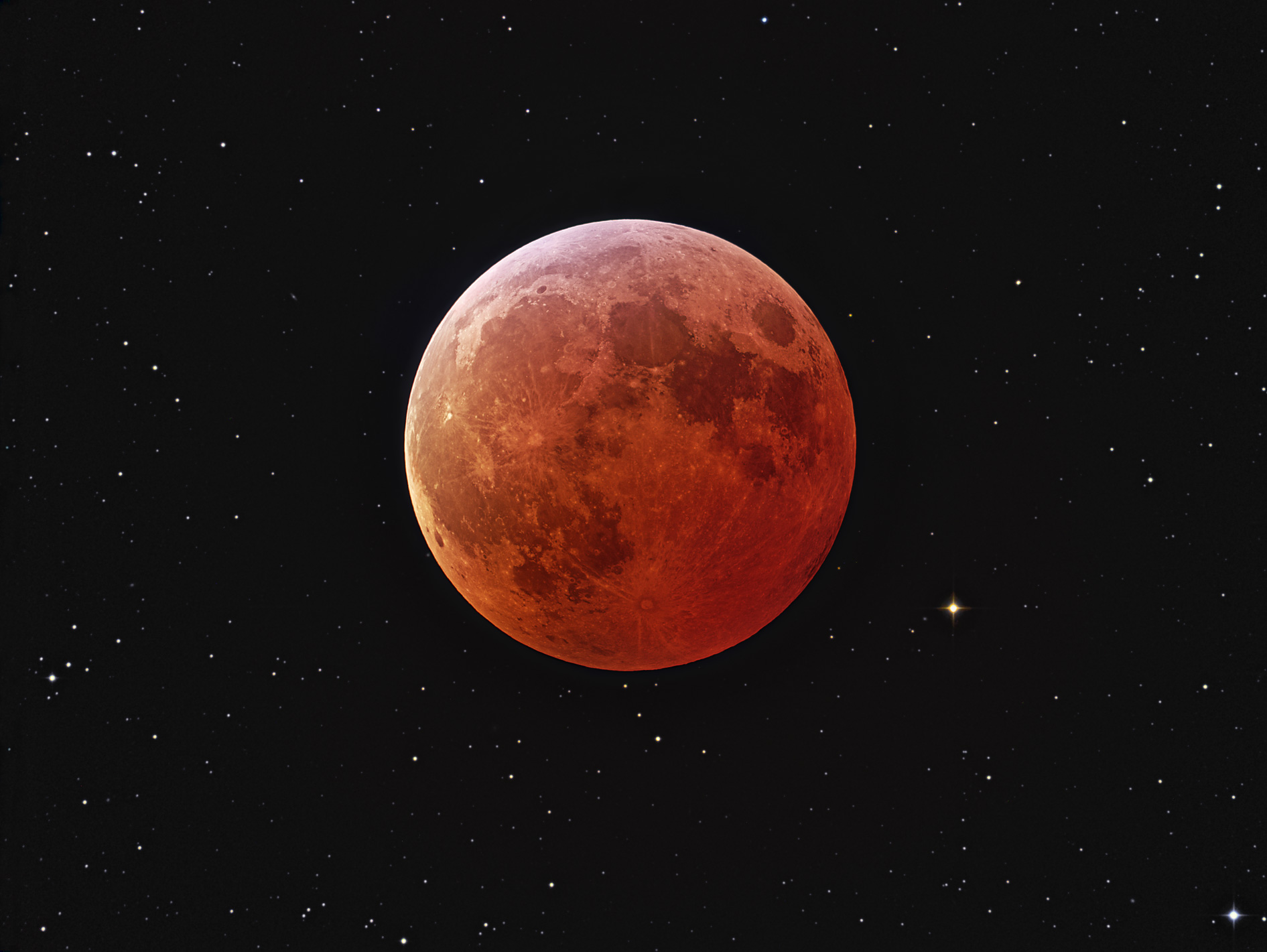
Eclipsed Moon and Stars

See Explanation.  Clicking on the picture will download  the highest resolution version available.

2007 March 8

This dramatic image features a dark red Moon during a total lunar eclipse -- celestial shadow play enjoyed by many denizens of planet Earth last Saturday.

Recorded near Wildon, Austria, the picture is a composite of two exposures; a relatively short exposure to feature the lunar surface and a longer exposure to capture background stars in the constellation Leo. Completely immersed in Earth's cone-shaped shadow during the total eclipse phase, the lunar surface is still illuminated by sunlight, reddened and refracted into the dark shadow region by a dusty atmosphere. As a result, familiar details of the Moon's nearside are easy to pick out, including the smooth lunar mare and the large ray crater Tycho. In this telescopic view, the background stars are faint and most would be invisible to the naked eye.

reposted from: Astronomy Picture of the Day
my: highlights / emphasis / key points / comments

Wednesday, March 07, 2007

Cosmic Pearls


Supernova 1987A

Two decades ago, astronomers spotted one of the brightest exploding stars in more than 400 years.

Since that first sighting, the doomed star, called Supernova 1987A, has continued to fascinate astronomers with its spectacular light show. NASA's Hubble Space Telescope is one of many observatories that has been monitoring the blast's aftermath. The supernova is located 163,000 light-years away in the Large Magellanic Cloud.

This image shows the entire region surrounding the supernova, the most prominent feature of which is a ring with dozens of bright spots, shining like cosmic pearls. Unleashed by the stellar blast, this material is slamming into regions along the ring's inner regions, heating them up, and causing them to glow. The ring, about a light-year across, was likely shed by the star about 20,000 years before it exploded.

This image was taken in December 2006 with Hubble's Advanced Camera for Surveys.

Image credit: NASA, ESA, P. Challis and R. Kirshner (Harvard-Smithsonian Center for Astrophysics)

reposted from: nasa

my: highlights / emphasis / key points / comments

Microsoft Set to Blast Google over Copyright

clipped from: www.pcmag.com


SEATTLE (Reuters) - Microsoft Corp. is set to launch a blistering attack on rival Google Inc. on Tuesday for what the software giant argues is the Web search leader's "cavalier" approach to copyright protection.


Microsoft Associate General Counsel Thomas Rubin argues that Google's move into new media markets has come at the expense of publishers of books, videos and software.

"Companies that create no content of their own, and make money solely on the backs of other people's content, are raking in billions through advertising revenue and IPOs,"

"Google takes the position that everything may be freely copied unless the copyright owner notifies Google and tells it to stop," said Rubin, noting that Microsoft takes the position of seeking the copyright owner's consent before they copy.

"In essence, Google is saying to you and to other copyright owners: 'Trust us - you're protected. We'll keep the digital copies secure, we'll only show snippets, we won't harm you, we'll promote you,'" Rubin argues in his speech.

Rubin invokes criticism that Google has faced since its acquisition late last year of YouTube, which has come under fire from several major media companies for allowing widespread copyright infringement of professionally produced video.

"But Google's track record of protecting copyrights in other parts of its business is weak at best," he said.

David Drummond, Google's senior vice president for corporate development and its chief legal officer, said in response that Google works with more than 10,000 publishing partners to make books searchable online and has recently added the BBC and NBA basketball league as YouTube video partners.

"We do this by complying with international copyright laws, and the result has been more exposure and in many cases more revenue for authors, publishers and producers of content."

Rubin sides with publishers in criticizing Google's ambitious plan to scan millions of published works in the world's great libraries and make them available to consumers via its Google Book Search system. He said by scanning copies of published works without first seeking copyright holders' permission, Google opens the door to massive infringement.

The attorney also says Google's defense of 'fair use' is overly broad. "Concocting a novel "fair use" theory, Google bestowed upon itself the unilateral right to make entire copies of copyrighted books," Rubin argues.

Drummond replied: "The goal of search engines, and of products like Google Book Search and YouTube, is to help users find information from content producers of every size."

Copyright Reuters 2007. All rights reserved. Users may download and print extracts of content from this website for their own personal and non-commercial use only. Republication or redistribution of Reuters content, including by framing or similar means, is expressly prohibited without the prior written consent of Reuters. Reuters and the Reuters sphere logo are registered trademarks or trademarks of the Reuters group of companies around the world.


reposted from: clipmarks.com
my: highlights / emphasis / key points / comments

Tuesday, March 06, 2007

Dark energy - speeding up the expansion of the universe


Dark energy: Seeking the heart of darkness

  • 16 February 2007
  • Exclusive from New Scientist Print Edition. Subscribe and get 4 free issues.
  • Stuart Clark

Every now and again cosmologists decide that the universe needs redecorating. Sometimes they declutter, as when Copernicus and Kepler shuffled the sun and the Earth to get rid of all those epicycles and make the planets move in straightforward orbits. Sometimes they embellish, as when Einstein decided that there's more to space than good old-fashioned nothingness, and introduced the concept of a deformable space-time.

They are at it again, but this time it's different. Like the decorator who strips away a layer of wallpaper to reveal a crumbling wall, cosmologists are realising that their findings point to serious problems with their models of the structure of the universe. This discovery is forcing them to contemplate bold changes to fix the damage.

When they are done, chances are we will hardly recognise the old place. "It will repaint not only our picture of the universe but perhaps particle physics, gravitational physics and string theory too," says Rocky Kolb, a cosmologist at Fermilab in Batavia, Illinois.

The problem giving cosmologists their big headache goes under the name of "dark energy". This enigmatic entity - which could be some kind of a substance, or a field, or maybe something else entirely - forced itself into cosmologists' consciousness in 1998, when astronomers discovered that something is speeding up the expansion of the universe. Almost a decade later, it is beginning to sink in that there is no easy way to understand what dark energy might be. The problem has become so intractable that many now see it as the greatest challenge facing physics.

The scale of the problem has galvanised astronomers into urgent action. Scanning the skies in ever greater detail, their observations could soon lead us to the origin and nature of what could, according to some theories, dark energy could make up almost three-quarters of the cosmos, and which will ultimately dictate its fate. "Dark energy is more of a challenge for physicists than it is for astronomers," says Kolb. "Astronomers just measure the acceleration of the universe but physicists have to explain what dark energy actually is."

There is no way to detect dark energy directly, so we have to measure its effects. The most obvious of these is the one that gave it away in the first place: the way it forces the expansion of the universe to accelerate.

Cosmic cure-all

Its discovery came about like this. Two independent teams of astronomers were using the Hubble Space Telescope and a host of large ground-based telescopes to track down supernovae in the distant universe. By measuring the wavelength and intensity of the light from these exploding stars it is possible to look back through cosmic history and calculate how fast the universe has been expanding during the past few billion years. What everyone expected was that the expansion that started with the big bang would be slowing down, as the outward rush of individual galaxies gets pulled back by the gravitational attraction of the rest of the universe. To their surprise, both teams' calculations showed that the opposite was happening: the rate of expansion was actually increasing.

Though this went against everything we thought we knew about the universe, the results were beyond dispute. "The fact that two independent teams came to the same conclusion certainly boosted everyone's confidence," says Adam Reiss of the Space Telescope Science Institute in Baltimore, Maryland, who led one of the teams.

Even before these astonishing results, cosmologists had been getting uncomfortable hints that something was wrong with their models of how the universe works. One of these came from detailed observations of the radiation released by the big bang. The only way to fit the observations to existing cosmological models was to slightly warp the fabric of space-time. Such warping is impossible to explain unless there is something in addition to all the normal matter, neutrinos, dark matter and radiation that we know about. Dark energy now seems to fit the bill.

For a while, cosmologists could dream that dark energy would solve various other problems too. It explained why certain stars seemed to be older than the universe itself; it provided possible clues about the nature of the dark matter that seems to be holding individual galaxies together; and maybe it could explain "inflation", the sudden acceleration in the expansion of the universe that happened within a blink of the big bang.

Dark energy on trial

That honeymoon period is now well and truly over. Although dark energy is a ubiquitous term in cosmological conversations, no one actually knows what it is. As Kolb says: "Naming is not explaining."

Although there are plenty of tentative explanations, each one seems to suffer from some fatal flaw. The simplest of the solutions on offer is the so-called cosmological constant. This is an energy associated with space-time that was originally invoked by Einstein in his equations of general relativity. It represents a cosmic repulsion that Einstein fine-tuned to prevent the universe - which he did not at the time realise was expanding - from collapsing in on itself as a result of all the gravity generated by the various celestial objects.

When Einstein learned of Edwin Hubble's discovery that space is indeed expanding, he realised that the cosmological constant was superfluous and famously called it his "biggest blunder". Now the accelerating expansion of the universe is making astronomers wonder whether there might be a cosmological constant after all, driving the universe's acceleration (see "1: a new form of energy").

Unfortunately, physicists are having trouble finding a way to fit a cosmological constant into their best existing theories. "A small non-zero dark energy is more difficult to explain than zero," says Sean Carroll, a cosmologist from the California Institute of Technology in Pasadena. "So we are driven to wilder ideas."

One of those wild ideas is quintessence, which postulates the existence of a hitherto unsuspected quantum field permeating the universe (see "2: a new force of nature"). Because this implies that there would also be a new fundamental force of nature, the idea set some physicists thinking: instead of adding a new force, why not modify an old one? Perhaps there are unexpected properties of gravity that appear over gargantuan distances that Einstein's general relativity does not predict (see "3: modify an old force").

Defenders of general relativity point out that the problem is not with general relativity, but with an even more fundamental aspect of our universe. They point out that it has been assumed for almost a century that the universe is the same in every direction you look. Let go of that assumption and the more complicated solutions of general relativity that result could lead to acceleration without the need for dark energy (see "4: introduce complexity").

Faced with these disparate approaches, not to mention the several variations that exist within each one, it is no wonder that cosmologists are scratching their heads wondering what to do for the best. Last year, two independent committees of leading cosmologists were convened to answer this question. Kolb chaired the Dark Energy Task Force, which reported to the US Department of Energy, NASA and the National Science Foundation. Its recommendation is for an "aggressive program to explore dark energy as fully as possible, since it challenges our understanding of fundamental physical laws and the nature of the cosmos". In Europe, John Peacock of the University of Edinburgh, UK, convened a committee under the auspices of the European Space Agency (ESA) and the European Southern Observatory. It came to a similar conclusion. Of all the challenges in cosmology, the discovery of dark energy "poses the greatest challenge for physics" because there is no "plausible or natural" explanation for it, says Peacock's committee.

How do they propose to tackle this? It's simple: with the biggest ever survey of the universe, to see whether dark energy changes with time and, if it does, how fast it changes. If dark energy is a manifestation of the cosmological constant, it will be unchanging. By contrast, quintessence is variable and could change over time, or from place to place in the universe. Modified gravity has similar, though not identical, characteristics.

Astronomical surveys will show the distorting effects that dark energy has on the distribution of galaxies across the universe. The more galaxies astronomers examine, the more marked these effects will be; and the further the survey reaches into the universe, the easier it will become to see if dark energy has changed with time.

The most comprehensive study is due to start in 2012, when the Large Synoptic Survey Telescope begins operating from Cerro Pachón in Chile. With its whopping 8.4-metre mirror and wide-field camera, the LSST is a monster that will devour the sky. It will see 400 times the area of the full moon in a single glance, and take an image every 15 seconds. In just three days it will be able to record the entire visible night sky.

Eventually the search will move into space for even greater accuracy and sensitivity. NASA and the US Department of Energy are funding three design studies for the Joint Dark Energy Mission, which they hope will launch sometime between 2011 and 2017. Peacock recommends that ESA should also investigate a project.

Even before these mega-projects begin, we may start to get answers. Astronomers already have most of the equipment to hand to start their grand survey, as observatories around the world are littered with outmoded telescopes. About 15 years ago, 4-metre telescopes were at the cutting edge of research, but now they are floundering in the wake of a new generation of larger instruments. "The 4-metre telescopes have been eclipsed by 8-metre telescopes," says Peacock, who is now pushing for them to be used for surveys.

The most ambitious map of the sky to date is the Sloan Digital Sky Survey. Using a 2.5-metre telescope at Apache Point, New Mexico, it has over the past five years collected light from 675,000 galaxies. A 4-metre telescope could not only work faster than this, but also reach further back into the universe's history. All that is required to begin the survey is a wide-angle camera to take pictures of large areas of the sky simultaneously.

Ofer Lahav of University College London has a plan to do just this. He leads a consortium of astronomers who are planning to build the kind of wide-field camera necessary for survey work. "Our survey could see 500 million galaxies," says Lahav. These would be spread throughout three-quarters of the visible universe. To cope with the flood of data, Lahav's team has used existing images of the sky to train a neural network to recognise galaxies and estimate their distances. The team also has permission to use its camera in conjunction with the 4-metre Blanco telescope in Cerro Tololo, Chile, and is now looking for the $20 to $30 million that will be needed to build the highly sophisticated optics and run the telescope.

Peacock would like to see many more such efforts - and soon. "We have to start now," he says. It's a big sky and there are plenty of telescopes to do the job, he points out. The more of them that can be brought to bear, the bigger and better the eventual survey will be.

Gone are the days when astronomical surveys like this were viewed as mundane, speculative chores. By giving us detailed measurements of the acceleration of different parts of the universe, the next generation of surveys could reveal the nature of the dominant component of the universe. Whatever it turns out to be, it will be big news. "Dark energy could be the ether of the 21st century," says Carroll. Even if we explain it away, we will learn something profound about the universe.

Dark energy could be the ether of the 21st century

It is a viewpoint shared by cosmologists everywhere. "We are definitely seeing something extra in the universe, we just do not know how to interpret it yet," says Lahav. And that has given cosmologists a new sense of purpose. A seismic shift in our understanding of the universe is coming. How soon it will arrive and from what direction it will come - that's still anyone's guess.

From issue 2591 of New Scientist magazine, 16 February 2007, page 28-33

Phantom energy forces the expansion faster and faster until eventually the universe rips itself to pieces
1 a new form of energy

Einstein himself flirted with a weird form of energy that might just fit the bill. He called it the cosmological constant. These days physicists prefer the name vacuum energy, and like to think of it as the "cost" of free space. By that they mean that every cubic metre of space, no matter how cold or empty, contains a certain amount of energy. According to the equations of general relativity, this energy drives the expansion of the universe.

"Had everyone been happy with the cosmological constant there would be no need to continue," says cosmologist Rocky Kolb of Fermilab in Illinois. The trouble is, no one really is happy with it. One reason for this is that quantum theory predicts a vacuum energy that is 120 orders of magnitude larger than what is needed to cause the observed acceleration in the universe's expansion. This colossal discrepancy is one reason why physicists formulated supersymmetry theory, which cancels out vacuum energy completely.

The trouble is, the universe has other ideas: if the dark energy pushing it apart really is vacuum energy, the small amount that exists is infuriatingly difficult to explain. It certainly defeats any existing model.

"If dark energy is the cosmological constant then we will just have to wait for the theorists to catch up," says Adam Reiss of the Space Telescope Science Institute in Baltimore.

2 a new force of nature

"When physicists don't understand something, they invent a new field to explain it," says cosmologist Rocky Kolb of Fermilab. "Now astronomers have also learned that trick."

In the case of the dark energy mystery, the result is a quantum field called quintessence. Like the cosmological constant, quintessence is said to pervade the universe, but one of its key differences from the cosmological constant is that it can vary depending on the time and the place. Various versions have sprung up depending on how fast they vary. One version, called phantom energy, builds with time, forcing the expansion faster and faster until eventually the universe rips itself to pieces.

In November 2006, a team led by astronomer Adam Reiss of the Space Telescope Science Institute in Baltimore, Maryland, announced that they had detected dark energy's influence on the universe as it existed 9 billion years ago (www.arxiv.org/abs/astro-ph/0611572). Reiss says his team's discovery rules out quintessence models that change rapidly. "It is narrowing our room to play a little," agrees cosmologist Sean Carroll of the California Institute of Technology in Pasadena. As more dark energy surveys get under way, he hopes they will narrow the field even more, eventually forcing everyone to converge on a single solution.

There are also some more fundamental problems that any solution involving quintessence will have to overcome. In the more familiar quantum fields, fluctuations in the field manifest themselves as particles. In the electromagnetic field, for instance, such fluctuations appear as photons.

Does this mean the same should happen for quintessence? Absolutely, says Carroll. Fluctuations in its field should lead to particles that can carry a quintessence force over large distances. This force would act between individual objects and be distinct from the general acceleration of the universe caused by the overall quintessence field.

The trouble is, no such quintessence force has shown itself. It should be apparent as a measurable deviation in the motion of celestial objects. "By all rights we should have detected it by now," Carroll says. This is forcing theorists to try to fine-tune their expectations to reduce the force of quintessence between individual objects while retaining its dominant character across the universe. Tricky.

3 modify an old force

Despite the slew of observations that make it look as though dark energy of one form or another is operating in the universe, astronomer Adam Reiss remains cautious. The common assumption, he points out, is that gravity operates the same way on large scales as it does on small scales. But what if it doesn't? If there were some unexpected gravitational effect that has remained undetected until now, dark energy might not be needed at all.

This idea that there might be some modification to gravity caught the attention of Caltech cosmologist Sean Carroll for a while, but he soon found it was not a short cut to a solution. "It turns out to be much harder than you imagine to find a modification that works," he says.

That's because modifying gravity to give large-scale acceleration also results in unwanted small-scale alterations, such as deviations to the way the planets orbit in the solar system. Carroll says he is now moving away from modified theories of gravity to explain away dark energy.

Not everyone is giving up. "No one promised it would be easy," says Gia Dvali, a theorist at New York University. He has developed a modified theory of gravity in which space-time is not as formless as we tend to think. According to the theory, which he developed with his colleagues Gregory Gabadadze and Massimo Porrati, space-time has a limited underlying shape that makes it look as if a weird form of energy is warping it.

The warping happens because gravitons - the as yet undiscovered particles that are presumed to carry gravity - have a small mass, and decay into other dimensions with half-lives of 15 billion years. This is strikingly similar to the age of the universe. "We don't know whether this is just a remarkable coincidence or the result of something more fundamental," says Dvali.

According to Dvali's calculations, such a modification of gravity would explain the acceleration of the universe's expansion. It would also alter the moon's orbit by about a millimetre away from the expectations of general relativity. A team of astronomers from Harvard University and the University of Washington in Seattle are planning to attempt this measurement using the mirrors left behind on the lunar surface by the Apollo astronauts.

4 introduce complexity

Perhaps the most outrageous - and yet paradoxically the most conservative - solution is to alter an assumption so ingrained in cosmology that most cosmologists have forgotten it is there. Called the cosmological principle it states, in essence, that viewed on sufficiently large scales the universe has no preferred directions or preferred places. "We have unquestioningly lived with this assumption for 85 years," says cosmologist Rocky Kolb.

It was introduced in the 1920s by Alexander Friedman to make the equations of general relativity tractable. It meant Friedman could think of the galaxies as particles in a uniform fluid that fills space. Cosmologists have stuck with Friedman's idea ever since, despite finding ever larger density variations across the universe. It might be time to ditch that assumption, suggests Kolb.

If the universe is no longer the same everywhere, effects of general relativity that are negligible in a uniform cosmos might become increasingly important. "It is just an idea at the moment, but sooner or later we are going to have to do the calculations and make a prediction," says Kolb.

That's where it gets tough, because to do that will require us finding a way to somehow meld general relativity with complexity theory. "We cannot do it yet, but one day a clever graduate student will see how to do the calculation," Kolb says. "I just hope he or she will be working for me.

reposted from: New Scientist my: highlights / emphasis / key points / comments

Panorama reveals thousands of growing galaxies


The visible universe has 80 billion galaxies. The number of stars is 3 x 10 to the power of 22. Each galaxy has on average 375 billion stars. As a rule of thumb i think of 100 billion galaxies each with 100 billion stars.

Now 150,000 galaxies have been photographed within the sky the width of your finger when held at arms length.


18:00 06 March 2007,
  • NewScientist.com news service - Hazel Muir

Hundreds of images snapped by the Hubble Space Telescope have been woven together to create a rich tapestry of thousands of galaxies.

Astronomers created the panoramic view as part of a five-year project called AEGIS (All-wavelength Extended Groth strip International Survey). Eight of the world's best space- and ground-based observatories, including Hubble, made meticulous surveys inside one patch of the night sky with an area about twice the size of the full Moon.

The observatories peered up to 9 billion light years away to see about 150,000 galaxies evolving when the universe was much younger than today. They recorded the galaxies in all colours from X-rays to radio waves.

"The goal was to study the Universe as it was when it was about half as old as it is at present, or about 8 billion years ago, a time when youthful galaxies undergoing active formation were becoming quieter mature adults," says Marc Davis from the University of California in Berkeley, US, one of the AEGIS project leaders.

Galactic collisions

Hubble recorded images of more than 50,000 galaxies in visible light by taking more than 500 separate exposures. Astronomer Anton Koekemoer from the Space Telescope Science Institute in Maryland, US, and colleagues combined them to create a panoramic image containing more than 3 billion pixels.

"These images reveal a wealth of galaxies at many stages of their evolution through cosmic time," says Koekemoer. Some are beautiful spirals or massive elliptical galaxies, but others have very haphazard shapes. They are probably the wreckage of violent galactic collisions.

Watch an MPEG video of the AEGIS strip beginning with its location in the constellation Ursa Major (the Big Dipper) and ending with a pan across the strip (courtesy of NASA/ESA/L Barranger/STScI).

Among the discoveries so far in the Hubble images is a giant red galaxy with two black holes at its core. They appear to be about 4000 light years apart, and one is 10 times more massive than the other, weighing 5 million times the mass of the Sun. They appear to be the result of a galactic merger hundreds of millions of years earlier.

Astronomers hope all the AEGIS observations will reveal new clues about how galaxies evolved from their "pre-teen" years to young adulthood. A total of 19 papers describing the results of the project will appear in a future issue of Astrophysical Journal Letters.

reposted from: New Scientist my: highlights / emphasis / key points / comments

top picture: Nasa - 10,000 galaxies

Long live satire

Sue Blackmore

In the name of academic freedom, Clare College, Cambridge, should have defended the pupil responsible for printing cartoons depicting Muhammad.

March 5, 2007 8:17 AM | Printable version

A Cambridge student is in hiding because he dared to print one of those infamous Danish cartoons and have a laugh at Islam's expense. Yet if offended Muslims want people to stop laughing at them, this latest incident will only have backfired.

I bet I'm not the only one whose reaction was to go straight to Google Images and type in "Muhammad". And yes, you find lots of pictures of him who must not be pictured - "about 88,400" to be precise. The top 20 includes some ancient depictions (and I've no idea whether these offended anyone), a selection of Muhammad clipart, and several cartoons. I especially like the first one that Google throws up - Muhammad looking at himself in a mirror and exclaiming "Blasphemy". Ha ha. Then there's one I regularly use in my lectures on memes. It shows some suicide bombers arriving in heaven to be met by the man himself shouting "Stop, stop, we've run out of virgins".

These are just simple jokes, available to all, but when a student at Clare College reprinted one in the college magazine, offended students complained in droves and the college started an investigation. Even worse, senior tutor Patricia Fara said, "The college finds the publication and the views expressed abhorrent." But isn't it the college's reaction that is abhorrent? I think the "offended" students are the real culprits, and the college should have had the guts to stand up to them in the name of academic freedom - and the good old freedom to laugh at ideas we find silly or disagree with.

The whole sad story is told on Cambridge University's "Varsity" site and in the Cambridge Evening News. On February 2 Clare College's prize-winning student paper, Clareification, published a special issue renamed "Crucification" and largely devoted to religious satire (and presumably, from its name, not just Islam). In its regular "lookalikes of the week" the cartoon of Muhammad was set next to a photograph of the president of the union of Clare students, along with a caption suggesting that one was "a violent paedophile" while the other was "a prophet of God, a great leader and an example to us all".

OK it's offensive, and funny, and that's what satire is all about. But the magazine apparently "provoked anger in Cambridge", with enraged students complaining in droves. A second-year student said these were "some of the most offensive things I've ever seen." The president of the university's Islamic society said "I found the magazine hugely offensive ... freedom of expression does not constitute a freedom to offend."

I say to him - oh yes it does, and you should be ashamed of yourself. You didn't have to read the magazine. You didn't have to spread the news about it. And you certainly didn't have to encourage other Muslims to believe that claiming to be offended gives them the right to stop the rest of us having a laugh. Yet you did so.

We are talking here about a student magazine read by a handful of students at one college at one university. Student magazines have always been satirical and satire hurts. The president of Clare students might have been offended too, along with any other students who get picked on by their student mag. I expect the politicians who are regularly lampooned in Private Eye feel offended and upset, but unless they have been libelled they accept it. The freedom to laugh and poke fun at things we disagree with is fundamental to freedom of thought.

And freedom of thought is fundamental to education, scholarship, and learning - all the things that Cambridge University should be standing up for. Great thinkers and scientists are always offending people by overthrowing the dogmas and false beliefs of the past. People were offended at the thought that earth was not the centre of the universe; they were offended at the idea that mountains and rivers were created by natural processes; they were offended at the idea that species were not immutable and they were offended at the suggestion that we humans might be descended from apes. Happily, in the end the evidence overwhelmed them.

I hope the same will happen with these claims, and society as a whole will not let religious believers claim a right not to be offended. When I contacted the college the master told me that the student has not been reprimanded and the disciplinary process will determine whether he has infringed any regulations. I sincerely hope he has not and that the college will offer him and his magazine their support. The freedom to think, to argue, and to laugh at silly ideas must be allowed to flourish.

*****************

Comments


GBR

Sue

You only have part of the story. The students are now out of hiding.

They have, however, been interviewed by the Cambridgshire police, under caution, in relation to an offence under the Public Order Act 1986. The offence in question is, I understand, either section 4A or section 5: possibly with a religiously aggravated element.

They may still be charged with intentionally causing religiously aggravated harrassment, alarm or distress. The CPS has yet to announce it's decision.

The Cambridge Muslim Welfare Society issued a statement calling for a *full and unconditional apology* from the students, and invoking *its duty before Almighty Allah and before humanity to defend the honour and good name of the Final Prophet*. The reports suggest that such an apology was given.

I am in the fortunate position of having seen a copy of the magazine. It is mostly full of college in jokes, which are completely incomprehensible. The religious theme is largely tied into these college in jokes.

The issue also includes:

- A lengthy article which ridicules the Gospel of St Mark - which was apparently given out to the student body by the Christian Union - and exploring the contradictions and inconsistencies in the Gospel. A certain proportion of the article is in Biblical Greek. The article is closely argued, and cites academic sources. It is pretty hard hitting, and includes the suggestion that the Messianic prophecies have not been fulfilled. It compares Jesus to a *builder who'd fucked off with the deposit and has left a note saying that he'll come back to finish the job*. It also suggests that the early evangalists did not mention Jesus, or the resurrection. I could go into further details: but you get the general idea.

- A picture of the *Behead those who insult Islam/Freedom go to Hell* protestors
* A quiz, in multiple choice form, which purports to help decide whether they are "the Islamic world". Students are asked to decide what their reaction would be to finding a *ginger haired man* kicking a puppy, being called a rapist, or - echoing the recent controversy involving the Pope's speech - being asked to come up with something an unnamed religious figure *brought into the world which was not evil*. The answers range from *ignore it*, *laugh at it* *argue against it* to *blame the puppy* and raping the person who made the accusation.
A short editorial which rambles on about the unedifying content of the Gospels, the provinence of the Christian imagery of the cover, includes a few Clare College in-jokes, and then says *Plus I hate Islam*.
- An unintelligible cartoon about Richard Dawkins, which features a woman in a niqab.

I've covered the issue here.

http://tinyurl.com/2lazlx

Follow the links backwards.


Excellent, excellent piece Sue - if the students who are responsible are punished it will be an outrage. I too will be contacting Clare in order to make the same point. If students at a university are punished for promoting offensive ideas then we really have returned to some kind of dark age. A civilized society should be judged on its ability to deal with offensive ideas - does it deal for them through rational debate or does it censor and censure those involved - we seem to be living in the latter type of society.

The Guardian (and the rest of the print/brodacasting media) should hang its head in shame for its role in this fiasco - the Guardian did not publish the pictures and therefore helped to deny adults in a democracy a chance to decide their own views on the situation.


reposted from: CIF
my: highlights / emphasis / key points / comments