Thursday, March 08, 2007

Right Reason & the Scientific Method

Image of Robert McHenryRight Reason

I’ve written occasionally on the results, sometimes ludicrous and sometimes dangerous, that can follow from the unbridled, ungrounded application of “reason,” so called, to the problems of human life. (See here in particular.) Let me be more pointed.

We’re not quite sure what “reason” is, to begin with. Humans have the capacity for disciplined and systematic thought along certain lines. The Greeks are usually credited with making the most, earliest, of this fact. Mathematics and logic are our inheritance from them, along with some practical applications thereof. Aristotle, of course, gets the credit for instituting the study of formal logic, in part by systematizing kinds of syllogisms and exploring their implications. It is thus that we recognize that

All men are mortal.
Socrates is a man.
Therefore, Socrates is mortal.

is a valid argument, while

All men are mortal.
Socrates is mortal.
Therefore, Socrates is a man.

is not valid, even though the conclusion happens to be true.

As regards the quantifiable, mathematics does wonderfully well. And as regards certain types of well constructed sentences, logic does, too. But understanding the limits implied by “certain types of well constructed sentences” took some time. No one could blame the Greek thinkers and their early successors for their exuberance in the application of their shiny new tool. Over time it began to be said that this “reason” was a gift of the gods, or a spark of the divine within us, or – secularly speaking – a sort of mental Swiss army knife, useful in any situation.

Because we are talking about human beings, it is no surprise that over the centuries many errors of logical deduction have been committed, sometimes because of carelessness, sometimes because premises were ill founded, sometimes because the desired conclusion was in mind from the outset and logic was overcome by the determination to arrive at it.

(A charming example of this last mode of intellection can be found in the article “Government” that James Mill, father of the more famous John Stuart, wrote for an early edition of the Encyclopædia Britannica. In it he began from first principles and, step by painstaking step, deduced the ideal form of government, which – what were the odds? – turned out to be a constitutional monarchy with a bicameral legislature, part elected and part hereditary!)

And sometimes errors have arisen from the fact that not everything in human life is quantifiable or narrowly logical.

By the time of René Descartes, a certain caution might have been expected, but no. Descartes was, among other things, a mathematician, and he persuaded himself that the same kind of axiomatic reasoning that worked in geometry would work in any subject matter. Thus it was that he reasoned himself into an inescapable trap called solipsism (Solipsism is the philosophical idea that "My mind is the only thing that exists". Solipsism (Latin: solus, alone + ipse, self) is an epistemological or metaphysical position that knowledge of anything outside the mind is unjustified. The external world and other minds cannot be known and might not exist), whence – having rested for a time on the famous “Cogito ergo sum” thing – he couldn’t reason himself out again without an ad hoc appeal to the existence and good will of a god.

The successes of the scientific method, to say nothing of our everyday experience, ought to have taught us all by now that this faculty called reason only works well when it is fed a carefully prepared diet of quantifiable, verifiable data from the outer world. And even then it is apt to go wrong, so the results we get must always be held lightly, as current best estimates, rather than tightly, as eternal truths. Eternal truths too often begin to look like weapons, and weapons tightly held are too often used.


reposted from: Britannica
my: highlights / emphasis / key points / comments

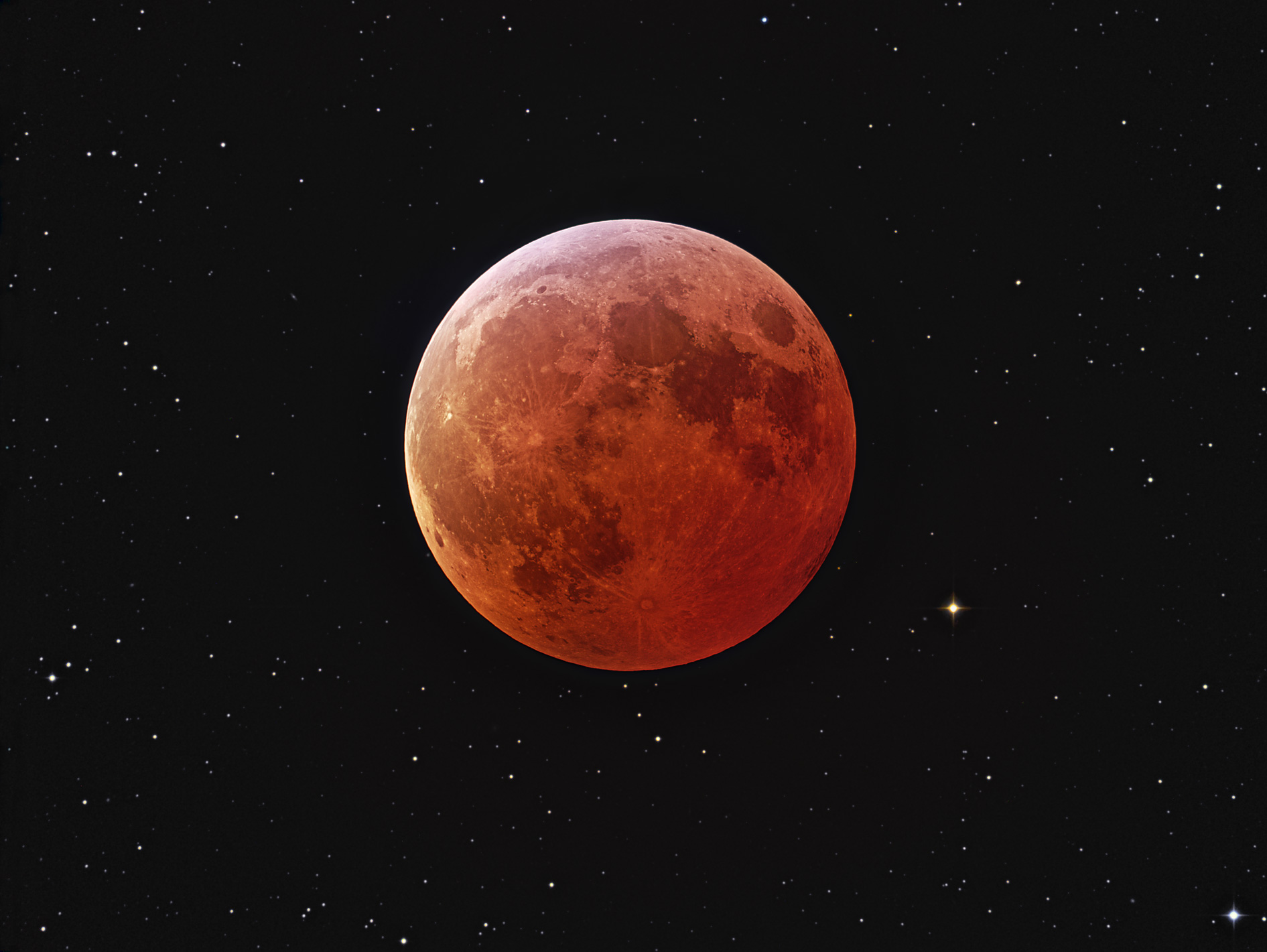
Eclipsed Moon and Stars

See Explanation.  Clicking on the picture will download  the highest resolution version available.

2007 March 8

This dramatic image features a dark red Moon during a total lunar eclipse -- celestial shadow play enjoyed by many denizens of planet Earth last Saturday.

Recorded near Wildon, Austria, the picture is a composite of two exposures; a relatively short exposure to feature the lunar surface and a longer exposure to capture background stars in the constellation Leo. Completely immersed in Earth's cone-shaped shadow during the total eclipse phase, the lunar surface is still illuminated by sunlight, reddened and refracted into the dark shadow region by a dusty atmosphere. As a result, familiar details of the Moon's nearside are easy to pick out, including the smooth lunar mare and the large ray crater Tycho. In this telescopic view, the background stars are faint and most would be invisible to the naked eye.

reposted from: Astronomy Picture of the Day
my: highlights / emphasis / key points / comments

Wednesday, March 07, 2007

Cosmic Pearls


Supernova 1987A

Two decades ago, astronomers spotted one of the brightest exploding stars in more than 400 years.

Since that first sighting, the doomed star, called Supernova 1987A, has continued to fascinate astronomers with its spectacular light show. NASA's Hubble Space Telescope is one of many observatories that has been monitoring the blast's aftermath. The supernova is located 163,000 light-years away in the Large Magellanic Cloud.

This image shows the entire region surrounding the supernova, the most prominent feature of which is a ring with dozens of bright spots, shining like cosmic pearls. Unleashed by the stellar blast, this material is slamming into regions along the ring's inner regions, heating them up, and causing them to glow. The ring, about a light-year across, was likely shed by the star about 20,000 years before it exploded.

This image was taken in December 2006 with Hubble's Advanced Camera for Surveys.

Image credit: NASA, ESA, P. Challis and R. Kirshner (Harvard-Smithsonian Center for Astrophysics)

reposted from: nasa

my: highlights / emphasis / key points / comments

Microsoft Set to Blast Google over Copyright

clipped from: www.pcmag.com


SEATTLE (Reuters) - Microsoft Corp. is set to launch a blistering attack on rival Google Inc. on Tuesday for what the software giant argues is the Web search leader's "cavalier" approach to copyright protection.


Microsoft Associate General Counsel Thomas Rubin argues that Google's move into new media markets has come at the expense of publishers of books, videos and software.

"Companies that create no content of their own, and make money solely on the backs of other people's content, are raking in billions through advertising revenue and IPOs,"

"Google takes the position that everything may be freely copied unless the copyright owner notifies Google and tells it to stop," said Rubin, noting that Microsoft takes the position of seeking the copyright owner's consent before they copy.

"In essence, Google is saying to you and to other copyright owners: 'Trust us - you're protected. We'll keep the digital copies secure, we'll only show snippets, we won't harm you, we'll promote you,'" Rubin argues in his speech.

Rubin invokes criticism that Google has faced since its acquisition late last year of YouTube, which has come under fire from several major media companies for allowing widespread copyright infringement of professionally produced video.

"But Google's track record of protecting copyrights in other parts of its business is weak at best," he said.

David Drummond, Google's senior vice president for corporate development and its chief legal officer, said in response that Google works with more than 10,000 publishing partners to make books searchable online and has recently added the BBC and NBA basketball league as YouTube video partners.

"We do this by complying with international copyright laws, and the result has been more exposure and in many cases more revenue for authors, publishers and producers of content."

Rubin sides with publishers in criticizing Google's ambitious plan to scan millions of published works in the world's great libraries and make them available to consumers via its Google Book Search system. He said by scanning copies of published works without first seeking copyright holders' permission, Google opens the door to massive infringement.

The attorney also says Google's defense of 'fair use' is overly broad. "Concocting a novel "fair use" theory, Google bestowed upon itself the unilateral right to make entire copies of copyrighted books," Rubin argues.

Drummond replied: "The goal of search engines, and of products like Google Book Search and YouTube, is to help users find information from content producers of every size."

Copyright Reuters 2007. All rights reserved. Users may download and print extracts of content from this website for their own personal and non-commercial use only. Republication or redistribution of Reuters content, including by framing or similar means, is expressly prohibited without the prior written consent of Reuters. Reuters and the Reuters sphere logo are registered trademarks or trademarks of the Reuters group of companies around the world.


reposted from: clipmarks.com
my: highlights / emphasis / key points / comments

Tuesday, March 06, 2007

Dark energy - speeding up the expansion of the universe


Dark energy: Seeking the heart of darkness

  • 16 February 2007
  • Exclusive from New Scientist Print Edition. Subscribe and get 4 free issues.
  • Stuart Clark

Every now and again cosmologists decide that the universe needs redecorating. Sometimes they declutter, as when Copernicus and Kepler shuffled the sun and the Earth to get rid of all those epicycles and make the planets move in straightforward orbits. Sometimes they embellish, as when Einstein decided that there's more to space than good old-fashioned nothingness, and introduced the concept of a deformable space-time.

They are at it again, but this time it's different. Like the decorator who strips away a layer of wallpaper to reveal a crumbling wall, cosmologists are realising that their findings point to serious problems with their models of the structure of the universe. This discovery is forcing them to contemplate bold changes to fix the damage.

When they are done, chances are we will hardly recognise the old place. "It will repaint not only our picture of the universe but perhaps particle physics, gravitational physics and string theory too," says Rocky Kolb, a cosmologist at Fermilab in Batavia, Illinois.

The problem giving cosmologists their big headache goes under the name of "dark energy". This enigmatic entity - which could be some kind of a substance, or a field, or maybe something else entirely - forced itself into cosmologists' consciousness in 1998, when astronomers discovered that something is speeding up the expansion of the universe. Almost a decade later, it is beginning to sink in that there is no easy way to understand what dark energy might be. The problem has become so intractable that many now see it as the greatest challenge facing physics.

The scale of the problem has galvanised astronomers into urgent action. Scanning the skies in ever greater detail, their observations could soon lead us to the origin and nature of what could, according to some theories, dark energy could make up almost three-quarters of the cosmos, and which will ultimately dictate its fate. "Dark energy is more of a challenge for physicists than it is for astronomers," says Kolb. "Astronomers just measure the acceleration of the universe but physicists have to explain what dark energy actually is."

There is no way to detect dark energy directly, so we have to measure its effects. The most obvious of these is the one that gave it away in the first place: the way it forces the expansion of the universe to accelerate.

Cosmic cure-all

Its discovery came about like this. Two independent teams of astronomers were using the Hubble Space Telescope and a host of large ground-based telescopes to track down supernovae in the distant universe. By measuring the wavelength and intensity of the light from these exploding stars it is possible to look back through cosmic history and calculate how fast the universe has been expanding during the past few billion years. What everyone expected was that the expansion that started with the big bang would be slowing down, as the outward rush of individual galaxies gets pulled back by the gravitational attraction of the rest of the universe. To their surprise, both teams' calculations showed that the opposite was happening: the rate of expansion was actually increasing.

Though this went against everything we thought we knew about the universe, the results were beyond dispute. "The fact that two independent teams came to the same conclusion certainly boosted everyone's confidence," says Adam Reiss of the Space Telescope Science Institute in Baltimore, Maryland, who led one of the teams.

Even before these astonishing results, cosmologists had been getting uncomfortable hints that something was wrong with their models of how the universe works. One of these came from detailed observations of the radiation released by the big bang. The only way to fit the observations to existing cosmological models was to slightly warp the fabric of space-time. Such warping is impossible to explain unless there is something in addition to all the normal matter, neutrinos, dark matter and radiation that we know about. Dark energy now seems to fit the bill.

For a while, cosmologists could dream that dark energy would solve various other problems too. It explained why certain stars seemed to be older than the universe itself; it provided possible clues about the nature of the dark matter that seems to be holding individual galaxies together; and maybe it could explain "inflation", the sudden acceleration in the expansion of the universe that happened within a blink of the big bang.

Dark energy on trial

That honeymoon period is now well and truly over. Although dark energy is a ubiquitous term in cosmological conversations, no one actually knows what it is. As Kolb says: "Naming is not explaining."

Although there are plenty of tentative explanations, each one seems to suffer from some fatal flaw. The simplest of the solutions on offer is the so-called cosmological constant. This is an energy associated with space-time that was originally invoked by Einstein in his equations of general relativity. It represents a cosmic repulsion that Einstein fine-tuned to prevent the universe - which he did not at the time realise was expanding - from collapsing in on itself as a result of all the gravity generated by the various celestial objects.

When Einstein learned of Edwin Hubble's discovery that space is indeed expanding, he realised that the cosmological constant was superfluous and famously called it his "biggest blunder". Now the accelerating expansion of the universe is making astronomers wonder whether there might be a cosmological constant after all, driving the universe's acceleration (see "1: a new form of energy").

Unfortunately, physicists are having trouble finding a way to fit a cosmological constant into their best existing theories. "A small non-zero dark energy is more difficult to explain than zero," says Sean Carroll, a cosmologist from the California Institute of Technology in Pasadena. "So we are driven to wilder ideas."

One of those wild ideas is quintessence, which postulates the existence of a hitherto unsuspected quantum field permeating the universe (see "2: a new force of nature"). Because this implies that there would also be a new fundamental force of nature, the idea set some physicists thinking: instead of adding a new force, why not modify an old one? Perhaps there are unexpected properties of gravity that appear over gargantuan distances that Einstein's general relativity does not predict (see "3: modify an old force").

Defenders of general relativity point out that the problem is not with general relativity, but with an even more fundamental aspect of our universe. They point out that it has been assumed for almost a century that the universe is the same in every direction you look. Let go of that assumption and the more complicated solutions of general relativity that result could lead to acceleration without the need for dark energy (see "4: introduce complexity").

Faced with these disparate approaches, not to mention the several variations that exist within each one, it is no wonder that cosmologists are scratching their heads wondering what to do for the best. Last year, two independent committees of leading cosmologists were convened to answer this question. Kolb chaired the Dark Energy Task Force, which reported to the US Department of Energy, NASA and the National Science Foundation. Its recommendation is for an "aggressive program to explore dark energy as fully as possible, since it challenges our understanding of fundamental physical laws and the nature of the cosmos". In Europe, John Peacock of the University of Edinburgh, UK, convened a committee under the auspices of the European Space Agency (ESA) and the European Southern Observatory. It came to a similar conclusion. Of all the challenges in cosmology, the discovery of dark energy "poses the greatest challenge for physics" because there is no "plausible or natural" explanation for it, says Peacock's committee.

How do they propose to tackle this? It's simple: with the biggest ever survey of the universe, to see whether dark energy changes with time and, if it does, how fast it changes. If dark energy is a manifestation of the cosmological constant, it will be unchanging. By contrast, quintessence is variable and could change over time, or from place to place in the universe. Modified gravity has similar, though not identical, characteristics.

Astronomical surveys will show the distorting effects that dark energy has on the distribution of galaxies across the universe. The more galaxies astronomers examine, the more marked these effects will be; and the further the survey reaches into the universe, the easier it will become to see if dark energy has changed with time.

The most comprehensive study is due to start in 2012, when the Large Synoptic Survey Telescope begins operating from Cerro Pachón in Chile. With its whopping 8.4-metre mirror and wide-field camera, the LSST is a monster that will devour the sky. It will see 400 times the area of the full moon in a single glance, and take an image every 15 seconds. In just three days it will be able to record the entire visible night sky.

Eventually the search will move into space for even greater accuracy and sensitivity. NASA and the US Department of Energy are funding three design studies for the Joint Dark Energy Mission, which they hope will launch sometime between 2011 and 2017. Peacock recommends that ESA should also investigate a project.

Even before these mega-projects begin, we may start to get answers. Astronomers already have most of the equipment to hand to start their grand survey, as observatories around the world are littered with outmoded telescopes. About 15 years ago, 4-metre telescopes were at the cutting edge of research, but now they are floundering in the wake of a new generation of larger instruments. "The 4-metre telescopes have been eclipsed by 8-metre telescopes," says Peacock, who is now pushing for them to be used for surveys.

The most ambitious map of the sky to date is the Sloan Digital Sky Survey. Using a 2.5-metre telescope at Apache Point, New Mexico, it has over the past five years collected light from 675,000 galaxies. A 4-metre telescope could not only work faster than this, but also reach further back into the universe's history. All that is required to begin the survey is a wide-angle camera to take pictures of large areas of the sky simultaneously.

Ofer Lahav of University College London has a plan to do just this. He leads a consortium of astronomers who are planning to build the kind of wide-field camera necessary for survey work. "Our survey could see 500 million galaxies," says Lahav. These would be spread throughout three-quarters of the visible universe. To cope with the flood of data, Lahav's team has used existing images of the sky to train a neural network to recognise galaxies and estimate their distances. The team also has permission to use its camera in conjunction with the 4-metre Blanco telescope in Cerro Tololo, Chile, and is now looking for the $20 to $30 million that will be needed to build the highly sophisticated optics and run the telescope.

Peacock would like to see many more such efforts - and soon. "We have to start now," he says. It's a big sky and there are plenty of telescopes to do the job, he points out. The more of them that can be brought to bear, the bigger and better the eventual survey will be.

Gone are the days when astronomical surveys like this were viewed as mundane, speculative chores. By giving us detailed measurements of the acceleration of different parts of the universe, the next generation of surveys could reveal the nature of the dominant component of the universe. Whatever it turns out to be, it will be big news. "Dark energy could be the ether of the 21st century," says Carroll. Even if we explain it away, we will learn something profound about the universe.

“Dark energy could be the ether of the 21st century”

It is a viewpoint shared by cosmologists everywhere. "We are definitely seeing something extra in the universe, we just do not know how to interpret it yet," says Lahav. And that has given cosmologists a new sense of purpose. A seismic shift in our understanding of the universe is coming. How soon it will arrive and from what direction it will come - that's still anyone's guess.

From issue 2591 of New Scientist magazine, 16 February 2007, page 28-33

“Phantom energy forces the expansion faster and faster until eventually the universe rips itself to pieces”
1 a new form of energy

Einstein himself flirted with a weird form of energy that might just fit the bill. He called it the cosmological constant. These days physicists prefer the name vacuum energy, and like to think of it as the "cost" of free space. By that they mean that every cubic metre of space, no matter how cold or empty, contains a certain amount of energy. According to the equations of general relativity, this energy drives the expansion of the universe.

"Had everyone been happy with the cosmological constant there would be no need to continue," says cosmologist Rocky Kolb of Fermilab in Illinois. The trouble is, no one really is happy with it. One reason for this is that quantum theory predicts a vacuum energy that is 120 orders of magnitude larger than what is needed to cause the observed acceleration in the universe's expansion. This colossal discrepancy is one reason why physicists formulated supersymmetry theory, which cancels out vacuum energy completely.

The trouble is, the universe has other ideas: if the dark energy pushing it apart really is vacuum energy, the small amount that exists is infuriatingly difficult to explain. It certainly defeats any existing model.

"If dark energy is the cosmological constant then we will just have to wait for the theorists to catch up," says Adam Reiss of the Space Telescope Science Institute in Baltimore.

2 a new force of nature

"When physicists don't understand something, they invent a new field to explain it," says cosmologist Rocky Kolb of Fermilab. "Now astronomers have also learned that trick."

In the case of the dark energy mystery, the result is a quantum field called quintessence. Like the cosmological constant, quintessence is said to pervade the universe, but one of its key differences from the cosmological constant is that it can vary depending on the time and the place. Various versions have sprung up depending on how fast they vary. One version, called phantom energy, builds with time, forcing the expansion faster and faster until eventually the universe rips itself to pieces.

In November 2006, a team led by astronomer Adam Reiss of the Space Telescope Science Institute in Baltimore, Maryland, announced that they had detected dark energy's influence on the universe as it existed 9 billion years ago (www.arxiv.org/abs/astro-ph/0611572). Reiss says his team's discovery rules out quintessence models that change rapidly. "It is narrowing our room to play a little," agrees cosmologist Sean Carroll of the California Institute of Technology in Pasadena. As more dark energy surveys get under way, he hopes they will narrow the field even more, eventually forcing everyone to converge on a single solution.

There are also some more fundamental problems that any solution involving quintessence will have to overcome. In the more familiar quantum fields, fluctuations in the field manifest themselves as particles. In the electromagnetic field, for instance, such fluctuations appear as photons.

Does this mean the same should happen for quintessence? Absolutely, says Carroll. Fluctuations in its field should lead to particles that can carry a quintessence force over large distances. This force would act between individual objects and be distinct from the general acceleration of the universe caused by the overall quintessence field.

The trouble is, no such quintessence force has shown itself. It should be apparent as a measurable deviation in the motion of celestial objects. "By all rights we should have detected it by now," Carroll says. This is forcing theorists to try to fine-tune their expectations to reduce the force of quintessence between individual objects while retaining its dominant character across the universe. Tricky.

3 modify an old force

Despite the slew of observations that make it look as though dark energy of one form or another is operating in the universe, astronomer Adam Reiss remains cautious. The common assumption, he points out, is that gravity operates the same way on large scales as it does on small scales. But what if it doesn't? If there were some unexpected gravitational effect that has remained undetected until now, dark energy might not be needed at all.

This idea that there might be some modification to gravity caught the attention of Caltech cosmologist Sean Carroll for a while, but he soon found it was not a short cut to a solution. "It turns out to be much harder than you imagine to find a modification that works," he says.

That's because modifying gravity to give large-scale acceleration also results in unwanted small-scale alterations, such as deviations to the way the planets orbit in the solar system. Carroll says he is now moving away from modified theories of gravity to explain away dark energy.

Not everyone is giving up. "No one promised it would be easy," says Gia Dvali, a theorist at New York University. He has developed a modified theory of gravity in which space-time is not as formless as we tend to think. According to the theory, which he developed with his colleagues Gregory Gabadadze and Massimo Porrati, space-time has a limited underlying shape that makes it look as if a weird form of energy is warping it.

The warping happens because gravitons - the as yet undiscovered particles that are presumed to carry gravity - have a small mass, and decay into other dimensions with half-lives of 15 billion years. This is strikingly similar to the age of the universe. "We don't know whether this is just a remarkable coincidence or the result of something more fundamental," says Dvali.

According to Dvali's calculations, such a modification of gravity would explain the acceleration of the universe's expansion. It would also alter the moon's orbit by about a millimetre away from the expectations of general relativity. A team of astronomers from Harvard University and the University of Washington in Seattle are planning to attempt this measurement using the mirrors left behind on the lunar surface by the Apollo astronauts.

4 introduce complexity

Perhaps the most outrageous - and yet paradoxically the most conservative - solution is to alter an assumption so ingrained in cosmology that most cosmologists have forgotten it is there. Called the cosmological principle it states, in essence, that viewed on sufficiently large scales the universe has no preferred directions or preferred places. "We have unquestioningly lived with this assumption for 85 years," says cosmologist Rocky Kolb.

It was introduced in the 1920s by Alexander Friedman to make the equations of general relativity tractable. It meant Friedman could think of the galaxies as particles in a uniform fluid that fills space. Cosmologists have stuck with Friedman's idea ever since, despite finding ever larger density variations across the universe. It might be time to ditch that assumption, suggests Kolb.

If the universe is no longer the same everywhere, effects of general relativity that are negligible in a uniform cosmos might become increasingly important. "It is just an idea at the moment, but sooner or later we are going to have to do the calculations and make a prediction," says Kolb.

That's where it gets tough, because to do that will require us finding a way to somehow meld general relativity with complexity theory. "We cannot do it yet, but one day a clever graduate student will see how to do the calculation," Kolb says. "I just hope he or she will be working for me.

reposted from: New Scientist my: highlights / emphasis / key points / comments

Panorama reveals thousands of growing galaxies


The visible universe has 80 billion galaxies. The number of stars is 3 x 10 to the power of 22. Each galaxy has on average 375 billion stars. As a rule of thumb i think of 100 billion galaxies each with 100 billion stars.

Now 150,000 galaxies have been photographed within the sky the width of your finger when held at arms length.


18:00 06 March 2007,
  • NewScientist.com news service - Hazel Muir

Hundreds of images snapped by the Hubble Space Telescope have been woven together to create a rich tapestry of thousands of galaxies.

Astronomers created the panoramic view as part of a five-year project called AEGIS (All-wavelength Extended Groth strip International Survey). Eight of the world's best space- and ground-based observatories, including Hubble, made meticulous surveys inside one patch of the night sky with an area about twice the size of the full Moon.

The observatories peered up to 9 billion light years away to see about 150,000 galaxies evolving when the universe was much younger than today. They recorded the galaxies in all colours from X-rays to radio waves.

"The goal was to study the Universe as it was when it was about half as old as it is at present, or about 8 billion years ago, a time when youthful galaxies undergoing active formation were becoming quieter mature adults," says Marc Davis from the University of California in Berkeley, US, one of the AEGIS project leaders.

Galactic collisions

Hubble recorded images of more than 50,000 galaxies in visible light by taking more than 500 separate exposures. Astronomer Anton Koekemoer from the Space Telescope Science Institute in Maryland, US, and colleagues combined them to create a panoramic image containing more than 3 billion pixels.

"These images reveal a wealth of galaxies at many stages of their evolution through cosmic time," says Koekemoer. Some are beautiful spirals or massive elliptical galaxies, but others have very haphazard shapes. They are probably the wreckage of violent galactic collisions.

Watch an MPEG video of the AEGIS strip beginning with its location in the constellation Ursa Major (the Big Dipper) and ending with a pan across the strip (courtesy of NASA/ESA/L Barranger/STScI).

Among the discoveries so far in the Hubble images is a giant red galaxy with two black holes at its core. They appear to be about 4000 light years apart, and one is 10 times more massive than the other, weighing 5 million times the mass of the Sun. They appear to be the result of a galactic merger hundreds of millions of years earlier.

Astronomers hope all the AEGIS observations will reveal new clues about how galaxies evolved from their "pre-teen" years to young adulthood. A total of 19 papers describing the results of the project will appear in a future issue of Astrophysical Journal Letters.

reposted from: New Scientist my: highlights / emphasis / key points / comments

top picture: Nasa - 10,000 galaxies

Long live satire

Sue Blackmore

In the name of academic freedom, Clare College, Cambridge, should have defended the pupil responsible for printing cartoons depicting Muhammad.

March 5, 2007 8:17 AM | Printable version

A Cambridge student is in hiding because he dared to print one of those infamous Danish cartoons and have a laugh at Islam's expense. Yet if offended Muslims want people to stop laughing at them, this latest incident will only have backfired.

I bet I'm not the only one whose reaction was to go straight to Google Images and type in "Muhammad". And yes, you find lots of pictures of him who must not be pictured - "about 88,400" to be precise. The top 20 includes some ancient depictions (and I've no idea whether these offended anyone), a selection of Muhammad clipart, and several cartoons. I especially like the first one that Google throws up - Muhammad looking at himself in a mirror and exclaiming "Blasphemy". Ha ha. Then there's one I regularly use in my lectures on memes. It shows some suicide bombers arriving in heaven to be met by the man himself shouting "Stop, stop, we've run out of virgins".

These are just simple jokes, available to all, but when a student at Clare College reprinted one in the college magazine, offended students complained in droves and the college started an investigation. Even worse, senior tutor Patricia Fara said, "The college finds the publication and the views expressed abhorrent." But isn't it the college's reaction that is abhorrent? I think the "offended" students are the real culprits, and the college should have had the guts to stand up to them in the name of academic freedom - and the good old freedom to laugh at ideas we find silly or disagree with.

The whole sad story is told on Cambridge University's "Varsity" site and in the Cambridge Evening News. On February 2 Clare College's prize-winning student paper, Clareification, published a special issue renamed "Crucification" and largely devoted to religious satire (and presumably, from its name, not just Islam). In its regular "lookalikes of the week" the cartoon of Muhammad was set next to a photograph of the president of the union of Clare students, along with a caption suggesting that one was "a violent paedophile" while the other was "a prophet of God, a great leader and an example to us all".

OK it's offensive, and funny, and that's what satire is all about. But the magazine apparently "provoked anger in Cambridge", with enraged students complaining in droves. A second-year student said these were "some of the most offensive things I've ever seen." The president of the university's Islamic society said "I found the magazine hugely offensive ... freedom of expression does not constitute a freedom to offend."

I say to him - oh yes it does, and you should be ashamed of yourself. You didn't have to read the magazine. You didn't have to spread the news about it. And you certainly didn't have to encourage other Muslims to believe that claiming to be offended gives them the right to stop the rest of us having a laugh. Yet you did so.

We are talking here about a student magazine read by a handful of students at one college at one university. Student magazines have always been satirical and satire hurts. The president of Clare students might have been offended too, along with any other students who get picked on by their student mag. I expect the politicians who are regularly lampooned in Private Eye feel offended and upset, but unless they have been libelled they accept it. The freedom to laugh and poke fun at things we disagree with is fundamental to freedom of thought.

And freedom of thought is fundamental to education, scholarship, and learning - all the things that Cambridge University should be standing up for. Great thinkers and scientists are always offending people by overthrowing the dogmas and false beliefs of the past. People were offended at the thought that earth was not the centre of the universe; they were offended at the idea that mountains and rivers were created by natural processes; they were offended at the idea that species were not immutable and they were offended at the suggestion that we humans might be descended from apes. Happily, in the end the evidence overwhelmed them.

I hope the same will happen with these claims, and society as a whole will not let religious believers claim a right not to be offended. When I contacted the college the master told me that the student has not been reprimanded and the disciplinary process will determine whether he has infringed any regulations. I sincerely hope he has not and that the college will offer him and his magazine their support. The freedom to think, to argue, and to laugh at silly ideas must be allowed to flourish.

*****************

Comments


GBR

Sue

You only have part of the story. The students are now out of hiding.

They have, however, been interviewed by the Cambridgshire police, under caution, in relation to an offence under the Public Order Act 1986. The offence in question is, I understand, either section 4A or section 5: possibly with a religiously aggravated element.

They may still be charged with intentionally causing religiously aggravated harrassment, alarm or distress. The CPS has yet to announce it's decision.

The Cambridge Muslim Welfare Society issued a statement calling for a *full and unconditional apology* from the students, and invoking *its duty before Almighty Allah and before humanity to defend the honour and good name of the Final Prophet*. The reports suggest that such an apology was given.

I am in the fortunate position of having seen a copy of the magazine. It is mostly full of college in jokes, which are completely incomprehensible. The religious theme is largely tied into these college in jokes.

The issue also includes:

- A lengthy article which ridicules the Gospel of St Mark - which was apparently given out to the student body by the Christian Union - and exploring the contradictions and inconsistencies in the Gospel. A certain proportion of the article is in Biblical Greek. The article is closely argued, and cites academic sources. It is pretty hard hitting, and includes the suggestion that the Messianic prophecies have not been fulfilled. It compares Jesus to a *builder who'd fucked off with the deposit and has left a note saying that he'll come back to finish the job*. It also suggests that the early evangalists did not mention Jesus, or the resurrection. I could go into further details: but you get the general idea.

- A picture of the *Behead those who insult Islam/Freedom go to Hell* protestors
* A quiz, in multiple choice form, which purports to help decide whether they are "the Islamic world". Students are asked to decide what their reaction would be to finding a *ginger haired man* kicking a puppy, being called a rapist, or - echoing the recent controversy involving the Pope's speech - being asked to come up with something an unnamed religious figure *brought into the world which was not evil*. The answers range from *ignore it*, *laugh at it* *argue against it* to *blame the puppy* and raping the person who made the accusation.
A short editorial which rambles on about the unedifying content of the Gospels, the provinence of the Christian imagery of the cover, includes a few Clare College in-jokes, and then says *Plus I hate Islam*.
- An unintelligible cartoon about Richard Dawkins, which features a woman in a niqab.

I've covered the issue here.

http://tinyurl.com/2lazlx

Follow the links backwards.


Excellent, excellent piece Sue - if the students who are responsible are punished it will be an outrage. I too will be contacting Clare in order to make the same point. If students at a university are punished for promoting offensive ideas then we really have returned to some kind of dark age. A civilized society should be judged on its ability to deal with offensive ideas - does it deal for them through rational debate or does it censor and censure those involved - we seem to be living in the latter type of society.

The Guardian (and the rest of the print/brodacasting media) should hang its head in shame for its role in this fiasco - the Guardian did not publish the pictures and therefore helped to deny adults in a democracy a chance to decide their own views on the situation.


reposted from: CIF
my: highlights / emphasis / key points / comments

Dorset Humanists Association

http://www.dorsethumanists.co.uk/
Founded in 1996, Dorset Humanist Association is a local humanist group affiliated to the British Humanist Association (BHA). Currently, we have just over 100 members. Our main activity is a lively programme of talks, lectures and discussions on a range of topics including religion, philosophy, human rights and global problems. Our aims are to promote Humanism, to be a friendly meeting-place for non-believers and doubters of every shade and description, and to do good in the world. Our governing principles are free speech and lively debate within an overall framework of tolerance and respect.

Our lecture programme is well-attended – between 40 and 70 people come along to the Moordown Community Centre once a month on Saturday afternoon. This is a chance to hear stimulating talks, get stuck in to topical debates and meet up with other Humanists. In the Summer months we arrange social get-togethers such as pub lunches and walks, often with neighboring Humanist groups. We celebrate Darwin Day every February with a buffet lunch and a topical talk. We extend a warm welcome to everyone, regardless of race, age, sex, sexual orientation, ability, belief, background, hairstyle or dress sense.

We publish a regular newsletter and an informal journal called The Dorset Humanist. This is for all members but particularly for those who can’t get along to our meetings. A few of our lectures are available in transcript format.

reposted from: http://www.dorsethumanists.co.uk/ my: highlights / emphasis / key points / comments
*****************************

What is Humanism?

Dorset Humanists are affiliated to British Humanists Association (BHA). The BHA defines Humanism:-

Humanism

Humanism is the belief that we can live good lives without religious or superstitious beliefs. Humanists make sense of the world using reason, experience and shared human values. We seek to make the best of the one life we have by creating meaning and purpose for ourselves. We take responsibility for our actions and work with others for the common good.

What humanists believe

Humanism is an approach to life based on humanity and reason - humanists recognise that moral values are properly founded on human nature and experience alone. Our decisions are based on the available evidence and our assessment of the outcomes of our actions, not on any dogma or sacred text.

Humanismencompasses atheism and agnosticism ‑ but is an active and ethical philosophy far greater than these negative responses to religion.

Humanistsbelieve in individual rights and freedoms ‑ but believe that individual responsibility, social cooperation and mutual respect are just as important.

Humanists believe that people can and will continue to find solutions to the world's
problems ‑ so that quality of life can be improved for everyone.

Humanists are positive ‑ gaining inspiration from our lives, art and culture, and a rich natural world.

Humanists believe that
we have only one life ‑ it is our responsibility to make it a good life, and to live it to the full.

source: http://www.humanism.org.uk/site/cms/contentChapterView.asp?chapter=309

BHA Vision & Mission

Our Vision
A world without religious privilege or discrimination, where people are free to live good lives on the basis of reason, experience and shared human values.

Our Mission
The British Humanist Association exists to promote Humanism and support and represent people who seek to live good lives without religious or superstitious beliefs.

source: http://www.humanism.org.uk/site/cms/contentChapterView.asp?chapter=333
***************
Groupwise - Starting a Group and Affiliations (pdf)
2.4 Who is Eligible to Join?..
You will find that some of your prospective members call themselves atheists,..
some agnostics, while others dislike labels but say they have no religious..
beliefs. Often people are uncertain and simply haven’t made up their minds...
They want to find out what Humanism is about and whether it is what they..
have been looking for. All these people will be welcome to join if they feel that..
your Group is right for them. It is important to have some leaflets with various..
definitions of Humanism so that there are no misunderstandings. For example,..
those calling themselves ‘Christian Humanists’ should be kindly told that..
Humanism, being non-religious, is unlikely to be for them...

************************

An explanation by David Warden
http://www.dorsethumanists.co.uk/whatishumanism/

Humanism is a positive alternative to religious belief. Humanists explore the big questions of life on the basis of human intelligence rather than religious authority and we are committed to moral action in the world and in our individual lives.

What do humanists believe?

Humanists believe in the freedom of the human mind, rather than submission to God or to any tyranny on earth. This is sometimes referred to as ‘autonomy’, an attitude which was the hallmark of the 18th century Enlightenment and many ancient Greek philosophers. Freedom of thought means that Humanists do not have any creed, except the creed of freedom of thought itself.

Humanist ethics

Humanists recognise that there is no basis to ethics except the voluntary adoption of modes of behaviour which enable us to live well together. Deciding how to behave is often a difficult choice between competing claims, for instance between my own needs and the needs of others. Humanists appreciate the complexity of moral reasoning and do not have any simple answers to difficult ethical questions. Ethics is not, however, simply a question of ‘doing good’. To live ethically means exploring the root causes of misery in the world, including oppressive relationships in families and in organisations.

Humanist politics

Humanists recognise that politics is a difficult balancing act between economic freedom and social cohesion, between the rights of the individual and the needs of the community. In constitutional affairs, Humanists would prefer to have an elected Head of State rather than an hereditary monarchy because the monarchy is a powerful symbol of privilege, deference and inequality.

Humanism as a counterculture

Global capitalism and consumerism have become a new form of totalitarianism. Economic well-being is important but Humanists are committed to moral well-being as well. Humanists do not advocate poverty but they have other concerns besides material acquisition.

Humanism and human rights

Human rights are based on the freedom and dignity of the individual and therefore Humanists are committed to human rights as expressed in various international declarations and conventions. We are opposed to any form of discrimination on the grounds of race, sex, age, ability, sexual orientation, belief, background, etc. More positively, we support the emancipation of any oppressed class including women, children, employees in oppressive organisations, animals and so on.

Humanism and education

Humanists are committed to education as long as it is based on the principle of free enquiry rather than the transmission of dogma.

Humanism for the individual

Because Humanists believe in freedom of thought and critical enquiry, they often find themselves going against the flow of society. This is sometimes called ‘authenticity’ – staying true to your own beliefs rather than conforming to society. This attitude is potentially very costly for Humanists as individuals. Many of our freethought predecessors were imprisoned for their beliefs and even today freethinkers in many parts of the world can be arrested and imprisoned.

Humanism in history

The word ‘humanist’ was first used in the late 15th century to refer to Italian scholars who specialised in the study of classical literature (humanitatis) in contrast to theology (divinitatis). The modern meaning of the word Humanism started to gain currency in the early part of the twentieth century with books such as Humanism: Philosophical Essays by Oxford pragmatist Ferdinand Schiller (1903) and Humanism by the American philosopher William James (1904). The first Humanist association was established in America in 1941 and in Britain in 1963. The roots of Humanism are much deeper than this however. In the 19th century there were many freethought and ethical societies which were Humanist in outlook.

Humanist campaigns

Humanists are working to ensure that our intellectual freedoms are safeguarded and that the voice of non-religious people is heard. If you visit British Humanist Association's website you can find out about humanist campaigns. The International Humanist and Ethical Union website website has more information about what is happening in other parts of the world.

How many humanists are there?

There are about 1 billion non-religious people in the world – nearly one-sixth of the world’s population. According to the last UK census, 13 million people in Britain are non-religious, probably an underestimate of the true number of non-believers. The British Humanist Association has around 5,000 members and 40 local groups. In some European countries, such as Belgium and Norway, Humanism has greater numerical strength, partly because of state funding for all religions, including Humanism as a secular alternative. Norway, for instance, has around 60,000 Humanists. There are Humanist groups on every continent including Africa, Asia and South America.

reposted from: http://www.dorsethumanists.co.uk/whatishumanism/ my: highlights / emphasis / key points / comments

************************

Web development - Daniels blog

Monday, March 05, 2007

Thomas Paine, Deism & Rationalism


David Warden will give a talk on "Thomas Paine: Rationalist Hero" on 10th March 2007 at the Dorset Humanist Association.

Rationalism

In epistemology and in its broadest sense, rationalism is "any view appealing to reason as a source of knowledge or justification" (Lacey, 286). In more technical terms it is a method or a theory "in which the criterion of truth is not sensory but intellectual and deductive" (Bourke, 263). Different degrees of emphasis on this method or theory lead to a range of rationalist standpoints, from the moderate position "that reason has precedence over other ways of acquiring knowledge" to the radical position that reason is "the unique path to knowledge" (Audi, 771).

In various contexts, the appeal to reason is contrasted with revelation, as in religion, or with emotion and feeling, as in ethics. In philosophy, however, reason is more often contrasted with the senses, including introspection but not intuition (Lacey, 286).

Within the Western philosophical tradition, "rationalism begins with the Eleatics, Pythagoreans, and Plato, whose theory of the self-sufficiency of reason became the leitmotif of Neoplatonism and idealism" (Runes, 263). Since the Enlightenment, rationalism is usually associated with the introduction of mathematical methods into philosophy, as in Descartes, Leibniz, and Spinoza (Bourke, 263). This is commonly called continental rationalism, because it was predominant in the continental schools of Europe, whereas in Britain empiricism dominated.

Rationalism is often contrasted with empiricism. Taken very broadly these views are not mutually exclusive, since a philosopher can be both rationalist and empiricist (Lacey, 286–287). Taken to extremes the empiricist view holds that all ideas come to us through experience, either through the five external senses or through such inner sensations as pain and pleasure, and thus that knowledge is essentially based on or derived from experience. At issue is the fundamental source of human knowledge, and the proper techniques for verifying what we think we know (see Epistemology).

Proponents of some varieties of rationalism argue that, starting with foundational basic principles, like the axioms of geometry, one could deductively derive the rest of all possible knowledge. The philosophers who held this view most clearly were Baruch Spinoza and Gottfried Leibniz, whose attempts to grapple with the epistemological and metaphysical problems raised by Descartes led to a development of the fundamental approach of rationalism. Both Spinoza and Leibniz asserted that, in principle, all knowledge, including scientific knowledge, could be gained through the use of reason alone, though they both observed that this was not possible in practice for human beings except in specific areas such as mathematics.


source: http://en.wikipedia.org/wiki/Rationalist

Thomas Paine (source: Wikipedia) was a Deist.

Deism is a religious philosophy and movement that became prominent in England, France, and the United States in the 17th and 18th centuries. Deists typically reject supernatural events (prophecy, miracles) and divine revelation prominent in organized religion, along with holy books and revealed religions that assert the existence of such things. Instead, deists hold that religious beliefs must be founded on human reason and observed features of the natural world, and that these sources reveal the existence of one God or supreme being.

Beliefs about immortality of the soul

Deists held a variety of beliefs about the soul. Some, such as Lord Herbert of Cherbury and William Wollastson,[14] held that souls exist, survive death, and in the afterlife are rewarded or punished by God for their behavior in life. Others such as Thomas Paine were agnostic about the immortality of the soul:

I trouble not myself about the manner of future existence. I content myself with believing, even to positive conviction, that the power that gave me existence is able to continue it, in any form and manner he pleases, either with or without this body; and it appears more probable to me that I shall continue to exist hereafter than that I should have had existence, as I now have, before that existence began. – Thomas Paine, The Age of Reason, Part I, Recapitulation

Still others such as Anthony Collins,[15] Bolingbroke, Thomas Chubb, and Peter Annet were materialists and either denied or doubted the immortality of the soul.

Critical elements of deist thought included:

  • Rejection of all religions based on books that claim to contain the revealed word of God.
  • Rejection of reports of miracles, prophecies and religious "mysteries".
  • Rejection of the Genesis story of creation and the doctrine of original sin, along with all similar stories.
  • Rejection of Christianity, Islam and other religious beliefs.

Constructive elements of deist thought included:

  • God exists and created the universe.
  • God wants human beings to behave morally.
  • Human beings have souls that survive death; that is, there is an afterlife.
  • In the afterlife, God will reward moral behavior and punish immoral behavior.

Concepts of "reason"

"Reason" was the ultimate court of appeal for deists. Tindal's Lockean definitions of reason, self-evident truth, and the light of nature are especially lucid.

By the rational faculties, then, we mean the natural ability a man has to apprehend, judge, and infer: The immediate objects of which faculties are not the things themselves, but the ideas the mind conceives of them.... Knowledge [is]... nothing but the perception of the agreement or disagreement of our ideas. And any two of these, when joined together so as to be affirmed or denied of each other, make what we call a proposition... Knowledge accrues either immediately on the bare intuition of these two ideas or terms so joined, and is therefore styled intuitive knowledge or self-evident truth, or by the intervention of some other idea or ideas .... this is called demonstrative knowledge...

If there were not some propositions which need not to be proved, it would be in vain for men to argue with one another [because there would be no basis for demonstrative reasoning] ... Those propositions which need no proof, we call self-evident; because by comparing the ideas signified by the terms of such propositions, we immediately discern their agreement, or disagreement: This is, as I said before, what we call intuitive knowledge.... [Intuitive knowledge] may, I think, be called divine inspiration as being immediately from God, and not acquired by any human deduction or drawing of consequences: This, certainly, is that divine, that uniform light, which shines in the minds of all men...

– Matthew Tindal, Christianity as Old as the Creation (II)[7]

Deists did appeal to "the light of nature" to support the self-evident nature of their positive religious claims.

By natural religion, I understand the belief of the existence of a God, and the sense and practice of those duties which result from the knowledge we, by our reason, have of him and his perfections; and of ourselves, and our own imperfections, and of the relationship we stand in to him, and to our fellow-creatures; so that the religion of nature takes in everything that is founded on the reason and nature of things.

I suppose you will allow that it is evident by the light of nature that there is a God, or in other words, a being absolutely perfect, and infinitely happy in himself, who is the source of all other beings....

– Matthew Tindal, Christianity as Old as the Creation (II)

Arguments for the existence of God

Thomas Hobbes— an early deist and important influence on subsequent deists— used the cosmological argument for the existence of God at several places in his writings.

The effects we acknowledge naturally, do include a power of their producing, before they were produced; and that power presupposeth something existent that hath such power; and the thing so existing with power to produce, if it were not eternal, must needs have been produced by somewhat before it, and that again by something else before that, till we come to an eternal, that is to say, the first power of all powers and first cause of all causes; and this is it which all men conceive by the name of God, implying eternity, incomprehensibility, and omnipotence.

– Thomas Hobbes, Works, vol. 4, pp. 59-60; quoted in John Orr, English Deism, p. 76


Source: Wikipedia - Deist

The Age of Reason is a philosophical treatise critical of the Bible written by the 18th Century British intellectual and American Founding Father Thomas Paine.

Selected Quotes

On the Old Testament

"Whenever we read the obscene stories, the voluptuous debaucheries, the cruel and torturous executions, the unrelenting vindictiveness, with which more than half the Bible [NOTE: It must be borne in mind that by the "Bible" Paine always means the Old Testament alone. -- Editor.] is filled, it would be more consistent that we called it the word of a demon, than the Word of God. It is a history of wickedness, that has served to corrupt and brutalize mankind; and, for my own part, I sincerely detest it, as I detest everything that is cruel."

-Chapter 7

On divine revelation

"No one will deny or dispute the power of the Almighty to make such a communication if he pleases. But admitting, for the sake of a case, that something has been revealed to a certain person, and not revealed to any other person, it is revelation to that person alone. When he tells it to a second person, a second to a third, a third to a fourth, and so on, it ceases to be a revelation to all those persons. It is revelation to the first person only, and hearsay to every other, and, consequently, they are not obliged to believe it.

It is a contradiction in terms and ideas to call anything a revelation that comes to us at second hand, either verbally or in writing. Revelation is necessarily limited to the first communication. After this, it is only an account of something which that person says was a revelation made to him; and though he may find himself obliged to believe it, it cannot be incumbent on me to believe it in the same manner, for it was not a revelation made to me, and I have only his word for it that it was made to him."

-Chapter 2

On Paine's personal beliefs

"As several of my colleagues, and others of my fellow-citizens of France, have given me the example of making their voluntary and individual profession of faith, I also will make mine; and I do this with all that sincerity and frankness with which the mind of man communicates with itself.

I believe in one God, and no more; and I hope for happiness beyond this life.

I believe the equality of man, and I believe that religious duties consist in doing justice, loving mercy, and endeavoring to make our fellow-creatures happy.

But, lest it should be supposed that I believe many other things in addition to these, I shall, in the progress of this work, declare the things I do not believe, and my reasons for not believing them."

-Chapter 1

source: http://en.wikipedia.org/wiki/The_Age_of_Reason

Thomas Paine described himself as a "Deist" and commented:

How different is [Christianity] to the pure and simple profession of Deism! The true Deist has but one Deity, and his religion consists in contemplating the power, wisdom, and benignity of the Deity in his works, and in endeavoring to imitate him in everything moral, scientifical, and mechanical.
source: http://en.wikipedia.org/wiki/Thomas_Paine