Reposted from: http://edge.org/q2007/q07_15.html
my highlights in blue
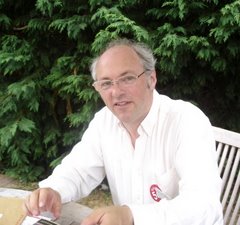
COREY S. POWELL
Senior Editor, Discover Magazine; Adjunct Professor, Science Journalism, NYU; Author: God in the Equation: How Einstein Transformed Religion

Corrective Goggles for Our Conceptual Myopia
Broadly speaking, I am optimistic that the world's current crises look terrifyingly large mainly because of our conceptual myopia. It is practically a truism to say that every era tends to regard its troubles as uniquely daunting, but I think that accelerating news cycles make the current generation particularly prone to this error of judgment. Making my best attempt to put on corrective goggles and take the longer view, I see a half-dozen areas where we are on the verge of major advances in our ability to expand our control over our environment and ourselves, in way that will be largely or entirely beneficial.
• I am optimistic that technology will soon show practical ways to eradicate the twin problems of carbon emissions and fossil-fuel scarcity. In the nearer term, carbon dioxide will follow the path of CFCs, acid-rain-causing sulfur oxides, and nearly all automobile tailpipe emissions. Nay-sayers warned that all of these would be difficult and economically disruptive to tackle; in every case, the nay-sayers were roundly proven wrong. Carbon sequestration is the most obvious technology for offsetting carbon emissions. Here's a firm prediction: If the world's leading economies set tough emissions standards for CO2, or establish a serious carbon tax, industry will find astonishingly inexpensive ways to comply within a few years.
• Farther ahead, new energy sources will begin to make serious contributions to the world economy long before fossil fuels run out. My bet is still on fusion energy, despite its perfect, five-decade record of never fulfilling any of its promises. I seriously doubt, though, that commercially viable fusion energy will look anything like the huge and hideously expensive magnetic-confinement test machines (like ITER) now being built or planned. More likely it will take the shape of a compact, laser- or radio-driven linear accelerator using exotic nuclear reactions that spit out protons, not neutrons; send the protons flying through a copper coil and you have direct electricity conversion, with no boiler, no steam, no turbine, no dynamo.
• I am optimistic that we are on the verge of developing the tools to program biological systems as effortlessly as we program digital ones. Synthetic biology, a field spearheaded by George Church, Drew Endy, and Jay Keasling, will be key to attaining this goal—and it is now in transition from theory to reality. Rather than snipping genes from one creature and clumsily inserting them into another, future biotechnicians will consult a master database of DNA sequences and specify the traits they want, whether to insert into an existing organism or to create in a brand-new one designed from the ground up. (A corollary is that these tools will finally allow effective stem-cell therapy, which leads to a related prediction: Thirty years from now, the current agonies over the ethics of stem-cell therapy will look as quaint as the hand-wringing over "test tube babies" in the 1970s.) Synthetic biology in its fully realized form will also be a dangerous weapon. A related part of my optimism is that it—like electricity, like radio, like all genetic research so far—will prove far more useful for positive applications than for negative ones.
• I am optimistic that young adults today will, on average, live to 120 and will remain healthy and vigorous until their final years. Researchers like Leonard Guarente, David Sinclair, and Cynthia Kenyon are zeroing in on the chemical and genetic basis of aging. Immortality is a long way off, but drugs and genetic therapies that hold back age-related diseases are coming soon. Treatments that slow the aging process as a whole will follow closely behind. Ultimately these will lead to a wholesale reordering of the pace of life and the social structures based around certain biological milestones.The child-bearing years may extend into the 60s; people may routinely continue working into their 80s or beyond. With this expanded timeline will come all kinds of new possibilities, including vastly expanded periods of intellectual creativity and a softening of the irrational behaviors that arise from the universal fear of death.
• I am optimistic that the longer life of the body will be accompanied by enhanced powers of the brain. We already live in world where it is getting harder and harder to forget. A simple Google search often revives long-lost trivia, historical experiences, even the names of long-dead relatives. What we have today is but a tiny taste of what lies ahead. Computing power is now so cheap, and wireless communication so effortless, that a person could easily wear a microphone (or even a low-res video camera) at all times and compile a digital database of every word he or she uttered.
In the future, many people will choose to do so; we will all have personalized, searchable databases at our commands. Rapid advances in brain prostheses mean that soon we will be able to access those databases simply by the power of thought. Within a couple decades, the information will be beamed back in a form the brain can interpret—we will be able to hear the playback in much the manner that deaf people can now hear the world with cochlear implants. Vision is slightly more difficult but it too will be reverse engineered. That will undoubtedly give space exploration a tremendous boost. Earthbound scientists will be able to "inhabit" robotic explorers on other worlds, and any interested participant will be able to log on passively to experience the adventure. Humans will venture into space physically as well but at first that will happen primarily for sport, I expect.
• I am optimistic that researchers, aided by longer careers and computer assistance, will crack the great twin mysteries of physics: the nature of gravity and the possibility of other dimensions. Here I'm talking not just about theoretical advances, as may occur at the Large Hadron Collider after it revs up in late '07, that could bolster the theory that gravity, unlike the other forces, has the ability to transmit out of the three dimensions of human experience. I am also talking about a kookier optimism that our discoveries will have practical consequences. It may be possible to build instruments that can sense universes lying outside of our dimensions. It may be possible to manipulate gravity, turning it down where convenient (to launch a rocket, for instance) and cranking it up where desired. It may even be possible to create a new universe as a laboratory experiment—the ultimate empirical investigation of the Big Bang that started our universe.
• Finally, I am optimistic that with all of these intellectual and material achievements will come a science-based spiritual awakening. Back in the 1930s Albert Einstein spoke of a "cosmic religious feeling" and tried to convince the public (with painfully little success) that scientists are every bit as spiritual as are the world's religious leaders. It may not look that way now, but I think Einstein will soon be vindicated. Longer, more connected lives will eat away at the religion of fear, the rudimentary form of faith rooted in anxiety about loneliness and the apparent absoluteness of death.
More important, the next round of scientific discoveries promise a powerful new sense of our connection to the rest of the universe, and even to universes beyond our own. One of the most potent knocks on science is that it, unlike religion, offers no sense of purpose. That has never been true—what greater purpose is there than intellectual exploration, the key trait distinguishing us from the other animals—but now more than ever science has a chance to make its case. It needs to develop more of a communal structure. It needs to develop a humane language, expressing its findings explicitly as triumphs of human achievement. It needs to celebrate our ever-expanding dominion over nature while articulating a humble appreciation that nature is, indeed, where we all came from.
Above all, science needs a face, a representative (or representatives) as charismatic as Pope Benedict XVI or, er, Tom Cruise, who can get rid of all those "it"s in the pervious sentences. Right now, the faces of science are selected by book sales, television specials, and pure self-promotion; its elected leaders, like the heads of scientific societies, rarely function as public figures. Surely there is a better way. Any suggestions?