| By Denise Winterman BBC News Magazine |

How hard can it really be? The rolls of surplus flesh, the tight waistband, not being able to see your own feet - you don't need to be a rocket scientist to work out you're carrying extra pounds.
But many people don't consider themselves overweight, according to fitness minister Caroline Flint, who says it's one reason why nearly a quarter of adults in the UK are obese.


The government and doctors use the body mass index (BMI) to assess a person's condition; classing us as "underweight, ok, overweight, obese or clinically obese". The calculation is based on comparing a person's weight with their height and does not take into account sex or the proportion of body fat to muscle.
Some medical bodies, including the World Health Organization, say waist size is a more accurate measure, but the government has no plans to ditch the BMI.
"We are aware of criticism and that there has been talk of the hip-to-waist ratio, but BMI is the agreed system and we will continue to use it," says a Department of Health spokeswoman.
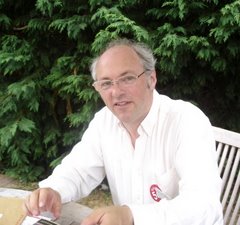
So what does obesity look like? The Magazine headed to Stratford, east London, to break the unhappy news to some unsuspecting men, who significantly outnumber women in the fight against fat.
"Obese! Not even just overweight. That is a bit of a shock. I think it's ridiculous, I'm 6ft 4ins so I'm never going to be as light as a feather. I think my weight is fine for my height.


 Enlarge Image
"To get to the weight slap in the middle of what the index says is right for a man of my height I would have to lose around five stone. That's madness, I'd look ill and as if I had a massive head.
"I eat one big meal a day, it is a really big meal - maybe a whole chicken, rice and peas.
I think the amount I eat and my diet is good. There is a problem with weight in this country but the index is confusing. It doesn't take into account things like muscle."
"No way. I don't agree with that - it's crazy. I know I'm carrying a few extra pounds and I am having a cheeseburger for breakfast, but obese? I'm just eating this to kill a bit of time before an appointment, I don't usually have a burger for breakfast.

"That classification isn't any good because it doesn't take into account my body frame, muscle or what sex I am, all of which make a difference.
"I'd have to lose around three stone for the government to think I'm the right weight, That's just stupid. I'd look ill and I probably would be ill.
"I know the government has to have a way to measure weight, but this is not it. They need to look at things again."
"I know I'm carrying a little bit of extra weight but I'm not obese. I think I am a fair weight for my height and build.

"The BMI doesn't take into account things like muscle, which is important. It would class most rugby players and footballers as obese and look how fit they are.
"According to the index my healthy weight is around 12 to 13 stone, but I actually think that is underweight for my height.
"There is a problem with obesity in this country, people don't eat well or look after themselves. But using the BMI is not the right way of assessing the problem, it's not very helpful."
"I knew it would have me as obese. I know I am packing a few extra pounds, but I don't consider myself obese.

"I'm big boned but the index doesn't take that into account and it should. I do drive a cab, which means I'm sitting on my bum all day but I wouldn't say I was unhealthy.
"I have lost weight in recent months. I did it by eating healthily, my wife does all that stuff - salads and that. She looks after me very well.
"The BMI is not a helpful way of calculating who's overweight and not. The problem is if people don't trust it they're not going to trust what else the government says about being healthy."
"I think that's a bit harsh. I know I could do with losing some weight, but only a few pounds.

"I'd have to lose about two stone to get to what the government thinks is the ideal weight for me. It's ridiculous, I would look ill, look like a skeleton. I would not look healthy.
"I know there are some things about my eating habits that I could change but on the whole I don't consider myself unhealthy.
"I'd like to see what some of those government ministers are classed as using this index. I would like to see how they react to being called fat."
I'm a male 5'8" and 12Stone. If I was built like George Cluney then the BMI wouldn't fit me but then I wouldn't have a double chin or love handles so I guess that I need to loose some weight. The problem is that because so many people are overweight being a bit chunky has become the norm and doesn't look out of place. However the fact of the matter is, if you are overweight then you increase your chances of dying before you should. So be fat or not but don't criticise the government for giving a simple guide to help you.
Paul, Glasgow
Current thinking is that a person's waist measurement is a more accurate way of seeing if they are obese. Many athletes, i.e. weight lifters, shot putters, etc. are very large but it is all muscle and would show as obese if bmi was used.
JILL BOND
I look at these pictures and see men that, mostly, look reasonably healthy. Maybe Britain's problem is not obesity but the BMI index. Its just another nanny state scare story.
Mike Ayres, Bodmin, UK
I challenge all members of parliament to have their weight checked against the BMI index and see how many of them come out overweight and obese.
maureen hodgson, telford shropshire UK
I'm sorry but I think many people in Britain are deluded about their weight. It is easy to disguise several stone of excess flesh by dressing carefully. However, the internal threat to our systems is there none the less. Stay fat if you like but be prepared to suffer the consequences of your denial!! Healthy eating is just a good habit we need to practise. Unhealthy eating is just a bad habit we need to give up. Not rocket science.
OmegaSarah, Huntingodn
These five men are in denial about their size. Of the four men you can see none of them look healthy, they are just hiding their bodies in lose fitting clothes. They all look overweight to me and could do with losing more than their suggested few pounds. Lee Embery sums up public perception of weight when he says "I'd have to lose two stone ... I would look ill, look like a skeleton". People don't see being overweight as looking ill they see being lean as ill. Even though the people with BMI index in the lower half of the ideal weight section have the least health problems.
Andrew Campbell, Southport, UK
Maybe the BMI takes it's baseline from the skeletal celebrities/models rather than real people? Not to take muscle into account is ridiculous as it weighs so much more than fat.
Sue, Cheshire
ig Boned? Given that your skeleton accounts for just 15% of your body weight it's clear that even if you had bones half as big again as the next person this isn't going to have much effect on your overall weight. Lay off the pies, and you'll end up with the correct BMI; people are just kidding themselves.
Ewan, Newcastle Upon Tyne
What a horrible world it would be if everyone conformed to this meaningless measure, and we all pottered about half starved, in our joyless feable frames. Thank god we still have the right to live our lives the way we want to, for now.
Steve Alcock, Colchester
According to the BMI Jonny Wilkinson is overweight and the likes of Lawrence Dallaglio are obese. Need I say more?
Steve Ferris, Gloucester
I have to say I agree with these blokes - they all look fine to me! I am in the ok weight-range on the chart, but then I am female so probably have less muscle than these guys, who all look ok to me. As they say, maybe a couple of them could do with losing a few pounds, but I certainly wouldn't class these people as obese...or even overweight in most cases! Very interesting - I thought BMI was a good way of measuring if someone was overweight or not, but now I'm not so convinced.
Rebecca, birmingham
Its crazy madness i tell you, none of those men look obese!! The chap who uses the example of rugby players is spot on, muscle weighs a lot more than fat. I went ona diet, exercised, changed shape and went down two dress sizes, but for the first few months i put weight on, as i was building muscle. I was told by a qualified fitness instructor NOT to weigh myself as it is misleading!! Utter rubbish this BMI scale, but unfortunatly it needs to be measured, just in a more realistic way.
Suz, Gloucestershire
I am a weight lifter and runner. I ran the Nike Run London 10km in 54 minutes and today I benched 120kg in the gym. At 6'1" and 105 kg I am obese according to the BMI.
Philip Duran, London
I'm 18 years old, and have lost 5and 1/2 stone in just over a year. My BMI states that I am right in the middle, if not towards the top end of the right weight for me (being 5ft 8 inches, weighing 1o stone 5 pounds) yet some people in my family have recommended that I need to put on 1/2 a stone to be at the right weight. I think that all the BMI can be used for is a vague benchmark for people, and is unreliable, and inaccurate.
Richard Durkin, Sheffield
Well, I'm 6'4" and approx 85kgs so with a BMI of about 22.5. Recently I weighed about 10kgs more than that, realised I was getting podgy and lost the weight. It's really not that hard, you've just got to stop deluding yourself that you're healthy. Theres a hude difference between International Rugby players and us common mortals.
Duncan, Cambridge
I'm 5'7", about 14st, broad-shouldered and stocky. The charts say I'm around 3.5st too heavy, and class me as obese. The charts lie. I had a medical a while ago (I weighed more then) that measured my actual body fat percentage. They calculated my ideal weight range to be only 1-2st less than my current. BMI is a fiction that succeeds only in setting unachievable targets, and making healthy people feel insecure in themselves.
Jon, Cambridge UK


 We should be able to put something like this in a leisure centre and members of the public could use it on a regular basis


 Fat is good in general, but when you have too much of it or fat in the wrong places it is bad