logo


6 years ago
Editorial by Terry Sanderson
Murphy O'Connor should be shown the door
In a somewhat over-blown speech in London this week, the head of the Catholic Church in England and Wales, Cardinal Cormac Murphy O'Connor, claimed that religion is under attack in this country.
Murphy O'Connor is still raging at the defeat of the Church's attempts to be exempted from legislation designed to protect gay, lesbian and bisexual people from discrimination. He became the first Catholic leader in nearly 200 years to question whether the policy of the government interferes with the practice of Roman Catholicism. He accused the British government of creating, "a different version of our democracy, one in which diversity and equality are held to be at odds with religion."
In a breathtakingly manipulative speech, aimed directly at Downing Street and Tony Blair's Catholic pretensions, Murphy O'Connor told an audience at Westminster Cathedral: "My fear is that, under the guise of legislating for what is said to be tolerance, we are legislating for intolerance. Once this begins, it is hard to see where it ends. My fear is that in an attempt to clear the public square of what are seen as unacceptable intrusions, we weaken the pillars on which that public square is erected, and we will discover that the pillars of pluralism may not survive. The question is whether the threads holding together pluralist democracy have begun to unravel. That is why I have sounded this note of alarm. I am conscious that when an essential core of our democratic freedom risks being undermined, subsequent generations will hold to account those who were able to raise their voices yet stayed silent."
Murphy O'Connor claimed that a secular society would cause religion to go off the rails. He said: "The secular state, which we now risk adopting in Britain, seeks a politics entirely independent of religion, in which religious principles have nothing to say in the 'real' world of political action. The choice of the State to side with the secular is said to be neutrality; and it is usually justified by an appeal to equality. But this is in itself ideology, divorcing religion from the public realm on the pretext that religion is divisive. This sets up great tensions in society. The more determinedly secular a state becomes, the more pressure mounts for religious beliefs to assert themselves. We then no longer have a common search for truth on the basis of shared reason, but a series of monologues in which each side excludes the other. People talk past each other. There is little reasoned thinking.
does Religion depend on reasoned thinking, or on Faith?
There is no adequate civil discourse. Society is then at risk of the fragmentation of its moral structure."
Murphy O'Connor said he feared that Britain was becoming a country where faith-based charity work will not be welcomed. "When Christians stand by their beliefs, they are intolerant dogmatists. When they sin, they are hypocrites. When they take the side of the poor, they are soft-headed liberals. When they seek to defend the family, they are right wing reactionaries," he moaned.
The Cardinal gave his strongest indication yet that the church would close their nine adoption agencies rather than take an estimated £10m of government money to run them in compliance with the new law.
Terry Sanderson, president of the National Secular Society, commented: "Murphy O'Connor's own behaviour in the past disqualifies him from lecturing others on morality – especially in relation to vulnerable children. We have yet to hear any meaningful apology from him for the disgusting cover up he engineered for the rampaging paedophile priest "Father" Michael Hill. And as for the Catholic Church suddenly becoming a defender of democracy – what does that institution know about democracy? Its headquarters, Vatican City – a supposed independent state – is the also the only surviving theocracy in Europe. The Vatican loves to interfere in the politics of other nations (see other stories in this edition of Newsline), but there is no opportunity for anyone to repay the compliment.
"The Catholic Church has happily allied itself with just about every totalitarian regime that has emerged over the centuries in Europe. At the moment it is in bed with the crypto-fascist regime in Poland. Cardinal Murphy O'Connor has nothing to teach us about morals or democracy, and nor is he qualified to lecture us on 'conscience'. The Catholic conscience seems to mean that those who have it have awarded themselves carte blanche to be as nasty and excluding as they like to those they don't approve of. Well, modern concepts of human rights must trump these claims of divine conscience. It's time for the Catholic Church – and all the other religious bodies that seek to impose their will on democratic governments – to be firmly put in their place."
Read the whole speech.
reposted from: NSS
my: highlights / emphasis / key points / comments

When the leaders of 27 countries meet in Berlin today to celebrate the 50th anniversary of the EU, there will be one significant absence. To the annoyance of many Poles, who have what is arguably the most crackpot right-wing government in Europe, God has not been invited to the party. Neither Christianity nor the deity feature in the declaration which Europe's leaders will sign to mark the occasion, signalling the high point of what has been a fantastic week for secularism.
I would think that, you might say, given that one of the jobs I most fancy is poster-girl for a strictly rational approach to human affairs. But recent events show that it isn't just sceptics who are worried by the inroads which other people's imaginary friends have been making in secular states. The politician behind the decision to exclude any reference to religion from the Berlin declaration is the German Chancellor Angela Merkel, a pastor's daughter, who recognises the crucial importance for most modern societies of a separation between church and state - and of not providing ammunition to critics who accuse the EU of being a Christian club.
In this country, in a blow to the Islamophobia industry which has tried to silence critics of Islam through strident accusations of racism, the Education Secretary Alan Johnson issued guidelines which will allow schools to ban paranoid forms of religious dress, including the mask, or "niqab", worn by some Muslim girls. I'm sure this will have wide public support, because the last thing most people want is a Talibanisation of relations between men and women in the UK.
At the same time, some of the country's most senior Anglican prelates were roundly defeated in the House of Lords when they made the idiotic error of supporting the Catholic Church in its attempt to discriminate against gay couples who want to use its state-funded adoption agencies. "What do we want? Discrimination! When do we want it? Now!" has never seemed to me a persuasive platform for any religion to fight on, especially when the public has warmed to gay weddings such as that of the singer Sir Elton John (who, by the way, is celebrating his 60th birthday with an eloquent blast against gay-bashing worldwide).
In a dramatic sign of the times, the Archbishop of York and two Anglican bishops found themselves criticised by peers who wanted to know what had happened to the notion of Christian love. Baroness Howarth and the former Culture secretary, Lord Smith, spoke as practising Christians and were supported by Lord Alli and my friend Baroness Massey, easily winning the debate. The Anglican hierarchy needs to do some soul-searching about why they joined this doomed cause, placing themselves on the same side as monstrously prejudiced bishops from Latin America and Africa.
Meanwhile in Paris, in a ruling welcomed as a robust assertion of the right to free speech, a French court acquitted Philippe Val, editor of the weekly satirical magazine Charlie Hebdo, who was taken to court by Muslim organisations after publishing three cartoons deemed offensive to the Prophet. And the European Court of Human Rights in Strasbourg ruled against Poland, which has one of the most restrictive abortion laws in Europe, after a Polish woman lost most of her sight when she was denied a legal abortion on medical grounds.
The Enlightenment, in other words, is back with a bang. Of course people have a right to their religious views, but they aren't entitled to exercise them in ways that trample on the rights of women, children, gay people and freethinkers. Wake up and smell the coffee: God doesn't rule, OK?
reposted from: independent
my: highlights / emphasis / key points / comments

by Terry Sanderson
Engaging with religious liberals will not help to undermine extremists; it will only enable and protect them.
There's an argument in religious circles that goes: in order to undermine the fanatics we have to encourage the liberal elements of religion. If you want to stop suicide bombers, you have to encourage the more moderate voices in Islam to speak up. The same argument surfaces regularly in Christian circles - yes, there are fundamentalists out there doing horrible things, but you can't judge all Christians by the activities of the minority at the extremes, it goes. Why not support the good guys who are doing their best and being ever so nice?
It's a seductive argument and I used to subscribe to it myself. But I've changed my mind.
As president of the National Secular Society I am are constantly approached by religious groups wanting to engage us in their pursuit of "interfaith dialogue". They want, they say, to "break down barriers", and who doesn't?
But once involved in these groups, it soon becomes clear that they are all from the liberal tradition. One set of moderates talking to another. The people who really need to engage - the jihadis and the literalists - are off practising the sectarian warfare they are so fond of. Let's talk? No, let's abuse human rights, persecute infidels and preach hate.
I've come to realise that the delusions of the liberals are not qualitatively different from those entertained by the Pat Robertsons or Abu Hamzas of this world.
The danger that these apparently harmless liberals pose is that of enabling the fanatics, who happily use them as human shields. Just as the terrorists of the Middle East will hide out in schools and hospitals to avoid being targeted by enemy bombs, so the ideological terrorists hide behind the liberals and the good-natured in order to spread their doctrine of intimidation and terror.
The poor, bleating liberals who are constantly complaining that their faith is not only misunderstood by its non-adherents, but also perverted by the fanatics who share it. There they stand, having spent a lifetime reinforcing in their heads the childhood brainwashing that they will never overcome, and making excuses for the same beliefs that motivate bombers and theocrats, misogynists and homophobes. This hinders the rest of us getting a clear run at the villains.
The liberals pave the way, open the doors and give succour to the very people they say bring their faith into disrepute. But it's no good the liberals trying to dissociate themselves from their wilder compatriots in faith. They promote and praise the same holy books that the fanatics use as justification for their murderous activities. "But the terrorists and the bigots are not true Christians/Muslims" say the liberals, while the bigots and the terrorists say exactly the same thing about them.
Or, as Sam Harris said in a recent essay:
"The problem is that wherever one stands on this continuum, one inadvertently shelters those who are more fanatical than oneself from criticism. Ordinary fundamentalist Christians, by maintaining that the Bible is the perfect word of God, inadvertently support the Dominionists, men and women who, by the millions, are quietly working to turn our country into a totalitarian theocracy reminiscent of John Calvin's Geneva. Christian moderates, by their lingering attachment to the unique divinity of Jesus, protect the faith of fundamentalists from public scorn. Christian liberals 'who aren't sure what they believe but just love the experience of going to church occasionally' deny the moderates a proper collision with scientific rationality. And in this way centuries have come and gone without an honest word being spoken about God in our society."
I am now accustomed to being accused of practising "fundamentalist secularism" and "atheist extremism" by religious reactionaries, but now the terms are being eagerly embraced by liberals. But a moment's thought would tell the liberals that democratic secularism is their best friend. Not only does it protect those of no belief from being persecuted by over-mighty and ruthless religious regimes, but it offers protection to the smaller religious groups who have become used to being stamped on by their holier-than-thou big brothers (try being a Christian in Saudi Arabia, for instance).
Liberals in religious traditions may not have evil intentions towards their fellow men, but they provide cover for their fellow believers who do.
reposted from: CIF
my: highlights / emphasis / key points / comments
I covered Rod Liddle programme here.
Unedited except for my highlights in bold.
Editorial by Terry Sanderson, National Securalists Society
The Rod Liddle programme The Trouble with Atheism on Channel 4 on Monday was, as we expected, biased, dishonest and about as profound as a pancake. We have to make allowances for the fact that it was a polemic, and that Mr Liddle had started out with a contention that he needed to support. So the programme proceeded from the idea that “militant” atheists are really just the mirror image of “fundamentalist” religious believers.
The first flaw in Mr Liddle’s approach was his use of terminology. He bandied about the words “atheist” and “secularist” as though they were interchangeable and synonymous. This is the favourite trick of the religious right, who love to sow confusion about secularism.
Mr Liddle then promoted atheism to the status of a full-blown ideology, with all kinds of sects and belief systems attached to it, and even with a holy book of its own. In fact, “atheism” simply means “without belief in entities called gods”. That’s all, no more.
Practically all atheists are happy to leave it at that and give it no further consideration. They don’t, as Mr Liddle was suggesting, have any desire to force others to abandon their religion, to suppress it or take it away from them by force (and if that doesn’t work, kill them).
There are those of us, though, who feel that religion’s malign influences far outweigh any good it does in the public sphere, and seek to keep it from casting its undesirable cloak over our lives. We are secularists. Some secularists are religious people, who also think “faith” is something that rightly belongs inside your head or in the church or the home. They, too, don’t think that organised religion has a place in parliament or shared institutions, for they know the havoc it can wreak when it seeks power.
Those of us who want to keep the public square a neutral space that all can inhabit without privilege or disadvantage are secularists. Most of us are also atheists, but by no means all. Mr Liddle -- and many others like him -- doesn’t seem to be able to make this distinction.
Mr Liddle suggests that all those who think that evolution is the most likely explanation for the existence of life as we know it on earth are also de facto “atheists”. Suddenly “atheists” have a holy book -- The Origin of Species -- which is beyond questioning, just like the Bible and the Koran are for true believers.
I know of no-one who declares themselves an atheist or a secularist who wants to eliminate religion by force -- although to hear Mr Liddle tell it, anyone who doesn’t believe in the supernatural is a nascent Stalin or Hitler.
Mr Liddle advised us that Stalin and Hitler ran atheistic regimes that resulted in the deaths of thousands of innocents -- therefore, atheism is a lethal as fundamentalist religion. Despite being corrected by Peter Atkins and Richard Dawkins (who told him that these were Marxist / fascist regimes, and atheism was incidental and not their moving force) Mr Liddle ploughed on (carefully editing the interviews to ensure that nobody could make a proper case in answer to any of the ludicrous claims he was making).
The atheists he interviewed were challenged and misrepresented and their interviews cut in such a way that they appeared unable to adequately answer Mr Liddle’s supposedly profoundly damaging accusations. Those who supported Mr Liddle’s arguments were, of course, given a clear run, without, in the main, interruption. If I had been interviewed for this programme and treated like that, I would be very annoyed.
The fact the Mr Liddle had carefully extracted the most extreme-sounding responses from the non-believers, (pulled out of context from what I expect were extensive interviews), transformed this programme from being an honest expression of an opinion into being plain distortion. Yes, Mr Liddle has a point of view to put over, and it’s legitimate that he should have the opportunity to do so, but this was a dissembling way to do it.
On the rare occasions that the atheists did manage to give a complete answer, they seemed perfectly reasonable. None of them sounded like the fundamentalist extremists that he was trying to paint them as.
I knew I wouldn’t agree with Mr Liddle’s contention before the programme began (mainly because I’ve heard it a thousand times in the past year from panicky Christian propagandists who are seeing their belief system being rejected by an increasing number of people who have come to the conclusion that it just isn’t sustainable in the modern world). I defend Rod’s right to say what he wants, but I also reserve the right to complain that this programme was so poorly made, badly argued and unfairly edited that it fell below the standards we have come to expect of British television.
See also: http://www.channel4.com/culture/microsites/C/can_you_believe_it/debates/talking_point_atheism.html


After Dennis Cobell (NSS, President) meeting with the Dorset Humanists on 11th November, on 16th November 2006 I became a member of the National Secular Society.
Those of us who value reason are becoming alarmed about the increasingly extreme religious influence in our government, our lawmakers, and our public institutions - especially in our education system. Many people, while standing up for freedom of religion, and freedom not to believe, feel that the proper place for religion is in the place of worship or home. They see the danger of religion becoming too politically ambitious.
The NSS is a rallying point for opposition to this religious resurgence. We must convince our politicians and public servants - as well as our friends, neighbours and colleagues - that our institutions and public life should be secular. A secular state should guarantee freedom of conscience, but eliminate religious privilege.
The only way to prevent the kind of religious power-seeking that leads to conflict is to make both religious discrimination and religious privilege constitutionally impossible.
We need a secular constitution that will:
Religious influence in Government has not been higher in living memory. The rise of fundamentalist religion of all shades has the potential to seriously erode hard-won freedoms.
Individually, we can only look on with mounting fear, but working together we can make a difference. Join the fight for a truly secular society and join the National Secular Society today.
Keith Porteous Wood
Executive Director
National Secular Society
Include
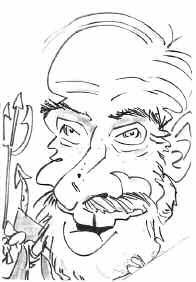
At the Dorset Humanists meeting in Bournemouth on 11th November Dennis Cobell gave a talk on the National Secular Society (NSS). He is the 10th President of NSS and described himself as a Secular Humanist. He is a member of both BHA (British Humanist Association) and NSS.
The weekly NSS Newsline is edited by Terry Sanderson (who should soon be the 11th President) and includes a database of articles in magazines & newspapers.
The NSS helped to defeat the Incitement to Religious Hatred bill. I note that NSS has a similar outlook as Comedian and actor Rowan Atkinson who branded as "draconian" plans to make incitement to religious hatred illegal. "In a democracy there is no right not to be offended" Shami Chakrabarti. The NSS is opposed to Faith Schools. School entry criteria based on religion must be reduced and eventually eliminated. 16 year olds students now (as parents already have) have the right to opt of out Religious Education lessons.
The Prophet is not the only one to
be caricatured – when the
President recently spoke this is
how one listener saw him… with
a devil’s trident! (source: NSS Annual Report 2006)
Nicolas Walter (editor, New Humanist) has defined Secularism as "this life is all we know. Their is no evidence for any other world. One world is quite enough to deal with any one time, in any case". (this quote needs verifying)
When BNP Leader Nick Griffin told a crowd Islam was a "wicked, vicious faith", he had no idea his speech was being secretly captured on camera by the BBC. Nick Griffen has been acquitted of race hate offenses. I note that he has maintained his words were intended not to stir up racial hatred but to motivate already like-minded people to get involved in the party. Judge Norman Jones QC said a democratic society gave its citizens the right to free speech. He said: "That does not mean it is limited to speaking only the acceptable, popular or politically correct things."
The NSS advocates that ALL weddings be Civil weddings but that in addition a separate ceremony could include religious or humanist content.
The NSS publishes The Bulletin three times a year.
The "non belief in the supernatural" is an issue that a minority of NSS members want to exclude from the NSS "constitution". This was not discussed further at this meeting but is clearly a crucial issue for NSS.
It is unlikely that NSS & BHA will merge. This proposal has been rejected by both organisations in the past.
Securalist of the Year
Professor Steve Jones, the scientist & geneticist, has recently been giving a lecture around the country entitled “Why evolution is right and creationism is wrong.” He was awarded the "Secularist of the Year" prize in October 2006 by NSS. I note that Jones has offended some Christians with his allegations that Creationism is "anti-science". This brings him into direct opposition with proponents of Creationism like Ken Ham (who Jones publicly criticised) who argue that evolution is hypothesis, not science. Jones suggested in a BBC Radio Ulster interview on 19 March 2006 that Creationists should be disallowed from being medical doctors because "all of its (Creationism's) claims fly in the face of the whole of science", and disputes the claim that anyone who believes in Biblical Creation can be a serious biologist.
Cobell mentioned that Dorset Humanists could consider affiliating to the NSS just as they were affiliated to British Humanists. I note that South Hampshire Humanists affiliate to both groups.
Questions from the Floor
Chris Street asked Cobell "Was not the ongoing Evolution v Creationism Scientifhc debate important and what was the NSS view of Science in relation to Religion? Chris stated that he believed that Science (in the words of Lewis Wolpert) is the Best Way of Understanding the World.
?? Asked: What were the differances between NSS and BHA. Cobell said the NSS focuses on challenging religious privaleges and promoting the separation of Church & State whilst BHA focuses on officiation at Humanist Ceremonies (Namings, Weddings and Deaths). The NSS has 2500 members and BHA 5000 members. Membership of both groups has grown significantly recently.
From the National Secular Society website
(this section needs editing)
We want a society in which all are free to practise their faith, change it or not have one, according to their conscience. Our belief or lack of it should neither advantage or disadvantage. Religion should be a matter of private conscience, for the home and place of worship; it must not have privileged input into the political arena where history shows it to bring conflict and injustice.
The National Secular Society is the leading pressure group defending the rights of non-believers from the demands of religious power-seekers. We campaign on a wide range of issues, including religious influence in the government, the disestablishment of the Church of England, the removal of the Bench of Bishops from the House of Lords and for conversion of religious schools (paid for by the taxpayer) to community schools, open to all.
Additionally:
Even now the government seems anxious to increase religious involvement in public life. Each increase disadvantages those who have no religion.
Only by secularising our institutions can we ensure that no religious ideology can dominate and discriminate against others.
The NSS was founded in 1866 by Charles Bradlaugh. A message from Claire Rayner.The NSS is a rallying point for opposition to this religious resurgence. We must convince our politicians and public servants - as well as our friends, neighbours and colleagues - that our institutions and public life should be secular. A secular state should guarantee freedom of conscience, but eliminate religious privilege.
The only way to prevent the kind of religious power-seeking that leads to conflict is to make both religious discrimination and religious privilege constitutionally impossible.
We need a secular constitution that will:
Religious influence in Government has not been higher in living memory. The rise of fundamentalist religion of all shades has the potential to seriously erode hard-won freedoms.
I visited the NSS website and extracted this info from it:-
About the National Secular Society
We want a society in which all are free to practise their faith, change it or not have one, according to their conscience. Our belief or lack of it should neither advantage or disadvantage. Religion should be a matter of private conscience, for the home and place of worship; it must not have privileged input into the political arena where history shows it to bring conflict and injustice.
The National Secular Society is the leading pressure group defending the rights of non-believers from the demands of religious power-seekers. We campaign on a wide range of issues, including religious influence in the government, the disestablishment of the Church of England, the removal of the Bench of Bishops from the House of Lords and for conversion of religious schools (paid for by the taxpayer) to community schools, open to all.
Additionally:
Even now the government seems anxious to increase religious involvement in public life. Each increase disadvantages those who have no religion.
Only by secularising our institutions can we ensure that no religious ideology can dominate and discriminate against others.
Those of us who value reason are becoming alarmed about the increasingly extreme religious influence in our government, our lawmakers, and our public institutions - especially in our education system. Many people, while standing up for freedom of religion, and freedom not to believe, feel that the proper place for religion is in the place of worship or home. They see the danger of religion becoming too politically ambitious.
The NSS is a rallying point for opposition to this religious resurgence. We must convince our politicians and public servants - as well as our friends, neighbours and colleagues - that our institutions and public life should be secular. A secular state should guarantee freedom of conscience, but eliminate religious privilege.
The only way to prevent the kind of religious power-seeking that leads to conflict is to make both religious discrimination and religious privilege constitutionally impossible.
We need a secular constitution that will:
Religious influence in Government has not been higher in living memory. The rise of fundamentalist religion of all shades has the potential to seriously erode hard-won freedoms.
Individually, we can only look on with mounting fear, but working together we can make a difference. Join the fight for a truly secular society and join the National Secular Society today.I visited the BHA website and extracted this stuff from it:-
The British Humanist Association
Atheist? Agnostic? Not religious? The BHA is the largest organisation in the UK supporting and representing the non-religious and campaigning for a secular society.
Culturally Christian (you tick the box but don't believe)?
Then You're Probably a Humanist Already
Try Our Test &
Join the British Humanist Association Today!
The Test: Are you a Humanist?
Our Vision
A world without religious privilege or discrimination, where people are free to live good lives on the basis of reason, experience and shared human values.
Our Mission
The British Humanist Association exists to promote Humanism and support and represent people who seek to live good lives without religious or superstitious beliefs.
The British Humanist Association (BHA) represents the interests of the large and growing population of ethically concerned but non-religious people in the UK – helping to set the agenda for debate. Committed to human rights, democracy, equality and mutual respect, the BHA works for an open and inclusive society with freedom of belief and speech, and for an end to the privileged position of religion – and Christianity in particular – in law, education, broadcasting and wherever else it occurs.
The BHA is renowned for its humanist funerals, weddings, baby-namings and other non-religious ceremonies. These meet a very real need in the community, and the rapidly growing demand for high quality ceremonies keeps our network of trained and accredited officiants extremely busy. Find out more here.
We also help humanists and other non-religious people to gain confidence in their beliefs (see Humanism) and build a foundation from which to live their lives with integrity. The BHA supports networks for families, teachers and others to share ideas and experience and provide mutual support. Local humanist groups provide opportunities for humanists to meet like-minded people for lectures, discussions and social activities. We lobby for the inclusion of Humanism in the school curriculum so that all pupils have the opportunity to learn about it, and provide educational resources for schools and students of all ages. Our contribution to improvements in religious education is widely recognised.
BHA policies are based on humanist principles and informed by our members and supporters, who include eminent authorities in many fields. With the support of its Humanist Philosophers’’ Group, scientists and other experts, the BHA contributes to debate on a wide range of ethical issues from sex education to gene therapy, and acts as a unique watchdog and lobbying organisation. Click here to see some of our submissions and briefings on human rights, social and ethical issues.
With a mixture of: high profile campaigns; submissions to Government, e.g. in proposed legislation; evidence to official enquiries, e.g. on the ethics of genetic research; liaison with humanists in Parliament; briefing and lobbying, the BHA campaigns for:
· freedom of belief and respect for the non-religious, including recognition of humanist views on a wide range of issue;
· an end to discrimination on the grounds of religion or belief, whether in marriage law, the workplace, or the provision of public services;
· an end to religious privilege;
· inclusive schools where children with parents of all faiths and none learn to understand and respect each other, instead of being segregated in the growing number of faith and sectarian schools;
· impartial, fair and balanced education about religion and beliefs, with an emphasis on shared human values;
· school assemblies without religious worship.