Yesterdays Sunday Times had an article on Edge.org (source: Feedwhip). My highlights are in bold.
The Sunday Times November 19, 2006
The Galileo effect: dangerous ideas waiting to happen
A group of scientists has been given freedom to express heretical theories. Steve Farrar reports
Here’s an idea. The way you raise your children has no influence on their personalities, their intelligence or the way they behave when they leave the family home. Sound ridiculous, offensive, dangerous even? But Judith Rich Harris, author of The Nurture Assumption, insists that aside from cases of abuse and neglect there is no robust scientific evidence to justify society’s overwhelming faith in the power of mums and dads to mould their children’s psyches.
Despite the unending effort to meet your offspring’s every demand, are they any more happy, self-confident, mentally healthy or less aggressive today than 60 years ago, when adults, not children, were masters of the home? Unsurprisingly, Harris’s idea sparked outrage when she first suggested it. Top psychologists speculated as to whether it constituted a licence for parental neglect. Harris had expected trouble but despite the fury the hard evidence necessary to debunk her idea has yet to be produced. “The Establishment’s failure to shoot me down has been nothing short of astonishing,” she says. By definition, dangerous ideas like Harris’s always provoke a reaction. They challenge the assumptions of the day. The more profound threaten our understanding of the universe, our place within it and the ways in which we live our lives, and are often dismissed without serious consideration of the facts. That is not to say that all will ultimately be proved correct or useful — on the contrary, most are rightly discarded by history. But some can eventually have an enormous influence on the way we think.
Harris’s proposal is just one of a collection of 108 similarly challenging notions put forward by some of the world’s sharpest minds when asked: “What is your dangerous idea?” Among those taking part in this provocative project were Lord Rees, president of the Royal Society, Richard Dawkins, the Oxford evolutionist, Craig Venter, the human genome pioneer, and Freeman Dyson, the physicist.
They have produced speculative statements of fact or policy backed up by evidence and argument. And it is this disturbing quality of possibility that makes them dangerous, argues John Brockman, the celebrated New York literary agent who is behind the whole initiative. “They deal with taboo subjects that people don’t want to think about,” he says. “And they are dangerous not because they are false but because they could be true.” How about the notion that our planet is not in peril — even if humankind faces a bleak future, the Earth and life will get on just fine without us. Or that the mental capacity to commit despicable atrocities against our fellow humans has evolved to be innate within every one of us. What about the suggestion that democracy is doomed as the proportion of well educated people in an increasingly globalised world inexorably shrinks. Could we be virtual simulations, are we mere puppets of our genes — do we really possess conscious free will?
Scientists and empirical thinkers have always generated dangerous ideas as they wrestle with evidence and theories that appear to contradict conventional wisdom and widely accepted social mores. Dawkins sees this as healthy for society. “Dangerous ideas are what has driven humanity onward, usually to the consternation of the majority in any particular age who thrive on familiarity and fear change,” he says. “Yesterday’s dangerous idea is today’s orthodoxy and tomorrow’s cliché.” He adds, however, that it is patently not enough for an idea just to be dangerous. It must also be good.
It was, of course, a particularly good idea to bring this remarkable group of scientists and thinkers together. Few would have been capable of doing so. But not for nothing has Brockman been described by Dawkins as having “the most enviable address book in the English-speaking world”. More than that, though, he has an insatiable hunger for ideas and intellectual debate. Back in the 1960s, when Brockman was working alongside the likes of Bob Dylan, Andy Warhol and Hunter S Thompson as an avant-garde arts promoter, he was invited regularly to dine and debate with John Cage, the composer and philosopher, and a small group of fiercely bright young artists and scientists. The experience had a profound impact on him. “Out of that I got an appreciation for almost the purity of ideas and the excitement of rubbing shoulders with people that could challenge you,” he says. When his friend, the late conceptual artist James Lee Byars, proposed getting together 100 of the world’s greatest thinkers to debate with one another in a single room, Brockman shared his excitement at the prospect of an explosion of ideas. And although the project — the World Question Centre — never got off the ground, the concept lived on. Working with Heinz Pagels, the physicist, Brockman later founded the Reality Club so that top thinkers could spar with and inspire one another over dinner. In 1997 he took this informal conversation into cyberspace with the online magazine Edge. It is here that the intellectual elite that he has gathered now thrash out their often contrary views. And it is here that each year on January 1, Brockman posts the group’s answers to a different, deceptively simple question. In 2005 it was: “What do you believe to be true, but cannot prove?” Last year it was: “What is your dangerous idea?” The question was proposed by the psychologist Steven Pinker, a prominent member of the group. “I suggested to John Brockman that he devote his annual Edge question to dangerous ideas because I believe that they are likely to confront us at an increasing rate and that we are ill-equipped to deal with them,” Pinker says. He notes that such ideas get loaded with ethical implications that in retrospect often seem ludicrous. The urge to suppress heretical views is, Pinker declares, a recurring human weakness. Brockman remarks: “Try holding up a glass of wine in a church and asking is this the blood of Christ or does it represent the blood of Christ. That’s an idea that hundreds of thousands of people have died for over the centuries.”
Nicolaus Copernicus, the 16th-century Polish astronomer, was aware that his suggestion that the Earth was not at the centre of the universe but instead went around the sun was dangerously controversial because it removed humankind from the heart of creation. Mindful of potential repercussions, he delayed publication until he was on his deathbed. Galileo would ultimately be tried for heresy for daring to support Copernicus’s theory.
The controversy surrounding Charles Darwin’s theory of evolution through natural selection and its implications for the origins of mankind rumbles on, 124 years after his death. Today in the West free thinkers still risk being ostracised for their views.
On the Edge website dangerous ideas are celebrated, although individually they get subjected to ruthless scrutiny. Visitors — there have been almost 5m this year — get to eavesdrop the whole conversation, although participation is by invitation only. Brockman has high hopes for the group. He refers to them as members of the “third culture” who are taking over from the traditional literary intellectuals. Furthermore, since his days debating with Cage, he has believed that the ideas of such leading thinkers are not mere academic exercises — they will shape history and ultimately touch the lives of everyone on the planet.
Of course, among the 108 thinkers was a dissenter. Daniel Hillis, the computer scientist, suggested that the idea that we should all share our most dangerous ideas was a dangerous idea. What about those notions about causing terror, pain and chaos, or those that seek to convince people of things that are not true? “Ideas are the most powerful forces we can unleash on the world and they should not be let loose without careful consideration of their consequences,” he notes. And so, with the one obvious exception, Hillis rejects the idea that he should share his dangerous ideas: “I hope it never catches on.” Now for the other scientists and thinkers of Brockman’s third culture, that surely is the most dangerous idea of all.
What is Your Dangerous Idea?, edited by John Brockman, is published by Simon & Schuster, £12.99 www.edge.org
Monday, November 20, 2006
Edge.org - The Galileo effect: dangerous ideas waiting to happen
Sunday, November 19, 2006
I'm an atheist, BUT . . . by Richard Dawkins
Richard Dawkins on 18th November 2006 says (I quote verbatim):-
Of all the questions I fielded during the course of my recent book tour (The God Delusion), the only ones that really depressed me were those that began "I'm an atheist, BUT . . ." What follows such an opening is nearly always unhelpful, nihilistic or – worse – suffused with a sort of exultant negativity. Notice, by the way, the distinction from another favourite genre: "I used to be an atheist, but . . ." That is one of the oldest tricks in the book, practised by, among many others, C S Lewis, Alister McGrath and Francis Collins. It is designed to gain street cred before the writer starts on about Jesus, and it is amazing how often it works. Look out for it, and be forewarned.
I've noticed five variants of I'm-an-atheist-buttery, and I'll list them in turn, in the hope that others will recognize them, be armed against them, and perhaps extend the list by contributing examples from their own experience.
1. I'm an atheist, but religion is here to stay. You think you can get rid of religion? Good luck to you! You want to get rid of religion? What planet are you living on? Religion is a fixture. Get over it!
I could bear any of these downers, if they were uttered in something approaching a tone of regret or concern. On the contrary. The tone of voice is almost always gleeful, and accompanied by a self-satisfied smirk. Anybody who opens with "I'm an atheist, BUT . . ." can be more or less guaranteed to be one of those religious fellow-travellers who, in Dan Dennett's wickedly perceptive phrase, believes in belief. They may not be religious themselves, but they love the idea that other people are religious. This brings me to my second category of naysayers.
2. I'm an atheist, but people need religion. What are you going to put in its place? How are you going to comfort the bereaved? How are you going to fill the need?
I dealt with this in the last chapter of The God Delusion, 'A Much Needed Gap' and also, at more length, in Unweaving the Rainbow. Here I'll make one additional point. Did you notice the patronizing condescension in the quotations I just listed? You and I, of course, are much too intelligent and well educated to need religion. But ordinary people, hoi polloi, the Orwellian proles, the Huxleian Deltas and Epsilon semi-morons, need religion. Well, I want to cultivate more respect for people than that. I suspect that the only reason many cling to religion is that they have been let down by our educational system and don't understand the options on offer. This is certainly true of most people who think they are creationists. They have simply not been taught the alternative. Probably the same is true of the belittling myth that people 'need' religion. On the contrary, I am tempted to say "I believe in people . . ." And this leads me to the next example.
3. I'm an atheist, but religion is one of the glories of human culture.
At a conference in San Diego which I attended at the end of my book tour, Sam Harris and I were attacked by two "I'm an atheist, but . . ." merchants. One of these quoted Golda Meir when she was asked whether she believed in God: "I believe in the Jewish people, and the Jewish people believe in God." Our smirking critic substituted his own version: "I believe in people, and people believe in God."
Religion, he presumably thought, is like a great work of art. Many works of art, rather, because different religions are so varied. I was reminded of Nicholas Humphrey's devastating indictment of an extreme version of this kind of thing, quoted in Chapter 9 of The God Delusion. Humphrey was discussing the discovery in the mountains of Peru of the frozen remains of a young Inca girl who was, according to the archaeologist who found her, the victim of a religious sacrifice. Humphrey described a television documentary in which viewers were invited . . .
" . . . to marvel at the spiritual commitment of the Inca priests and to share with the girl on her last journey her pride and excitement at having been selected for the signal honour of being sacrificed. The message of the television programme was in effect that the practice of human sacrifice was in its own way a glorious cultural invention – another jewel in the crown of multiculturalism . . ."
I share the outrage that Humphrey eloquently expressed: -
"Yet, how dare anyone even suggest this? How dare they invite us – in our sitting rooms, watching television – to feel uplifted by contemplating an act of ritual murder: the murder of a dependent child by a group of stupid, puffed up, superstitious, ignorant old men? How dare they invite us to find good for ourselves in contemplating an immoral action against someone else?"
It would be unfair to accuse our critic in San Diego of complicity in such an odious attitude towards the Inca 'ice maiden'. But I hope at least he will think twice before repeating that bon mot (as he obviously thought of it): "I believe in people, and people believe in God." I could have overlooked the patronizing condescension of his remark, if only he hadn't sounded so smugly satisfied by this lamentable state of affairs.
4. I'm an atheist, but you are only preaching to the choir. What's the point?
There are various points. One is that the choir is a lot bigger than many people think it is, especially in America. But, again especially in America, it is largely a closet choir, and it desperately needs encouragement to come out. Judging by the thanks I received all over North America, the encouragement that people like Sam Harris, Dan Dennett and I are able to give is greatly appreciated. So is this website, as I heard again and again. My thanks, yet again, to Josh.
A more subtle reason for preaching to the choir is the need to raise consciousness. When the feminists raised our consciousness about sexist pronouns, they would have been preaching to the choir where the more substantive issues of the rights of women and the evils of discrimination against them were concerned. But that decent, liberal choir still needed its consciousness raising with respect to everyday language. However right-on we may have been on the political issues of rights and discrimination, we nevertheless still unconsciously bought into linguistic conventions that made half the human race feel excluded.
There are other linguistic conventions that still need to go the same way as sexist pronouns, and the atheist choir is not exempt. We all need our consciousness raised. Atheists as well as theists unconsciously buy into our society's convention that religion has uniquely privileged status. I've already mentioned the convention that we must be especially polite and respectful to a person's faith. And I never tire of drawing attention to society's tacit acceptance that it is right to label small children with the religious opinions of their parents.
That's consciousness-raising, and atheists need it just as much as anybody else because atheists, too, have been lulled into overlooking the anomaly: religious opinion is the one kind of parental opinion that – by almost universal consent – can be battened upon children who are, in truth, too young to know what their opinion really is.
5. I'm an atheist, but I wish to dissociate myself from your intemperately strong language.
Sam Harris and I have both received criticism of this kind, and Nick Humphrey probably has too, for the quotation given above. Yet if you look at the language we employ, it is no more strong or intemperate than anybody would use if criticizing a political or economic point of view: no stronger or more intemperate than any theatre critic, art critic or book critic when writing a negative review. Our language sounds strong and intemperate only because of the same weird convention I have already mentioned, that religious faith is uniquely privileged: above and beyond criticism. On pages 20-21 of The God Delusion I gave a wonderful quote from Douglas Adams on the subject.
Book critics or theatre critics can be derisively negative and earn delighted praise for the trenchant wit of their review. A politician may attack an opponent scathingly across the floor of the House and earn plaudits for his robust pugnacity. But let a critic of religion employ a fraction of the same direct forthrightness, and polite society will purse its lips and shake its head: even secular polite society, and especially that part of secular society that loves to announce, "I'm an atheist, BUT . . ."
Read the hundreds of comments on this viewpoint.
I've read the first 100 of 323 @ 19th November - here are my pick of them. All of these comments are unedited:
4. Comment #7272 by Dom on November 18, 2006 at 2:43 am
I think it is a fair, realistic (and difficult) question to ask what do we replace religion with. Not everyone (I'd even say the majority of the public) and not wowed by the mysteries and the wonders of science. If we're to change that (and we need to consider if thats something that we should change) we have to change the mindset of the pubic at large from the most basic levels and reinvigorate the image of science to schoolchildren, which is a Herculean task. This will also take many years, possibly even decades.
In the meantime, the question about how we replace God with awe of nature is a valid one, in my opinion and although we should and have made a start to addressing this, its something that we're going to have to keep returning to in the short and medium term
6. Comment #7275 by robzrob on November 18, 2006 at 2:59 am
I don't understand this 'what are we going to replace religion with' thing. Millions of us in Europe are not religious and we're getting on perfectly well without it already.
10. Comment #7282 by maryhelena on November 18, 2006 at 4:26 am
Richard Dawkins wrote:
" 1. I'm an atheist, but religion is here to stay. You think you can get rid of religion? Good luck to you! You want to get rid of religion? What planet are you living on? Religion is a fixture. Get over it!
I could bear any of these downers, if they were uttered in something approaching a tone of regret or concern. On the contrary. The tone of voice is almost always gleeful, and accompanied by a self-satisfied smirk. "
Well, I certainly think that religion is here to stay. I say this with no gleeful tone or even with a self-satisfied smirk. Nor do I have regret or concern that religion is here to stay. For me, it just is. A fact of life, a fact of the human experience of life. There is not the slightest evidence available upon which one could base the possibility that religion will disappear.
Where there is possibility for change is within theology. Theology does change as time moves on, as history clearly testifies. Religion, as the fundamental desire/need/orientation for man to seek spiritual values is static. Religion is the foundation, theology the superstructure. The change, the mutations, occur in man's theological/intellectual structures. It is within these theological structures that lies the potential for good or evil. The evil potential is realized when theology seeks to operate as something other than theology - when it seeks to operate either as morality or as political ideology.
So yes indeed, I have great concern for any society that allows theological ideas to dangerously infiltrate the fabric of the social/political environment. On the other hand, I do have respect for religion, respect for it's insistence that spiritual value, as opposed to purely material values, are what enable us to reach the heights of our humanity.
Knock theological ideas by all means - in whatever language suits. Theological ideas are fair game, they come and they go, in fashion out of fashion - kick one to the sidelines, another will pop up. That's the nature of theology, never a one size fits all. Religion, from it's history back to whenever, is indeed a one size fits all. All known people having some sort of religious expression/experience. Hence, knocking religion is a waste of time - it's inbuilt immune system is able to ward off any attack.
Attack theology, get specific - specific not about some invisible skygod or another - but about the real reality of theology seeking political expression in the here and now….
13. Comment #7286 by Donald E. Flood on November 18, 2006 at 5:02 am
I am an atheist, BUT...
1) I am not happy about having to "wake-up someday and then die, pass into nothingness, nonexistence, etc..."
2) I am not happy about little children dying, especially, needless deaths that could have been prevented. What do I, as an atheist, say to a sobbing mother at the funeral of her dead infant? All I could ever say is, "I'm very, very sorry..."
This list could go on and on. As an atheist, I believe that an objective reality exists, independent of what we believe (or do not believe) about it. When faced with Reality, we can have but two choices: 1) Accept it and deal with it the best you can, 2) Have it impose itself upon you. As an atheist, I choose the former.
16. Comment #7292 by Jonathan McKenzie on November 18, 2006 at 5:52 am
For some people, it's hard to disbelieve a lie that's been laid on thick for years and years and years. Especially in American culture, where groupthink is ever present. Popular conceptions of beauty, intelligence, sophistication, music, literature, and other forms of media are largely the result of wanting to fit in. As you so rightly point out, atheists don't fit in. The quote of Julia Sweeney's mother you use in your book is pretty apropos, here, too. Set aside not believing in god, that's one thing. But atheism is an inferior caste; being atheist means being untouchable. I think America's obsession with popularity is what stifles the de facto atheism of a lot of people. The melting pot is more like oil in water. Not to be trite, but you're really shaking things up. And perhaps, like a vinaigrette, we do have to be shaken up from time to time. Religion, after all, is the lazy alternative. It's atheism that's hard. Atheists are willing converts, if only there were evidence. The same can't be said about most religious folk, unfortunately.
19. Comment #7297 by J on November 18, 2006 at 6:26 am
You are an athiest AND an anti-religious proselytizer. Fine, but these are two separate things. The question of the existence of god and of the whether organized religion or belief has had a net positive affect in human affairs are two separate questions, as of course you know.
You seem to be suggesting here that those of us who are athiests BUT have no desire to proselytize are somehow not quite genuine. Sorry to dissapoint, but it's hard enough, when surrounded by religious people, to stand up to ones parents and in-laws to keep one's kids out of church; or to stand up to a fundamentalist's grilling and calmly explain ones atheism.
It's been hard enough for me to come out of the Atheist closet and teach my kids to make up their own minds about things.
You telling religious people that they are ignorant, delusional fools has NOT helped around here, but fed into their fears of atheists.
21. Comment #7300 by Randy Ping on November 18, 2006 at 6:47 am
I always get the whole "Well, I'm an atheist, but you don't have the right to tell other people that thier imaginary friend is imaginary because they hve a right to believe in...." kind of arguments.
I try to tell them that if it was a holocaust denyer, they would never make that argument.
They say "You can't tell people what top teach their children".
Richard, Do we not have the DUTY to our fellow humans to strip away false beliefs and the fairy tales?
25. Comment #7305 by Yorker on November 18, 2006 at 6:55 am
MaryHelena wrote,
"Religion, as the fundamental desire/need/orientation for man to seek spiritual values is static."
I agree, and therein is the seed of its demise. The fact that the tales of religion are static (and cannot be updated for obvious reasons) is a fatal weakness, which I think, will result in its natural death sometime in the future. That is why religion needs to indoctrinate children; the godites know that reality will tell a different tale and so they must inoculate kids against reason as soon as possible, the collusion of parents helps them greatly. However, as I've said before on this website, this is a dynamic evolving planet, upon which change is inevitable, that which is static and unable to change eventually dies.
Religion only needs replacing for those afflicted with it, one doesn't miss what one's never had. My father, by accident of birth, was nominally Catholic but atheistic in reality. When he judged my intellectual capacity to have reached the stage where I could understand, he took me aside and explained how he had had religion forced upon him and wanted to make sure that the same did not happen to me. He assured me that whatever religious or non-religious path I chose in life, would be fine with him. So, I've never had a god and never felt the need for one. If this situation was the case for all children, religion – far from being a fixture – would be gone in a few generations.
Mystics and religious fanatics held back human development for almost 1500 years, imagine where we might be now if the ancient tradition and reverence for knowledge had not been destroyed, perhaps many major causes of current human misery would have been eradicated long ago. Unfortunately, last time round the mystics won, they burned the written work and murdered the scientists; we can't let that happen again, and it's entirely possible that it could.
In a recent article AC Grayling remarked that educational standards in the UK have fallen, I agree with him; returning home after ten years in the USA, I noticed that worship of dumb-assed celebrities and various forms of so-called New Age nonsense had reached insane levels, crappy subjects like Media Studies and Theology are favourite educational pursuits of young people. The UK is becoming like the USA but we seem to take only bad Americanisms, not good ones. This pathetic situation must cause religite leaders to wring their hands in glee.
Of all the nutty religious sects around (including the major league), the Amish are the only group I have a teeny measure of respect for. They fail, but at least try to live "the old way" without benefit of modern technology; can you imagine Falwell or Robertson clip-clopping their way to the bank with the proceeds of another successful fleecing of their flock?
We need to do two things: prevent the religious indoctrination of children and raise public consciousness with regard to the virtues of science. Far too many people use the products of science but decry its method, these mega-hypocrites must be made aware that science, not religion, is the reason they're not living in caves and grubbing in the dirt for their next meal.
28. Comment #7308 by stefanc on November 18, 2006 at 7:08 am
I'm definitely an athiest - AND I understand where some parts of religion come from:
- I think there is an innate urge toward the transcendent - whether or not the "transcendent" actually exists (personally, I think it's an extension of the brain's ability to make connections between ideas - sort of a meta-aha!. But I'm open to the idea that there's a transcendent aspect that's an artifact - not a controlling intelligence - of reality).
- Religion is deeply connected to tribalism and community, and its relationship to authority. Those are deep human needs whether or not there's a God involved. Of course there are other and often better ways to serve those needs, but religion serves as a useful built-in default.
I think religion act as a kind of catch-all system for several real human needs. Since it serves several functions - some useful - it becomes difficult to argue about; if you argue one aspect (e.g. cause of the Universe) then the rebuttals come from another aspect (e.g. morality).
- Religion seems to be related to immaturity. My daughter believes in God and Santa Claus and the Easter Bunny and fairies, and that's completely fine. As she gets older she hopefully will drop all those beliefs and exchange them for deeper understandings. God-belief is tougher since there's social pressure to conform, but I think that just adds to its complexity and requires more maturity and courage from her. I think many people newly confronted with the atheism concept simply aren't ready. In that sense I think of religion as a big pit with a sign nearby saying "real thinking coming soon!".
I've had a few "religious" experiences, which is why I'm open but not committed to the transcendence idea. I know this sounds contradictory, but one of those experiences consisted of "seeing God" and having God tell me "there's no God". Thus if there is no God then it was an interesting experience, and if there IS a God then who am I to argue?
S.
42. Comment #7324 by Anonymous on November 18, 2006 at 8:21 am
I have one more constructive "but" suggestion perhaps.
I'm an atheist, but I prefer to focus on what I do believe in, not what I don't. True I don't believe in some almighty anthropomorphic god and the supernatural and so forth. I tend to replace "god" with "nature". Instead of wondering at the supernatural, wonder at all the marvels of nature and science. We are part of nature, and should do what we can to preserve nature and ourselves.
But that's not to say I am simply replacing religion with science, or simply replacing "god" with "nature" in the bible and still believing that book. There is no institution or dogma involved.
44. Comment #7326 by Yorker on November 18, 2006 at 8:24 am
Comment #7317 by Walter Yergen
We didn't come from nothing Walter, as Sagan said:
"We are made of starstuff"
So, we came from the stars and to the stars we shall return. Your atoms have at least in some sense, a kind of immortality.
46. Comment #7328 by Torbjörn Larsson on November 18, 2006 at 8:32 am
"That's what it's about! Unlike religion and other foolish doctrine, science constantly corrects its own errors, thereby advancing and adding to the body of knowledge that it is."
Exactly. It is such a powerful method that someone said words to the effect that 'science is not to prove but disprove theories', I think.
In fact, while many clings to the century old idea that science is induction ie extrapolating from known cases, it is probably more apt to describe it as hypothesis testing. (Induction is still powerful when suggesting hypotheses.) And hypothesis testing is putting a hypothesis and its negation to test, and disprove either by contradiction with evidence.
Further, the related concept of falsifiability is so powerful that Popper tried to define science by its use. Cue evolution - the cambrian rabbit fossil is a falsification by principle. (No one expects the Rabbit Inquisition, though... :-)
asdf:
I don't agree with Dawkins on the need to defer pantheism from any other supernatural claim. But if one does, one can still make the argument that the label may be scrubbed off nature by Occam's razor. That argument is however not so powerful as soon as one drops the idea of using observations. (Parsimonity is part and parcel of observationally based models.)
So I need to read Dawkins book. :-)
49. Comment #7331 by Seamus7 on November 18, 2006 at 8:42 am
I am an Atheist. The enormous evolving mystery of existence is more than enough for me. I don't need any silly inadequate man-made theosophies to dumb it down for me. Thank you Bertrand Russell and Richard Dawkins for coming so unwaveringly to the atheists' defense.
51. Comment #7333 by vega on November 18, 2006 at 8:52 am
Thank you for the article Richard. These are good points to ponder.
My take is that people will, in time and of their own accord (with a little help from those such as yourself), be attracted less and less to religious belief and the organised religions as science seeks to answer/answers more and more of the questions that led them to religion in the 1st place: why, what, how, when etc.
As it stands, anyone with a basic understanding of the modern scientific disciplines will have little excuse to turn to religion for answers.
I look forward to the day when children will stroll, hand in hand with their parents, through the Museum of Religious Belief, giggling at the silly things people used to believe...
52. Comment #7335 by Charley on November 18, 2006 at 8:57 am
"Are you suggesting that old people who have lost the plot or never had it should be respected and or patronized? Surely if you look at them it is evident that they aided and abetted wretched family values such as saying it's ok to hate Italians or Catholics since they are dirty?"
Maybe some, but not the ones I know. This is like lumping atheists together and judging them based on Hitler, Pol Pot and Stalin. The people I am talking about tried to live morally and raise their children the best way they knew how, based on limited education which sadly lacked Enlightenment values.
I'm sorry if your world doesn't include people like this. They are worth knowing and worthy of respect, even if their religion is based on nonsense.
58. Comment #7342 by Steven on November 18, 2006 at 9:26 am
I don't believe that a god exists.
I agree with Sam Harris when he says that he doesn't see why he has to label himself atheist. I don't call myself an afairyist or aghostist or apsychist because I don't believe in fairies, ghosts and psychics.
77. Comment #7367 by mspreij on November 18, 2006 at 11:54 am
@ #7329 by Some dude
"But the biggest theory that's just an utter let down is the big bang theory of how everything just came to existence. So, how does complete nothingness just come into complete living ability?"
We don't know - no one does. The *theory* of the Big Bang is based on observations and calculations (there be books about this stuff).
But to explain it away by saying there was a god who made it all, that's just pushing the question away. Where did *he* come from, who made him, or it? "Always been there" ? Well, then the big bang that created our universe was just triggered from another universe. Yup, it's turtles all the way down!
(i'm not even an atheist. dunno exactly what, though)
80. Comment #7370 by asdf on November 18, 2006 at 11:59 am
"Religion fills no fundamental human need and can be very safely abandoned"
As someone who has regularly been around religious people, i'd have to disagree. People often turn to religion for support after some kind of psychological trauma (breakup, death, injury and disease etc), depression on feelings of loneliness (as well as indoctrination as a child). Religion will need to be replaced with something else, perhaps the likes of Cognitive Behaviour Therapy and the like?
87. Comment #7377 by EntropyFails on November 18, 2006 at 12:22 pm
#7370
We may have CREATED a need for religion, but I see no reason to believe it to be fundamental. To be a fundamental part, you have to be an essential, can't live without part. Many people cope with the things you mentioned without religion. Therefore, religion isn't fundamentally required to fulfill that need.
I personally would argue that religion doesn't fulfill ANY need because it replaces logical thought with irrational belief. In that way, it covers reality with gibberish. I believe that takes away the beauty of our world. It also is dangerous both to the believer and those who come into contact with the believer.
So from my view, religion isn't fulfilling the needs of the religious people dealing with their problems. Religion COVERS UP the problem with pleasing sounding promises that it never has to deliver on because of "evil." Covering up problems digs you into a DEEPER hole! Even if you replace religion with NOTHING, you do better.
So I think one can make an argument for replacing religion with nothing at all and still cover the things you mentioned.
88. Comment #7379 by Think! on November 18, 2006 at 12:29 pm
To the blind followers of Dawkins: To me, the greatest proof that God exists is me. Myself. Take a hard look in the mirror and ask yourself: "How can I not believe that this is a perfect creation?", "Could I have evolved from a slug?". How can anyone insult one's intelligence and actually buy into this farce of 'chance' and 'random selection'? There is nothing random about the human body, just as there is nothing random about the works of Shakespeare. It doesn't need a rocket scientist to figure that out. Just remove all prejudice and preconception and think it over. You will get it, trust me. Just free your mind. Peace.
89. Comment #7380 by asdf on November 18, 2006 at 12:31 pm
#7377
I'd certainly agree that religion is an illusion though some find it a comfort. However, this does not change the fact that people DO turn to it. Just because some people can cope with trauma etc. without religion, it does not follow that everyone can cope without some kind of replacement support mechanism to replace religion.
95. Comment #7386 by Kyle on November 18, 2006 at 12:43 pm
What do we replace religion with? The answer is as simply as saying "reason". That question is not the problem. As with so many other things in the world the problem is the question of "How do we do that?" Thankfully we have sites such as this one to help in that goal.
98. Comment #7390 by Davin on November 18, 2006 at 12:52 pm
I'm an atheist but it's difficult being an atheist.
As an atheist I have to defend my non-belief with reason, knowledge and facts, I need to be informed, back up my arguements with sound rational reasoning, this is not so easy for the mentally challenged, admittedly Prof. Dawkins et al have recently made it easy with their book, but by being an atheist you choose the hardest path since irrationality and fantasy are tools you are not allowed to use, we are restricted to reality. Ignorance is not a virtue, what to do with the majority of religious people who are incapable of reason?
Beyond belief: In place of God - Science, religion, reason and survival
Discussion about the Science Network with Roger Bingham plus Richard Dawkins talking about his book "The God Delusion".Beyond belief: In place of God
18 November 2006, Magazine issue 2578Can secular science ever oust religious belief - and should it even try?
IT HAD all the fervour of a revivalist meeting. True, there were no hallelujahs, gospel songs or swooning, but there was plenty of preaching, mostly to the converted, and much spontaneous applause for exhortations to follow the path of righteousness. And right there at the forefront of everyone's thoughts was God.
Yet this was no religious gathering - quite the opposite. Some of the leading practitioners of modern science, many of them vocal atheists, were gathered last week in La Jolla, California, for a symposium entitled "Beyond belief: Science, religion, reason and survival" hosted by the Science Network, a science-promoting coalition of scientists and media professionals convening at the Salk Institute for Biological Studies.
They were there to address three questions:-
- Should science do away with religion?
- What would science put in religion's place?
- can we be good without God? and a forth question ...
- can science take on religion and win?
Edge.org also reported on the event.
[From the "Beyond Belief" program:] Just 40 years after a famous TIME magazine cover asked "Is God Dead?" the answer appears to be a resounding "No!" According to a survey by the Pew Forum on Religion & Public Life in a recent issue of Foreign Policy magazine, "God is Winning". Religions are increasingly a geopolitical force to be reckoned with. Fundamentalist movements-some violent in the extreme-are growing. Science and religion are at odds in the classrooms and courtrooms. And a return to religious values is widely touted as an antidote to the alleged decline in public morality. After two centuries, could this be twilight for the Enlightenment project and the beginning of a new age of unreason? Will faith and dogma trump rational inquiry, or will it be possible to reconcile religious and scientific worldviews? Can evolutionary biology, anthropology and neuroscience help us to better understand how we construct belief, and experience empathy, fear, and awe? Can science help us create a new rational narrative as poetic and powerful as those that have traditionally sustained societies? Can we treat religion as a natural phenomenon? Can we be good without God? And if not God, then what?
This is a critical moment in the human situation, and The Science Network in association with the Crick-Jacobs Center is bringing together an extraordinary group of scientists, philosophers, political commentators and writers to explore answers to these questions.
Q1 - Should science do away with religion?
Nobel prize winner Cosmologist Steven Weinberg of the University of Texas, Austin. His answer was an unequivocal yes. "The world needs to wake up from the long nightmare of religion," Weinberg told the congregation. "Anything we scientists can do to weaken the hold of religion should be done, and may in fact be our greatest contribution to civilisation."
Neil deGrasse Tyson, director of the Hayden Planetarium in New York spoke with an evangelist's zeal, and he had the heretics in his sights. Referring to a recent poll of US National Academy of Sciences members which showed 85 per cent do not believe in a personal God, he suggested that the remaining 15 per cent were a problem that needs to be addressed. "How come the number isn't zero?" he asked. "That should be the subject of everybody's investigation. That's something that we can't just sweep under the rug. This single statistic, he said, gave the lie to claims that patiently creating a scientifically literate public would get rid of religion. "How can [the public] do better than the scientists themselves? That's unrealistic."
DeGrasse Tyson clearly found it hard to swallow the idea that a scientist could be satisfied by revelation rather than investigation. "I don't want the religious person in the lab telling me that God is responsible for what it is they cannot discover," he said. "It's like saying no one else will ever discover how something works."
"It is just as futile to get someone to give up using their ears, or love other children as much as their own... Religion fills very basic human needs." Mel Konner, ecologist, Emory University, Atlanta, Georgia
"Religion is leading us to the edge of something terrible... Half of the American population is eagerly anticipating the end of the world. This kind of thinking provides people with no basis to make the hard decisions we have to make." Sam Harris, author of The End of Faith
"Religion allows billions of people to live a life that makes sense - they can put up with the difficulties of life, hunger and disease. I don't want to take that away from them." Francisco Ayala, biologist and philosopher, University of California, Irvine
"No doubt there are many people who do need religion, and far be it from me to pull the rug from under their feet." Richard Dawkins, biologist, University of Oxford
"Science can't provide a sense of magic about the world, or a community of fellow-believers. There's a religious mentality that yearns for that." Steven Weinberg, physicist, University of Texas, Austin
"Science's success does not mean it encompasses the entirety of human intellectual experience."
Lawrence Krauss, physicist and astronomer, Case Western Reserve University, Ohio
Q2 - What would science put in religion's place?
Carolyn Porco of the Space Science Institute in Boulder, Colorado said "Science could do at least as well as religion. "If anyone has a replacement for God, then scientists do." Porco said. "At the heart of scientific inquiry is a spiritual quest, to come to know the natural world by understanding it... Being a scientist and staring immensity and eternity in the face every day is about as meaningful and awe-inspiring as it gets." Astronomers in particular, she suggested, regularly confront the big questions of wonder. "The answers to these questions have produced the greatest story ever told and there isn't a religion that can offer anything better." Religious people, she claimed, use God to feel connected to something grander than they are, and find meaning and purpose through that connection. So why not show them their place in the universe and give them a sense of connectedness to the cosmos? The answers to why we are here, if they exist at all, will be found in astronomy and evolution, she said. Science provides an aesthetic view of the cosmos that could replace that provided by religion - a view that could even be celebrated by its own iconography, Porco added. Images of the natural world and cosmos, such as the Cassini photograph of Earth taken from beyond Saturn, Apollo 8's historic Earthrise or the Hubble Deep Field image, could offer a similar solace to religious artwork or icons. The big challenge, according to Porco, will be dealing with awareness of our own mortality. The God-concept brings a sense of immortality, something science can't offer. Instead, she suggested highlighting the fact that our atoms came from stardust and would return to the cosmos - as mass or energy - after we die. "We should teach people to find comfort in that thought. We can find comfort in knowing that everyone who has ever lived on the Earth will some day adorn the heavens."
Joan Roughgarden, a professor of geophysics and biology at Stanford University, California, described some of the statements being made as an "exaggerated and highly rose-coloured picture of the capabilities of science" while presenting a caricature of people of faith. Attempts by militant atheists to represent science as a substitute for religion would be a huge mistake, she said, and might even set back science's cause. "They are entitled as atheists to generate more activism within the atheist community," she told New Scientist. "But scientists are portraying themselves as the enlightened white knights while people of faith are portrayed as idiots who can't tell the difference between a [communion] wafer and a piece of meat." People of faith are being antagonised, and this is "a lose-lose proposition", she said.
"It is the job of science to present a fully positive account of how we can be happy in this world and reconciled to our circumstances." Sam Harris, author of The End of Faith
"Let me offer the universe to people. We are in the universe and the universe is in us. I don't know any deeper spiritual feeling that those thoughts." Neil deGrasse Tyson, astrophysicist, Hayden Planetarium, New York
"Let's teach our children about the story of the universe and its incredible richness and beauty. It is so much more glorious and awesome and even comforting than anything offered by any scripture or God-concept that I know of." Carolyn Porco, planetary scientist, Space Science Institute, Boulder, Colorado
"I'm not one of those who would rhapsodically say all we need to do is understand the world, look at pictures of the Eagle nebula and it'll fill us with such joy we won't miss religion. We will miss religion." Steven Weinberg, cosmologist, University of Texas, Austin
Question 3: Can we be good without God?
Patricia Churchland of the University of California, San Diego said "Values are set by what we care about, and as social animals we care about mates, kin and insider-outsider relationships. Every human social value and moral, she said, can be traced back to group dynamics and biochemistry; there is no need for a scriptural mandate. Thus the answer to the third question of the meeting became an overwhelming yes."
"The axiom that values come from reason or religion is wrong... There are better ways of ensuring moral motivation than scaring the crap out of people."
Patricia Churchland, philosopher, University of California, San Diego
"What about the hundreds of millions of dollars raised just for Katrina by religions? Religions did way more than the government did, and there were no scientific groups rushing to help the victims of Katrina - that's not what science does."
Michael Shermer, editor-in-chief, Skeptic magazine
"It doesn't take away from love that we understand the biochemical basis of love."
Sam Harris, author of The End of Faith
Q4 - Can Science take on religion and win?
With three positive verdicts in the bag, the mood was clear: science can take on religion and win. "We've got to come out," urged chemist Harry Kroto of Florida State University, Tallahassee. Dawkins also used the same phrase, and compared the secular scientists' position to that of gay men in the late 1960s. If everyone was willing to stand up and be counted, they could change things, he said. "Yes I'm preaching to the choir," Dawkins admitted. "But it's a big choir and it's an enthusiastic choir."
Kroto certainly declared himself ready to fight the good fight. "We're in a McCarthy era against people who don't accept Christianity," he said. "We've got to do something about it." His answer is to launch a coordinated global effort at education, media outreach and campaigning on behalf of science. Such an effort worked against apartheid, he said, and the internet now provided a platform that could take science education programmes into every home without being subject to the ideological and commercial whims of network broadcasters. He has schools run by religious groups firmly in his sights too. "We must try to work against faith schooling," he said.
For all the evangelical fervour, some attendees suggested that a little more humility might be in order. "This is Alice in Wonderland, it's just a neo-Christian cult," Scott Atran of the CNRS in Paris told New Scientist. "The arguments being put forward here are extraordinarily blind and simplistic. The Soviets taught kids in schools about science - religiously - and it didn't work out too well. I just don't think scientists, when they step out of science, have any better insight than the ordinary schmuck on the street. It makes me embarrassed to be an atheist."
Krauss was similarly critical. "The presumption here was that any effort to respect the existence of faith is a bad thing," he told New Scientist. "Philosophically I'm in complete agreement, but it's not a scientific statement, and I've seen how offensive it is when scientists say 'I can tell you what you have to think'. They make people more afraid of science. It's inappropriate, and it's certainly not effective."
Dawkins, though, is ready to mobilise. The meeting, he says, achieved "probably a little" - but every little helps. "There's a certain sort of negativity you get from people who say 'I don't like religion or I'm an Atheist ... but you can't do anything about it'. That's a real counsel of defeatism. We should roll our sleeves up and get on with it."
Posted by
crabsallover
at
Sunday, November 19, 2006
0
comments
Labels: Atheism, Beyond Belief, science v religion
Relationship between religion and science
The relationship between religion and science
The relationship between religion and science takes many forms as the two fields are both extremely broad. They employ different methods and address different questions. The scientific method relies on an objective approach to measure, calculate, and describe the natural/physical/material universe. Religious methods are more subjective (or intersubjective in community), relying on varying notions of authority, ideas believed to have been revealed, intuition, belief in the supernatural, individual experience, "reasoned" (in a dogmatic sense) observations about life or the universe or a combination of these to understand the universe. Science attempts to answer the "how" and "what" questions of observable and verifiable phenomena; religion attempts to answer the "why" questions of value, morals and spirituality. However, some science also attempts to explain such "why" questions[citation needed], and some religious authority also extends to "how" and "what" questions regarding the natural world, creating the potential for conflict.
The Scientific Method is one way we can understand the world. Religion or Faith or a Belief System is another.
Scientific Method
The Scientific Method as defined in Wikipedia:-
Scientific method is a body of techniques for investigating phenomena and acquiring new knowledge, as well as for correcting and integrating previous knowledge. It is based on gathering observable, empirical, measurable evidence, subject to the principles of reasoning[1].
Although procedures vary from one field of inquiry to another, there are identifiable features that distinguish scientific inquiry from other methods of developing knowledge. Scientific researchers propose specific hypotheses as explanations of natural phenomena, and design experimental studies that test these predictions for accuracy. These steps are repeated in order to make increasingly dependable predictions of future results. Theories that encompass wider domains of inquiry serve to bind more specific hypotheses together in a coherent structure. This in turn aids in the formation of new hypotheses, as well as in placing groups of specific hypotheses into a broader context of understanding.
Among other facets shared by the various fields of inquiry is the conviction that the process must be objective so that the scientist does not bias the interpretation of the results or change the results outright. Another basic expectation is that of making complete documentation of data and methodology available for careful scrutiny by other scientists and researchers, thereby allowing other researchers the opportunity to verify results by attempted reproduction of them. This also allows statistical measures of the reliability of the results to be established. The scientific method also may involve attempts, if possible and appropriate, to achieve control over the factors involved in the area of inquiry, which may in turn be manipulated to test new hypotheses in order to gain further knowledge.
Religion
as defined in Wiki:-
Religion is a system of social coherence based on a common group of beliefs or attitudes concerning an object, person, unseen being, or system of thought considered to be supernatural, sacred, divine or highest truth, and the moral codes, practices, values, institutions, traditions, and rituals associated with such belief or system of thought. It is sometimes used interchangeably with "faith" or "belief system"[1], but is more socially defined than that of personal convictions. The development of religion has taken many forms in various cultures. "Organized religion" generally refers to an organization of people supporting the exercise of some religion with a prescribed set of beliefs, often taking the form of a legal entity (see religion-supporting organization). Other religions believe in personal revelation and responsibility.
Major Religious groups (source: wiki)

- Christianity 2.1 billion
- Islam 1.3 billion
- Secular/Atheist/Irreligious/Agnostic/Nontheist 1.1 billion
- Hinduism 900 million
- Chinese folk religion 394 million
- Buddhism 376 million
- Primal indigenous ("Pagan") 300 million
- African traditional and diasporic 100 million
- Sikhism 23 million
- Juche 19 million
Posted by
crabsallover
at
Sunday, November 19, 2006
0
comments
Labels: science v religion, scientific method
Why study Chemistry at University?
As a graduate Biochemist I'm proud to have studied Chemistry at Bristol University. And I'm proud that my grandfather, who was a member of the Royal Society of Chemistry and a working chemist at BDH all his life, got me interested in the subject when I was 10 years old. If money was not an issue for me, I might go back to work in a Chemistry lab.
Article (with a few minor & bold edits by Chris Street) from New Scientist, From issue 2568 of New Scientist magazine, 09 September 2006, page 54-55
Something to be proud of
If you had to pick one area of modern chemistry to inspire the next generation to take up the discipline, what would you choose? Anna Gosline asked some of the field's leading lights.
IT IS all too easy to paint a grim picture of chemistry in the UK. Undergraduate enrolment in chemistry courses began to plummet in the late 1990s, bottoming out in 2003 with barely 3000 students. These dwindling numbers, coupled with the high cost of teaching the subject, have led some universities to shut down their departments. Chemists graduating from the University of Exeter, King's College London and Queen Mary, University of London, have all seen windows boarded up behind them.
Countless papers, talks and initiatives have been spawned in an effort to entice students back into the field. Working chemists should venture into classrooms, they say, armed with demonstrations of the big, loud and dangerous reactions of past schooldays. Chemistry teachers should have chemistry degrees to impart their enthusiasm to students, reckons the UK government.
But maybe there is a simpler way to turn the tide: good old-fashioned PR. One way to do this is by demonstrating how chemistry can step up to the challenges of the modern world, be it answering energy needs, addressing climate change or improving our health. So New Scientist polled a selection of leading chemists and asked them what we should be celebrating in today's chemistry, and how this research will answer the future demands of life, just as it has done for the past 200 years.
At the forefront of modern chemistry are new energy technologies. It is up to chemists to sort out an alternative to burning fossil fuels, says Nobel laureate and former president of the Royal Society of Chemistry Harry Kroto. One of the most promising avenues is cheap photovoltaic cells. Solar cells are currently made with silicon, which although abundant on Earth, occurs as silicon dioxide. Refining it to make pure silicon is a costly endeavour, requiring temperatures of up to 1900 °C, meaning that manufacturing a solar cell can consume more energy than the cell eventually produces. Now chemistry is offering the possibility of making photovoltaics from cheap organic polymers, or plastics, such as those developed by Richard Friend at the University of Cambridge. What's more, these thin, flexible materials can essentially be printed out by an ink-jet printer. "The possibility of producing large areas of solar cells by printing them on a printing press sounds like a major breakthrough to me," says Kroto. "At some point we need to design technologies that produce and store energy from the sun at the same rate as we consume it." For Kroto, the ultimate goal would be to take photovoltaics and use them to break apart the highly energetic bond between oxygen and hydrogen in water molecules - producing pure hydrogen fuel.
It will also be chemistry that is ultimately behind technologies to remove greenhouse gases from the atmosphere, says Gerry Lawless, head of the recently reprieved chemistry department at the University of Sussex in Brighton. "Chemists are the only ones who can provide those answers. Our atmosphere is a giant chemical solution." For example, researchers in the US and Canada are working on ways to scrub the atmosphere of excess CO2, based on hydroxides that absorb the gas.
For Martyn Poliakoff who specialises in green chemistry at the University of Nottingham, one of chemistry's most vital frontiers is finding environmentally responsible ways to manufacture chemicals and products. For example, he has collaborated with chemists in Ethiopia and at Procter & Gamble to create plastic bags made from local sugar cane. "If you can do this, then Ethiopia doesn't have to import oil to make petroleum-based plastics, and when the bags are thrown on the ground the cows can just eat them."
Of course, chemistry's future lies not only in energy and materials but also at the molecular level of biology, says Lawless. "Our understanding of biology is deep enough now that we can apply chemical techniques to its study." Take the report in Nature last year by Stephen Fesik at Abbott Laboratories in Chicago. By interfering with the proteins that help cancer cells avoid programmed cell death, or apoptosis, they were able to kill tumours and also improve the efficacy of radiation treatment and chemotherapy. It is thinking like this - at a chemical level - that will advance the next generation of antibiotics, which are desperately needed to fight the growing plague of resistant infections such as MRSA, says Lawless.
For David Lathbury, director of process chemistry at AstraZeneca R&D, the real excitement lies in our new ability to create commercial-scale quantities of medically important natural chemicals. He points to the work of Swiss pharmaceutical giant Novartis with discodermolide, a potent anti-cancer drug isolated from sea sponges,. "They made around 600 grams of that material. Ten or 15 years ago we couldn't have made 6 grams. It was a Herculean effort but it did show how the field has moved on."
The next challenge, says Lathbury, is to use chemistry's powers to create whole tissues, such as synthetic skin that could be used to treat burns. "We know how the protein keratin is made. We know how to make membranes. We know a lot of the basic building blocks of cells. But what sort of completely different molecules could you make that would surpass nature? There is nothing to say that nature has arrived at the ultimate solution."
According to Richard Pike, CEO of the Royal Society of Chemistry, the most exciting prospect for tissue generation lies with nanotechnology. He cites the work of people like Samuel Stupp at Northwestern University in Illinois, who are developing tissue scaffolding from nanofibres that encourages spinal cord regeneration. Stupp injected the spinal cords of paralysed rodents with peptides that then self-assemble to form nanoscale scaffolding, giving new tissue a framework to grow on. What's more, these tiny tubes send chemical signals to neural stem cells to promote neuron development. Within two months, the mice could walk again. "You could do the exact same thing to grow blood vessels or grow bone," says Pike. "To me, that is incredible."
Hopes for nanotech extend well beyond tissue repair. From molecule-sized motors to super-strong nanomaterials, and Kroto's own discovery of C60 carbon "buckyballs", the science of small has been hailed as the next big thing across a range of fields, including medicine, electronics, materials science and computing. No matter what discipline the application ultimately falls in, the science will continue to require precise chemical control. "I don't think we fully appreciate the complexity of bottom-up molecular assembly that is necessary to achieve many of the goals of nanoscience," says Kroto. Chemists have often pointed out that nanotech is chemistry by another name.
This identity crisis pervades the entire field of chemistry. Photovoltaic cells can sound more like engineering. Anti-cancer drugs are seen as medicine or biology. Carbon capture could be atmospheric research, while new plastics might be considered materials science. The breadth of the discipline, coupled with its myriad industrial applications, means that while chemistry really is all around us, few can delineate where the field starts and ends, and that is the crux of the PR problem hastening chemistry's seeming demise. If the public does not see solar cells or tissue regeneration as chemistry, then students and even universities are apt to follow.
The need to demonstrate chemistry's ownership of exciting science has never been greater, and affects more than just this discipline, says Kroto, because even as other fields chip away at what is by rights chemistry's territory, the science of molecular interaction has become more important.
"Many of the major areas of advancement are the now at the molecular level," he says. "In physics, nanotechnology is on the molecular scale. In biology, we have gone into the genome, but understanding the DNA molecule requires an understanding of the chemical bond. If we are not careful, people will be working in these areas without an understanding of chemistry, which is the overarching science. We are going to breed a whole generation of people who don't have a good enough understanding of chemistry to make the technologies for a sustainable future."
Job market snapshot
Growth has been slow in the chemical industries over the past few years, with not only fewer jobs but also fewer graduates applying for entry-level positions. Overall there is still a shortage of qualified technicians, meaning that those with a good degree are well positioned. Pharmaceutical companies continue to offer the best packages for graduates. The UK's chemical industry is also becoming more specialised and entrepreneurial. As a result, the largest jobs boom has been in leadership positions in smaller companies, says Simon Marsh, director of employment relations at the Chemical Industries Association. A new wave of younger leaders also makes for a more flexible, parent-friendly working environment.
Saturday, November 18, 2006
BMW Series 7 car runs on Hydrogen
Heading north out of Berlin, towards miles and miles of German autobahn, the roaring six-litre engine belies the top-of-the-range BMW's true potential: to save the world.
Powered by liquid hydrogen that is stored in a vacuum-sealed tank, the engine delivers a whopping 300bhp, yet the emission escaping through the exhaust pipe is mainly pure water vapour.
Unlike rival hydrogen models in the making, which use fuel cells, the BMW Hydrogen 7 is kitted out with a conventional combustion engine that can also run on petrol.
This makes it possible to use it as an everyday car, which is why BMW has announced plans to put hydrogen powered cars into production, months or years ahead of its competitors.
Having stolen a march on its rivals, BMW is far from shy about milking it for all it is worth.
Wealthy endorsement
BMW has already received plenty of offers from politicians and executives, scientists and athletes, rock stars and TV personalities, all eager to help "create visibility for hydrogen".
Madonna, David Suzuki, Al Gore and Arnold Schwarzenegger are said to be among a long line of celebrities queuing up to endorse the car, and perhaps further enhance their own green images in the process.
But they will have to pay for the privilege.
The risk of explosion if the car is parked inside a garage and the lack of luggage space caused by the massive hydrogen tank taking up half the boot.
With no more than five hydrogen fuelling stations in the world supporting BMW's technology, early adopters will have to rely on mobile fuelling vehicles that are set to arrive, complete with support crews.
Or they can press a little button on the steering wheel that switches to petrol and extends the car's range by a further 500 gas-guzzling km.
BMW says it wants to lead the way to encourage governments and investors to provide a regulatory framework and an infrastructure that can make a hydrogen economy a reality.
Even more important than getting the fuelling stations up and running is the need to find ways to create enough cheap and clean hydrogen.
"Hydrogen is an energy carrier," points out Wolfgang Leder of Total Deutschland's new energy team.
"There are several ways to produce it. Wind power would be the best, or solar."
The problem is that currently most hydrogen is generated from fossil fuels, since the cost of generating it from, say, solar energy can be up to four times higher.
And when hydrogen is produced this way, well-to-tank and tank-to-wheel analysis shows the overall carbon dioxide emissions from hydrogen powered cars can be higher than that from petrol or diesel powered vehicles.
What is required is large scale investment in technology, BMW insists, and the carmaker - along with many of its rivals - is prepared to do its bit.
"One day, even petrol and diesel will have to compete with hydrogen," predicts BMW's marketing and brand manager, Torsten Muller-Otvos.
The company declines to divulge exactly how much money it has sunk into the project, though it says 300 of its 7,500 engineers work on it full time.
Posted by
crabsallover
at
Saturday, November 18, 2006
0
comments
Labels: energy conservation, global warming, hydrogen fuel
James Martin 21st Century School at Oxford University

New Scientist 13 September 2006, James Martin, Magazine issue 2568
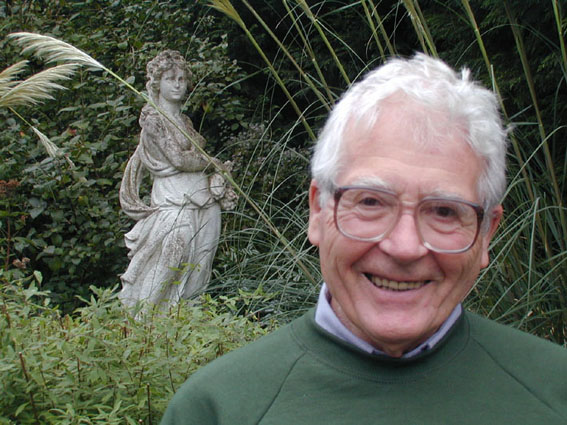
James Martin believes that by using logic, and by understanding history, technology and the behaviour of complex organisms we can explore the future properly and find solutions.
Markets and capitalism are the solution to some very big problems requiring complex, expensive solutions and the only safe bet is to do this through corporations. You can set up corporations motivated by profit to deal with these big problems such as global warming. General Electric has set out to transform 12 product lines into the kind of ecologically inventive products they think customers will want five years from now.
I have this idea of a World Upper House, rather like the UK's House of Lords, which oversees the elected House of Commons. It would be populated by statesmen who have been through the political mill and know how to get action, as well as scientists who can talk to and trust the statesmen. This world upper house would make decisions about the new energy sources or forms of transport etc.
And they would choose anything other than carbon. Right now there seems to be a strong motivation not to have non-carbon solutions because of the subsidies. The total subsidy for the car and petroleum industries is around a trillion dollars. Huge profits are being made out of huge subsidies and these profits are going to destroy the planet.
I think James Lovelock's view of runaway global warming is going to be proved right. The ice in the Arctic - which is the size of the US - is melting, and if it disappears, the Earth will absorb massive amounts of extra heat. If we took action right now, we could slow it down, though it's not clear whether we could stop all the self-perpetuating processes that have already begun.
Mass Human Extinction
Writing in the British newspaper The Independent in January 2006, James Lovelock argues that, as a result of global warming, "billions of us will die and the few breeding pairs of people that survive will be in the Arctic where the climate remains tolerable" by the end of the Twenty First century.
James Lovelock claims that by the end of the century, the average temperature in temperate regions will increase by as much as 8°C and by up to 5°C in the tropics, leaving much of the world's land uninhabitable and unsuitable for farming. He suggests that "we have to keep in mind the awesome pace of change and realise how little time is left to act, and then each community and nation must find the best use of the resources they have to sustain civilisation for as long as they can."
We may not have time to solve the real problems of humanity because there is a lot of apathy. If everyone was excited about solving the problems, it would work fine, but that's not the case. It will take a catastrophe to get most people interested - this is how things happen. For example, the US Food and Drug Administration tightened up its regulations after the thalidomide scandal, and the UN Declaration of Human Rights & Preamble with 30 Articles was drafted after the Holocaust.
We're almost certainly going to get some kind of catastrophe in the next 20 years or so, such as a bird flu pandemic.
Right now it isn't poor people who are damaging the planet, it's the rich. What if you could turn them to eco-affluence, with a high standard of living which doesn't harm the planet? This will involve a huge transition away from a consumer society. And a lot of ideas to solve global warming will be politically controversial. If you put shades up in space to shield our planet from the sun, for example, this would affect countries around the world differently, so would cause controversy.
James Martin Quotes
”It isn't the poor people who are damaging the planet, it's the rich
"Now people are driven to develop specific skills to make money."
"There's a wisdom deficit in our world."
"I feel like I'm at the beginning of my life aged 73. When I was 18, I remember Bertrand Russell saying that the key to being 90 is to keep learning."
"A lot of apathetic people are as happy as pigs, watching reality TV shows and getting drunk on a Friday night."
"The biggest problem in solving the urgent problems that face humanity is apathy: the public is not putting pressure on the politicians."
Profile
After reading physics at the University of Oxford in the 1950s, James Martin worked as a rocket scientist before joining IBM. In 1981 he set up a management consultancy, Headstrong, which holds seminars for politicians and business leaders. His latest book is called The Meaning of the 21st Century.
Posted by
crabsallover
at
Saturday, November 18, 2006
0
comments
Labels: ageing, bioscience ethics, climate change, emergent infections, future of the mind, james lovelock, James Martin 21st Century School, migration
Friday, November 17, 2006
Cancer - The Basics
Cancer - Learn more about one of the world’s biggest killers in New Scientist comprehensive special report.
One in three of us will get cancer at some point in our lives. Once so feared its name was whispered, the disease is no longer an inevitable death sentence. Today, almost two-thirds of those who develop cancer will still be alive five years later, compared with just half in the 1970s....
Thursday, November 16, 2006
Nanotechnology - The Basics
Nanotechnology - Learn more about all things nuclear in New Scientist explosive special report.
Imagine a world where microscopic medical implants patrol our arteries, diagnosing ailments and fighting disease; where military battle-suits deflect explosions; where computer chips are no bigger than specks of dust; and where clouds of miniature space probes transmit data from the atmospheres of Mars or Titan....
Cosmology - The Basics

Cosmology - Keep up with the latest ideas in New Scientist special report.
Cosmologists study the universe as a whole: its birth, growth, shape, size and eventual fate. The vast scale of the universe became clear in the 1920s when Edwin Hubble proved that "spiral nebulae" are actually other galaxies like ours, millions to billions of light years away....
Quantum World - The Basics
Quantum World - Learn more about a weird world in our comprehensive special report.
If successful scientific theories can be thought of as cures for stubborn problems, quantum physics was the wonder drug of the 20th century. It successfully explained phenomena such as radioactivity and antimatter, and no other theory can match its description of how light and particles behave on small scales....
Evolution - The Basics

Evolution - Learn more about the struggle to survive in New Scientist comprehensive special report.
In 1859 Charles Darwin published his theory of natural selection amid an explosion of controversy. Like the work of Copernicus in the 16th century revealing the movement of the Earth, Darwin's idea shook the foundations of the establishment and profoundly altered humanity's view of its place in the universe....
Stem Cells - The Basics
Stem Cells - Learn more about the promise and the controversy in New Scientist cutting edge special report .
Fast-forward to the end of the 21st Century: surgeons can create new organs to order, regrow crippled spines and hearts and reverse the damage of Parkinson's disease or diabetes with ease. Immune rejection and waiting lists for replacement organs are consigned to history.....
More from New Scientist ... or from Wikipedia or from the BBC